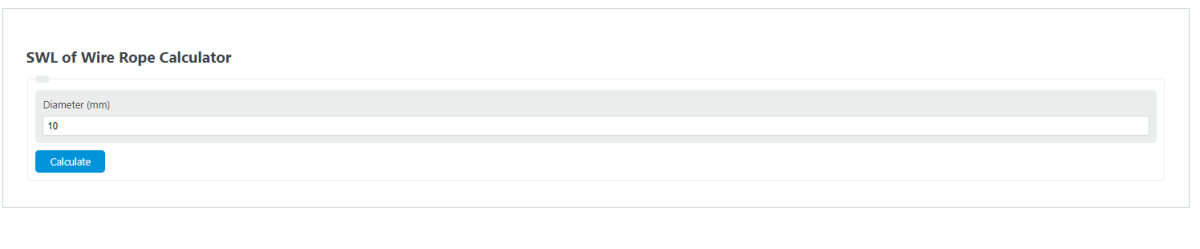
Calculate wire rope safe working load from minimum breaking load and a design factor, or estimate SWL from rope diameter in common metric and imperial units.
- All Construction Calculators
- Factor of Safety Calculator
- Pressure Test Safe Distance Calculator
- Tensile Strength Calculator
- Yield Strength Calculator
SWL of Wire Rope Formula
This calculator uses a simplified rule-of-thumb to estimate the working load of a wire rope from its nominal diameter. It is most useful for quick checks, training, and rough planning. It should not be treated as a certified lifting rating for field operations.
In this equation, the diameter is used in millimeters and the result is an estimated load in kilograms. If you enter the rope size in other units, the calculator converts the value before applying the formula.
What the Variables Mean
- Estimated working load = the approximate load the rope may carry based on this simplified diameter rule.
- Diameter = the nominal wire rope diameter, typically measured across the widest outside dimension of the rope.
If you know the desired load and want to estimate a rope diameter, the relationship can be rearranged as follows:
This reverse form is helpful for rough sizing, but the final rope selection should always be based on the manufacturer’s rated capacity and the actual service conditions.
How to Use the Calculator
- Enter the wire rope diameter if you want to estimate the load, or enter the estimated load if you want to back-calculate diameter.
- Select the proper input and output units.
- Leave the other field blank so the calculator can solve for the unknown value.
- Review the result as an approximation, not as a certified lifting limit.
Example
For a wire rope with a nominal diameter of 10 mm:
The estimated working load is 800 kg, which is about 1,764 lb.
SWL vs. Rated Capacity
The term SWL is commonly used in the field, but many modern lifting programs prefer WLL or working load limit. A true rated working load is not determined by diameter alone. It depends on the specific rope design, tested strength, safety factor, and the condition of the entire rigging system.
This is why a diameter-only formula is best treated as a screening tool. Two ropes with the same diameter can have different real-world capacities if they differ in construction, grade, core type, or end connection.
Factors That Affect Actual Allowable Load
| Factor | Why It Matters |
|---|---|
| Rope construction | Different strand patterns and core types can change flexibility, fatigue resistance, and overall strength. |
| Material grade | Higher-grade rope may provide greater strength at the same diameter. |
| Design factor | The allowable working load is usually derived from breaking strength divided by a required safety factor. |
| End terminations | Clips, sockets, swaged fittings, and splices can reduce or control the usable capacity of the assembly. |
| Bending over sheaves or drums | Tight bending increases stress in the rope and can lower effective service capacity. |
| Wear, corrosion, and broken wires | Damage and deterioration reduce strength and may require immediate removal from service. |
| Shock loading | Sudden starts, stops, or impacts can create forces much higher than the static suspended load. |
| Temperature and environment | Heat, chemicals, moisture, and contamination can weaken rope performance over time. |
Common Input Mistakes
- Using the wrong diameter units when applying the formula manually.
- Assuming the estimate is the same as the manufacturer’s rated working load.
- Ignoring the effect of hooks, shackles, clips, sockets, and other rigging hardware.
- Using the value for dynamic lifts where impact or motion increases loading.
- Failing to account for rope condition, age, abrasion, or corrosion.
Practical Interpretation
The calculator output should be read as an approximation based on size alone. It is useful when you want a fast estimate, a training reference, or a sanity check on rope sizing. For any actual hoisting, lifting, or rigging decision, use the rope manufacturer’s published rating, inspect the rope and hardware, and follow the applicable lifting procedure for the job.