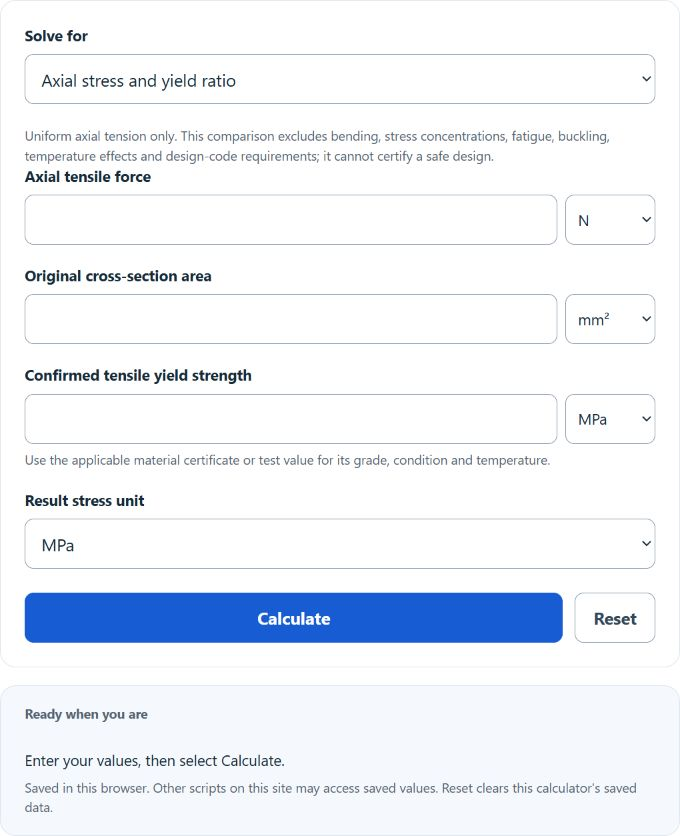
Choose an axial-stress comparison using confirmed tensile yield strength, a required-strength calculation, or a conversion of an unverified legacy material example.
- All Construction Calculators
- Stress Calculator
- Bending Stress Calculator
- Punching Force Calculator
- Vickers Hardness Number Calculator
- SWL of Wire Rope Calculator
- Strength to Weight Ratio Calculator
Yield Strength Formula
The following formula gives the required yield strength for an entered design stress and factor against yielding:
- Where Ys is the required yield strength
- fs is the safety factor
- Ds is the design stress
To calculate required yield strength, multiply the required factor against yielding by the design stress.
This result is a design requirement, not a measured material property. Actual yield or proof strength requires an applicable test or material certificate.
Yield Strength Definition
Yield strength is defined as the maximum amount of stress a material can take without causing permanent deformation.
Yield Strength Example
How to calculate a required yield strength?
- First, determine the required factor.
Determine the factor against yielding required by the applicable design criteria.
- Next, determine the design stress.
Determine the maximum design stress.
- Finally, calculate the required yield strength.
Select Required yield strength and Calculate using the design stress and required factor.
FAQ
Yield strength is a stress associated with the onset of yielding, or a specified proof-stress criterion such as 0.2% offset. It is not a force.
Design stress is the stress used for the stated design check. The axial mode here uses uniform tensile force divided by original cross-section area.
For this yielding comparison, the factor is yield strength divided by design stress. The required value depends on applicable design criteria; this calculator does not certify overall safety.