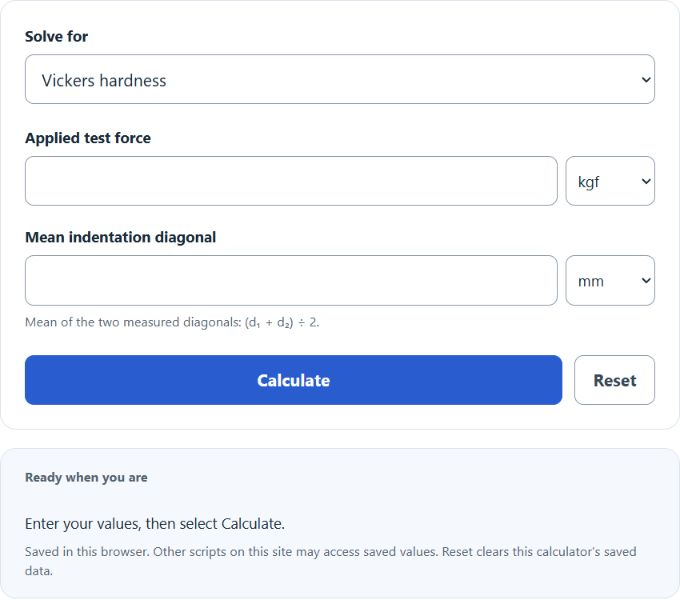
Choose Vickers hardness, test force, or mean indentation diagonal to calculate. Enter the two required quantities and select their units, then select Calculate.
- All Physics Calculators
- Brinell Hardness Number Calculator w/ Formula
- X Factor (Welding) Calculator
- Yield Strength Calculator
- Tensile Strength Calculator
- Compressive Strength Calculator
Vickers Hardness Number Formula
The Vickers hardness number measures a material’s resistance to indentation by comparing the applied test force to the size of the indentation left by a diamond pyramid indenter. In the standard form of the equation, force is entered in kilograms-force (kgf) and the mean indentation diagonal is entered in millimeters (mm).
| Symbol | Description | Standard Formula Unit |
|---|---|---|
| HV or VHN | Vickers Hardness Number | Reported as HV |
| F | Applied test force | kgf |
| d | Mean of the two indentation diagonals | mm |
If you are solving manually, convert the force to kgf and the diagonal length to mm before using the constant 1.8544. If you are using the calculator, you can enter any supported unit combination and let the conversion happen automatically.
Rearranged Forms
If you know the hardness and diagonal length, you can solve for force:
If you know the hardness and force, you can solve for the mean diagonal length:
What the Vickers Hardness Number Means
Vickers hardness is an indentation-based hardness value obtained using a square-based diamond pyramid indenter with a 136° included angle. After the test force is applied, the two diagonals of the resulting impression are measured, averaged, and used in the hardness equation. A smaller indentation corresponds to a higher hardness value, while a larger indentation corresponds to a lower hardness value.
One major advantage of the Vickers method is that the same indenter geometry can be used across a wide range of materials, from relatively soft metals to very hard alloys and heat-treated surfaces. It is commonly used for base metals, weld zones, case-hardened layers, and small sections where a precise indentation method is preferred.
Why the Diagonal Measurement Matters So Much
The diagonal length is squared in the formula, which means small measurement errors can noticeably change the final hardness value. If the measured diagonal is slightly too large, the calculated hardness will be too low. If the diagonal is slightly too small, the calculated hardness will be too high. Careful optical measurement is essential for reliable results.
How to Use the Calculator
- Enter the applied force used during the Vickers test.
- Measure both indentation diagonals and calculate their mean value.
- Enter the mean diagonal length into the calculator.
- Read the resulting Vickers Hardness Number.
The mean diagonal is calculated from the two measured diagonals:
This average value is the one substituted into the hardness equation.
Example
Suppose a test is performed with a force of 40 kgf and the average indentation diagonal is 0.5 mm.
The material hardness is approximately 296.7 HV.
How Vickers Hardness Is Commonly Reported
Hardness values are usually written as an HV number, and many technical reports also include the test force designation. For example, a notation such as 300 HV10 indicates a Vickers hardness of 300 measured with a 10 kgf test force. Including the force is useful because hardness comparisons are most meaningful when the testing conditions are known.
Practical Notes for Better Accuracy
- Use a smooth surface: Rough or poorly prepared surfaces make diagonal measurement less reliable.
- Measure both diagonals: Always average the two diagonals rather than using only one reading.
- Choose an appropriate load: Loads that are too small can exaggerate surface effects, while loads that are too large may be unsuitable for thin sections.
- Maintain proper spacing: Indentations should not overlap or sit too close to edges, since that can distort the reading.
- Be cautious with thin coatings: Very shallow layers can be influenced by the substrate beneath them.
Common Mistakes
- Entering a diagonal measurement that is not the mean of the two diagonals.
- Using the standard 1.8544 constant without first converting to kgf and mm.
- Confusing Vickers hardness with other scales such as Brinell or Rockwell.
- Comparing HV values from different loads without noting the test condition.
- Rounding the diagonal too aggressively before calculation.
When the Vickers Test Is Especially Useful
The Vickers method is often chosen when a single hardness approach is needed across many materials or when the part is too small for larger indentation methods. It is also valuable for examining local hardness changes across welds, heat-affected zones, surface treatments, and microstructural regions where a smaller and more precise indentation is beneficial.