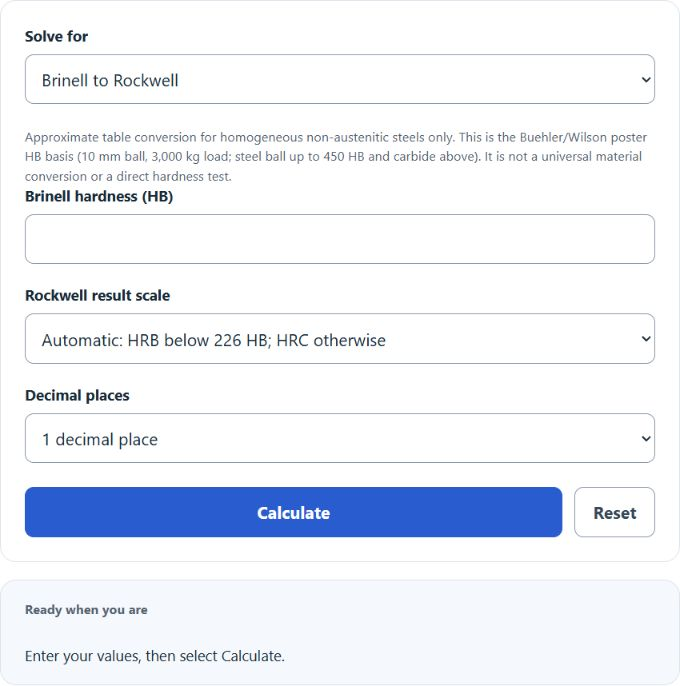
Convert Brinell HBW hardness to Rockwell C or B, or convert HRC/HRB back to HBW, using interpolated ASTM E140 steel conversion data and clear valid-range guidance.
- All Unit Converters
- Materials Properties Unit Converters
- Brinell Hardness Number Calculator w/ Formula
- Surface Roughness Calculator
- Vickers Hardness Number Calculator
Brinell To Rockwell Formula
Brinell ↔ Rockwell conversions are not governed by one universal equation. In practice, conversions are performed using standardized conversion tables (for example, ASTM E140) for a specified Rockwell scale (such as HRB or HRC) and within limited validity ranges. A common way to compute between tabulated points is linear interpolation.
Variables:
- HR is the Rockwell hardness on the selected scale (for example, HRB or HRC)
- HB is the Brinell hardness number (often written HB or BHN)
- (HB1, HR1) and (HB2, HR2) are the two surrounding points taken from a published conversion table
To estimate Rockwell hardness from Brinell hardness, select the Rockwell scale (HRB or HRC), find the two nearest Brinell values in a conversion table, and linearly interpolate between the corresponding Rockwell values. (Different materials and heat treatments can produce different conversions, so these results should be treated as approximations.)
| Brinell (HB/BHN) | Rockwell (HRB) |
|---|---|
| 100 | 55.0 |
| 107 | 60.0 |
| 116 | 65.0 |
| 125 | 70.0 |
| 137 | 75.0 |
| 150 | 80.0 |
| 165 | 85.0 |
| 185 | 90.0 |
| 210 | 95.0 |
| 240 | 100.0 |
| Approximate values for applicable steels; see source note below. | |
* Selected exact points from the Buehler/Wilson 2020 hardness conversion poster. The calculator linearly interpolates within its full HRB 55–100 / HB 100–240 and HRC 20–65 / HB 226–739 tables. Applicable to homogeneous non-austenitic steels only. The poster specifies 10 mm / 3,000 kg Brinell testing, a steel ball through 450 HB and carbide above. These approximate empirical conversions do not replace a specified hardness test. Source: Buehler/Wilson hardness conversion poster
What is Brinell To Rockwell?
A Brinell to Rockwell conversion is a method used to convert the hardness value of a material from the Brinell hardness scale to a Rockwell hardness scale (such as HRB or HRC). Both scales are used to measure the hardness of materials, but they use different test methods and loads. The conversion is often done using published conversion tables within limited ranges (for example, ASTM E140), and the best-fit conversion depends on material type and condition.
How to Calculate Brinell To Rockwell?
The following steps outline how to estimate a Brinell to Rockwell conversion using table lookup and linear interpolation between tabulated values.
- First, determine the Brinell hardness number (HB/BHN).
- Next, choose the Rockwell scale you need (for example, HRB for lower hardness, or HRC for higher hardness).
- Find the two Brinell values (HB1 and HB2) in a published conversion table that bracket your HB value.
- Read the corresponding Rockwell values (HR1 and HR2) from the same table.
- Linearly interpolate to estimate the Rockwell hardness: HR = HR1 + (HB − HB1)·(HR2 − HR1)/(HB2 − HB1).
- Finally, compare the estimate with the calculator above (noting that conversions are approximate and depend on material and valid ranges).
Example Problem:
Use the following variables as an example problem to test your knowledge.
Brinell hardness (HB) = 200 (for many steels, this corresponds to approximately HRB ≈ 93).