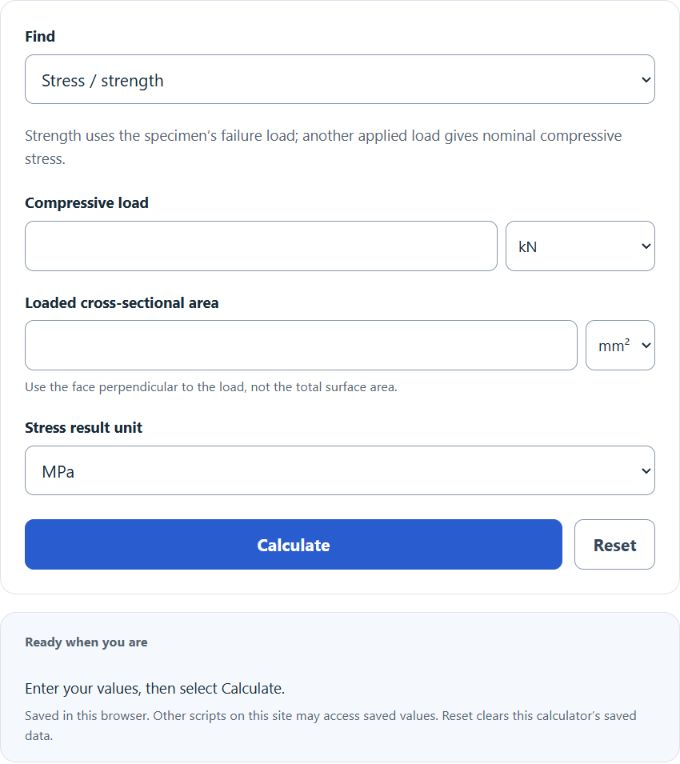
Find nominal compressive stress or strength, compressive load, or loaded cross-sectional area with MPa, psi, newtons, pounds-force and common area units. Strength interpretation requires the relevant failure load and specimen test basis.
Compressive Strength Formula
The basic compressive strength formula is force divided by loaded area. If the entered force is the failure load, the result is compressive strength. If the entered force is a working load or any non-failure load, the result is compressive stress at that load.
- CS = compressive strength or compressive stress
- F = maximum compressive force, usually the failure load
- A = loaded cross-sectional area
To solve for compressive force:
To solve for loaded area:
Select the quantity to find, enter the two corresponding values, choose your units and select Calculate:
- Compressive strength or stress: calculated from force divided by area.
- Compressive load: calculated from the entered stress or measured strength multiplied by the loaded area; this alone does not establish an allowable structural load.
- Loaded area: calculated from force divided by strength.
Calculations are converted internally to base SI units: newtons for force, square meters for area, and N/m² for strength or stress. The final answer is then converted back to the unit you selected.
Common Compressive Strength and Stress Units
| Unit | Equivalent | Common use |
|---|---|---|
| N/m² | 1 Pa | Base SI stress unit |
| kN/m² | 1,000 N/m² | Soils, bearing pressure, light structural loads |
| MPa | 1,000,000 N/m² | Concrete, metals, engineered materials |
| psi | 6,894.76 N/m² | US customary material testing and pressure values |
Compressive Strength Reference Notes
Material names alone do not determine strength. These notes are not allowable design values; use test results for the relevant material, specimen and conditions.
| Material | Strength reference | Notes |
|---|---|---|
| Normal concrete | Use mix-specific test results | Depends on mix, curing, and test age |
| High-strength concrete | 55 MPa or more, in ACI terminology | ACI defines high-strength concrete by specified compressive strength of 55 MPa or greater; this is not a universal upper limit. ACI definition. |
| Common clay brick | Use product-specific test results | Varies with material and manufacturing; individual brick and masonry assemblage strength have different test bases. |
| Softwood parallel to grain | Use species- and moisture-specific test data | Species, moisture, grain and specimen condition matter; clear-wood averages do not directly describe all structural lumber. |
Example Calculations
Example 1: Find compressive strength
A specimen fails under a compressive load of 200 kN. The loaded area is 0.01 m².
The compressive strength is 20,000,000 N/m², or 20 MPa.
Example 2: Find failure load
A material has a compressive strength of 30 MPa and a loaded area of 50 cm².
Convert the values first:
- 30 MPa = 30,000,000 N/m²
- 50 cm² = 0.005 m²
The failure load is 150,000 N, or 150 kN.
FAQ
What is the difference between compressive stress and compressive strength?
Compressive stress is the force per unit area at any given load. Compressive strength is the maximum compressive stress a material can withstand before failure. The formula is the same, but the meaning depends on the force you enter. If you enter the failure load, the result is strength. If you enter a smaller applied load, the result is stress.
Which area should be used in the compressive strength formula?
Use the specimen cross-sectional area perpendicular to the compressive load: the circular face for a cylinder or the loaded face for a rectangular specimen. Do not substitute total surface area. Specimen preparation and the applicable test method matter; ASTM C39/C39M covers concrete cylinders and cores, and a force/area calculation alone does not verify compliance. ASTM public scope.
Why are MPa and psi common for compressive strength?
Compressive strength values are often large when expressed in N/m², so MPa gives a more practical number in SI units. For example, 20,000,000 N/m² is 20 MPa. In US customary units, psi is commonly used for concrete, masonry, and material test results.