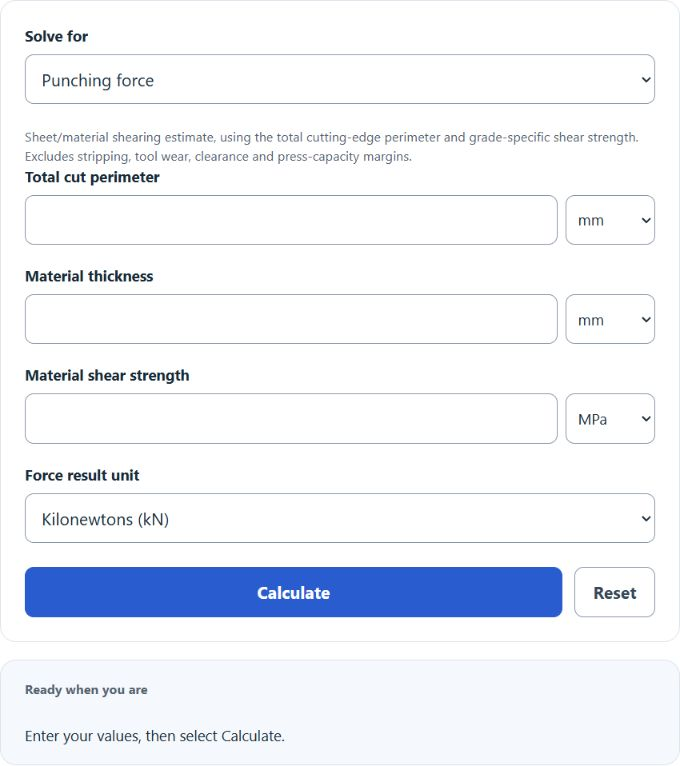
Estimate sheet-material punching force, perimeter, thickness or implied shear strength. Select the value to solve, then enter the other three with their units.
- All Sports and Fitness Calculators
- Press Force Calculator
- Shear Force Calculator
- Shear Area Calculator
- Tensile Strength Calculator
- Yield Strength Calculator
- Clamping Force Calculator
Punching Force Formula
Punching force is the shearing load required to drive a punch through a material along the full cutting edge. For flat stock, sheet metal, gaskets, plastics, and similar parts, the required force depends on three things: the total cut perimeter, the material thickness, and the material shear strength.
- PF = punching force
- P = total perimeter being cut
- T = material thickness
- SS = material shear strength
This relationship is linear, which means doubling the perimeter, doubling the thickness, or doubling the shear strength will double the required punching force.
Rearranged Formula Forms
If your calculator is solving for a different variable, these equivalent forms are useful:
How to Use the Calculator
- Enter the total perimeter of the feature being punched.
- Enter the material thickness.
- Enter the material shear strength.
- Select the value to solve and its result unit, then select Calculate. For an inverse solve, enter the other three known values.
The most common input mistake is using area instead of perimeter. Punching force is based on the length of material being sheared, not the size of the hole area.
Perimeter for Common Punch Shapes
If you need help determining the perimeter before using the calculator, use the total cutting edge length for the shape being punched.
Circle
Rectangle
Slot / Obround
For multiple holes punched at the same time, add the perimeter of every active cut edge to get the total perimeter.
Unit Consistency
For hand calculations, keep units consistent. The calculator converts each selected input unit independently and uses the selected result unit:
- If perimeter and thickness are entered in millimeters, shear strength should be in N/mm², kN/mm², or an equivalent metric stress unit.
- If perimeter and thickness are entered in inches, shear strength should be in psi or ksi.
- In the calculator, choose the force result unit explicitly. In hand calculations, the force unit follows the length and shear-strength units.
For example, if thickness is in mm and perimeter is in mm, then the force result follows:
Approximate Shear Strength Values
Use grade- and condition-specific shear strength from material/tooling data. The following generic values are rough examples from Mate tooling guidance, not certified values for every alloy or temper:
| Material | Approx. Shear Strength |
|---|---|
| Aluminum | 0.1724 kN/mm² |
| Brass | 0.2413 kN/mm² |
| Carbon Steel | 0.3447 kN/mm² |
| Stainless Steel | 0.5171 kN/mm² |
Example
Suppose a punch has a total perimeter of 40 mm, the material thickness is 3 mm, and the material shear strength is 0.1724 kN/mm².
That means the ideal cutting force is 20.688 kN, or 20,688 N.
What Increases Punching Force?
- Greater perimeter: more cutting edge means more force.
- Greater thickness: thicker stock requires more shearing load.
- Stronger material: higher shear strength directly increases required force.
- Simultaneous hits: punching several features at once combines the required force.
Practical Press Sizing Notes
The calculator gives the theoretical shearing force. Real press selection may require additional capacity for:
- stripper force
- tool wear and edge condition
- die clearance effects
- part ejection and slug control
- safety margin for production use
Because of that, the required press capacity is often higher than the pure calculated cutting force.
Common Mistakes
- Using tensile strength instead of shear strength
- Mixing units in hand calculations without conversion; the calculator converts selected units automatically
- Forgetting to include the full perimeter of all punched features
- Using nominal part size when the actual cutting profile is more complex
Frequently Asked Questions
Is punching force the same as press tonnage?
Not exactly. Punching force is the calculated shearing load. Press tonnage is the machine capacity needed to safely deliver that load in real operating conditions.
Does hole area matter directly?
No. The force depends on the cut perimeter and thickness, not the enclosed area.
What if I only know the hole diameter?
Calculate the perimeter first for the hole shape, then use that perimeter in the punching force formula.
Can the calculator be used for non-circular punches?
Yes. Any shape can be used as long as you know the total perimeter being cut.