Estimate average kick impact force, effective striking mass, foot speed, or contact time with a transparent impulse-momentum model.
Kick Force Formula or Method
The model assumes the entered effective striking mass loses the entered forward speed during contact. Average force equals that momentum change divided by the contact interval.
How the Calculation Works
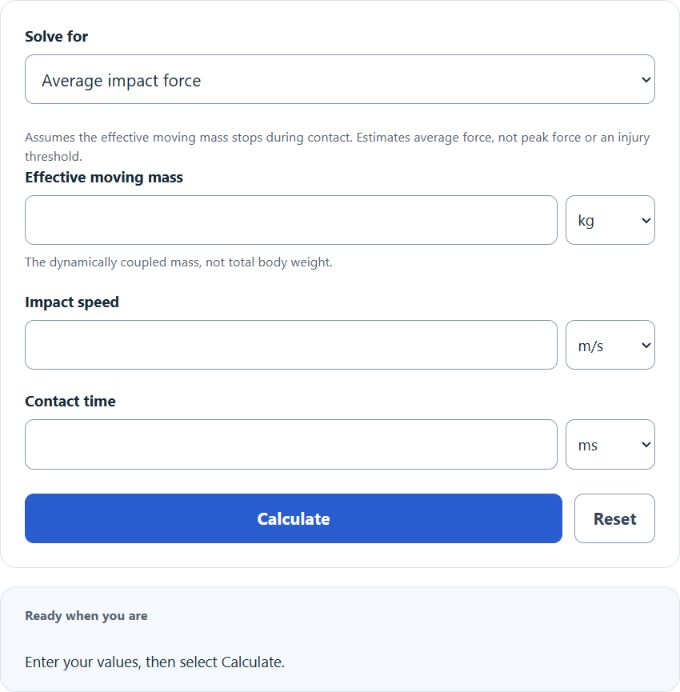
Select the unknown quantity; only its required source inputs are shown. Unit changes convert the entered quantity.
How to Use This Calculator
- Select the result you want in the Solve for menu.
- Enter only the visible source values and their explicit units.
- Select Calculate and review the primary answer, supporting values, and substituted steps.
- Use Reset before starting a different fighter, bout, or scenario.
Worked Example
An effective striking mass of 12 kg moving at 10 m/s over 30 ms produces an average-force estimate of 4,000 N, or about 899.2 lbf.
Input and Result Guide
| Item | How to use it |
|---|---|
| Effective striking mass | The dynamically coupled portion of the leg and body, not total body weight. |
| Impact speed | Foot or shin speed immediately before contact, entered in m/s or mph. |
| Contact time | Duration of force application in milliseconds. |
| Average force | An impulse-based mean; it is not the instantaneous peak. |
| Technique | Roundhouse, front, side, and other kicks can couple mass and direction differently. |
Interpreting the Result
Compare estimates only when effective mass, measured impact speed and contact-time definitions describe comparable stopping events. The average is not a measured peak force.
Assumptions and Limitations
This is a simplified physics estimate, not a force-plate measurement. It omits peak loading, target and limb compliance, rebound, rotation, angle, balance, technique, sensor response, and injury risk. Never strike a person to test a calculation.
Common Questions
What is the average force of a human kick?
There is no single well-supported average for all people and kicks. Technique, training, target padding and the measurement method affect the result. A 2023 force-plate study of one 60 kg taekwon-do master reported mean peak forces of about 2,009 N for front kicks, 2,331 N for roundhouse kicks and 2,407 N for side kicks, each based on three trials. A separate 2024 study of four trained male taekwon-do practitioners reported median peak forces of about 2,662 N for turning kicks and 4,596 N for side kicks. These are study-specific peaks summarized across trials, not population averages or the average force during one kick’s contact interval.
Body weight alone does not provide the effective moving mass, impact speed or contact time needed here. Do not enter full body weight as effective mass. Use measurements from the same event, or clearly chosen hypothetical inputs; the calculator describes those inputs rather than predicting your kick strength from your weight or training level.
Why did an input disappear when I changed Solve for?
The hidden field is the requested output. Enter the remaining visible values and the calculator will solve for that target.
Will my last successful calculation be restored?
Yes. The calculator saves enabled source values and the successful result in this browser. Reset clears that saved state.
Sources
OpenStax, University Physics Volume 1, impulse and momentum; Bureau International des Poids et Mesures, The International System of Units, 9th edition.