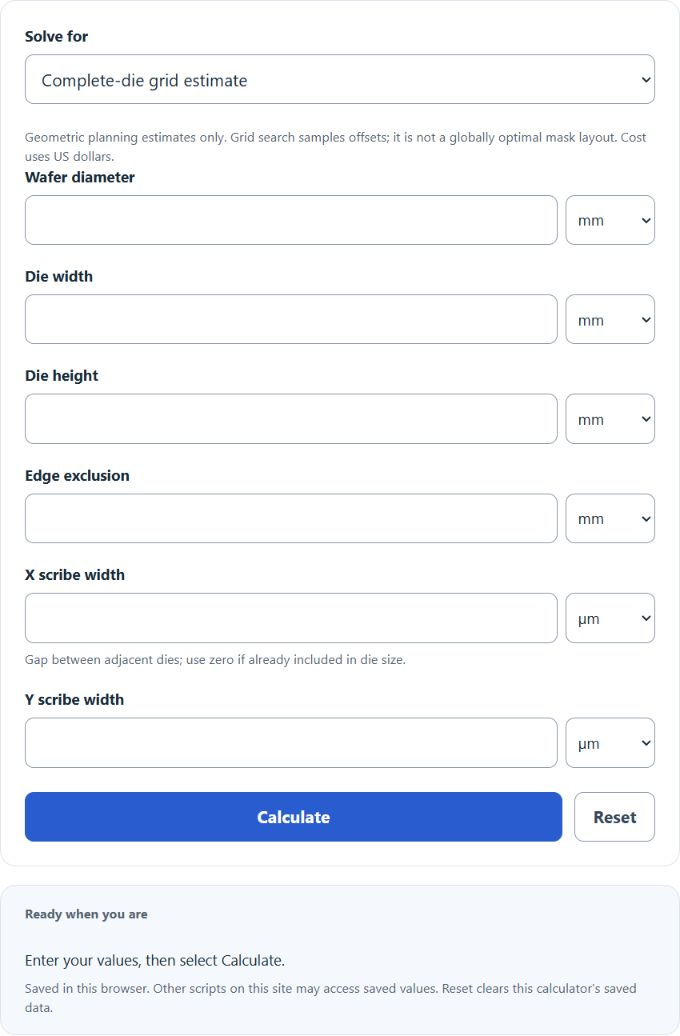
Calculate complete dies per wafer from die size, scribe width, edge exclusion, and layout, then estimate good dies, utilization, and cost per die.
- Total Manufacturing Cost Calculator
- Direct Labor Costs Calculator
- PPM Calculator
- Blow Up Ratio Calculator
- All Math and Numbers Calculators
- Casting Yield Calculator
Die Per Wafer Formula
Choose a solve mode for a quick corrected-area estimate, a sampled complete-die grid, or expected good dies and cost.
Quick corrected-area estimate (before edge exclusion and scribe gaps):
- DPW = gross dies per wafer
- d = full wafer diameter, in mm for quick mode
- A = die width × die height, in mm² for quick mode
Grid layout: pitches equal die dimensions plus the respective scribe gaps. A die counts only when all four corners lie within radius R = wafer diameter/2 − edge exclusion. The search compares 31 evenly spaced offsets plus centered and half-centered phases in each axis, in 0° and 90° orientations. The best sampled count is not a proof of a globally optimal layout.
Expected good dies = complete grid count × entered combined yield/100. Cost per expected good die = processed wafer cost ÷ expected good dies; it is undefined at zero yield. Fractional good-die counts are expectations. Flats, notches, reticle stepping and foundry rules are not modeled.
Reference Tables
Typical wafer areas before edge exclusion:
| Wafer diameter | Area (mm²) | Area (cm²) |
|---|---|---|
| 100 mm | 7,854 | 78.5 |
| 150 mm | 17,671 | 176.7 |
| 200 mm | 31,416 | 314.2 |
| 300 mm | 70,686 | 706.9 |
| 450 mm | 159,043 | 1,590.4 |
Use a measured or process-specific combined yield for cost mode. No defect-density or yield-model default is assumed.
Worked Example
In quick mode, a 300 mm wafer and 10 mm × 10 mm die have die area 100 mm². The area-only count is floor(π × 150²/100) = 706; subtracting the circular-edge term and rounding down gives 640 dies. This quick estimate does not include edge exclusion or scribe gaps.
For a small grid example, a 10 mm wafer, 2 mm × 2 mm dies, zero edge exclusion and zero gaps give a best sampled count of 12. At 80% combined yield and a $100 wafer cost, expected good dies = 9.6 and cost per expected good die ≈ $10.42.
FAQ
Why is my answer lower than (wafer area / die area)? Rectangular dies cannot tile a circular wafer perfectly. The √(2A) term subtracts the dies lost along the curved edge.
Where does the yield come from? Enter a measured or otherwise justified combined good-die yield. This calculator applies that yield directly; it does not infer defect density or fit Poisson or Murphy models.
What should I use for scribe street? Enter the actual gap between adjacent dies for each axis. Set a gap to zero when that gap is already included in the corresponding die dimension.
What is edge exclusion? The outer ring of the wafer where dies are not patterned because of handling damage or process non-uniformity. Use the process specification; no edge-exclusion default is assumed.