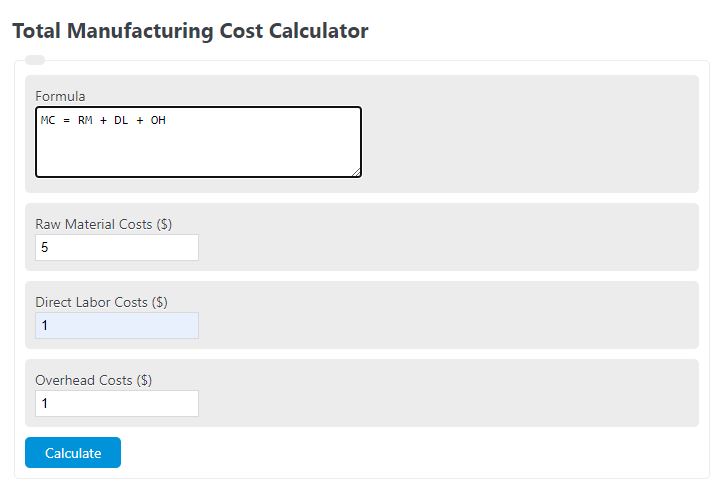
Total Manufacturing Cost Calculator for materials, labor, overhead, inventory, COGM, COGS, per-unit cost, and missing-component analysis.
- All Business Calculators
- All Cost Calculators
- Manufacturing Overhead Calculator
- Labor Productivity Calculator
- Cycle Time Calculator
- Sintering Process Cost Calculator
Total Manufacturing Cost Formula
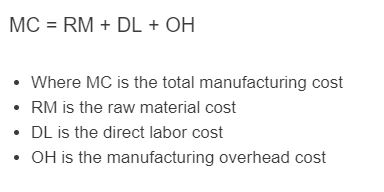
The core formula is the same in every mode. The other modes add steps before or after that core calculation.
- TMC = Total manufacturing cost for the period
- DM = Direct materials used
- DL = Direct labor
- MOH = Manufacturing overhead (fixed plus variable)
When you only have inventory records, calculate direct materials used first:
To extend TMC into cost of goods manufactured and cost of goods sold:
- WIP = Work-in-process inventory
- FG = Finished goods inventory
- COGM = Cost of goods manufactured
- COGS = Cost of goods sold
Assumptions: all costs belong to the same period, overhead is already allocated to production (not period expense), and indirect materials and indirect labor are inside MOH, not DM or DL. Selling, general, and administrative costs are not part of TMC.
The three calculator modes use these formulas as follows:
- Direct totals applies TMC = DM + DL + MOH directly when you already have the three summary numbers.
- From records derives DM Used from raw material inventory and splits MOH into fixed and variable before summing to TMC.
- COGM & COGS takes TMC and rolls it through WIP and finished goods inventory to produce COGM and COGS.
Reference Tables
Use these to sanity check your inputs and your result.
| Cost component | Typical share of TMC | What belongs here |
|---|---|---|
| Direct materials | 40% to 60% | Raw materials and components traced to the product |
| Direct labor | 15% to 30% | Wages and payroll taxes for workers building the product |
| Manufacturing overhead | 20% to 35% | Factory rent, utilities, depreciation, indirect labor, indirect materials, maintenance |
Ranges vary by industry. Highly automated plants run lower direct labor and higher overhead. Assembly-heavy operations flip those.
| Item | Manufacturing cost? | Bucket |
|---|---|---|
| Steel used in a frame | Yes | Direct materials |
| Assembly line wages | Yes | Direct labor |
| Factory supervisor salary | Yes | Overhead (indirect labor) |
| Lubricants and glue | Yes | Overhead (indirect materials) |
| Factory utilities | Yes | Overhead |
| Sales commissions | No | Selling expense |
| CEO salary | No | G&A expense |
| Office building rent | No | G&A expense |
| Delivery truck fuel | No | Selling expense |
Worked Example and FAQ
Example. A shop has beginning raw materials of $5,000, purchases of $25,000, and ending raw materials of $4,000. Direct labor is $25,000. Fixed overhead is $10,000 and variable overhead is $5,000. They produced 1,000 units.
- Direct materials used: $5,000 + $25,000 – $4,000 = $26,000
- Manufacturing overhead: $10,000 + $5,000 = $15,000
- TMC: $26,000 + $25,000 + $15,000 = $66,000
- Cost per unit: $66,000 / 1,000 = $66.00
If beginning WIP was $60,000 and ending WIP was $40,000, COGM = $66,000 + $60,000 – $40,000 = $86,000. With beginning finished goods of $100,000 and ending finished goods of $80,000, COGS = $100,000 + $86,000 – $80,000 = $106,000.
Is total manufacturing cost the same as cost of goods sold? No. TMC is what you spent on production this period. COGS is what you spent on the units you actually sold. WIP and finished goods inventory move costs between them.
Should I use direct materials purchased or direct materials used? Use materials used. Purchases that sit in raw materials inventory have not entered production yet.
Where do indirect materials go? In manufacturing overhead. Direct materials only include items you can trace to a specific unit.
Do I include depreciation? Include depreciation on factory equipment and the factory building in overhead. Depreciation on office equipment is a period expense, not a manufacturing cost.
What if my overhead share looks too high? Check whether non-factory costs slipped in. Office rent, sales salaries, and admin software are common mistakes. Also confirm that depreciation is split correctly between factory and non-factory assets.
How does TMC connect to pricing? Cost per unit from TMC is your floor before operating expenses and profit. A selling price equal to cost per unit covers production only. You still need margin to cover SG&A and target profit.