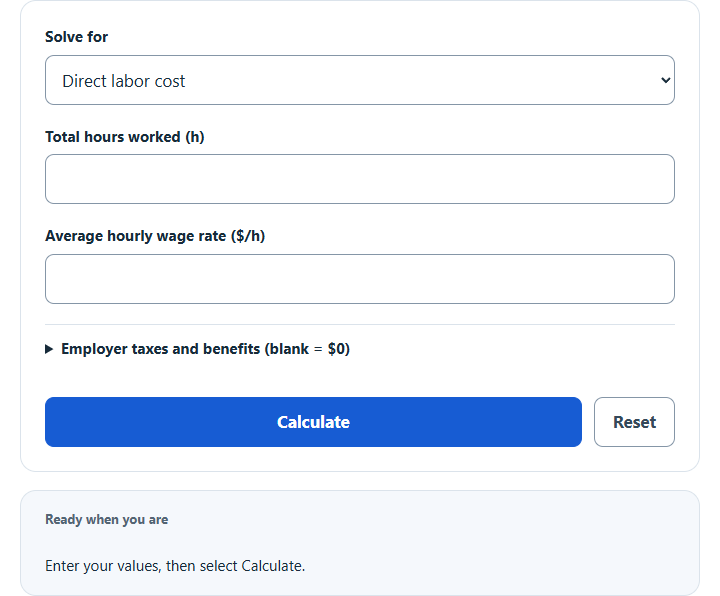
Calculate direct labor cost from hours worked and hourly wage plus optional employer taxes and benefits, or solve for hours, rate, taxes or benefits.
- All Business Calculators
- Labor Efficiency Variance Calculator
- Marginal Product of Labor Calculator
- Labor Percentage Calculator
Direct Labor Costs Formula
The calculator uses total hours, average hourly rate, taxes, and benefits to calculate direct labor costs. Select the value to solve for, then enter the known values. Taxes and benefits may be left blank for $0 in the cost, hours and rate modes. Use employer-paid taxes and benefits for the same period and exclude any costs already included in the hourly wage rate.
- DLC = Direct labor costs, in dollars
- H = Total hours worked
- R = Average hourly rate, in dollars per hour
- T = Taxes paid out, in dollars
- B = Benefits paid out, in dollars
To calculate direct labor costs, multiply total hours worked by the average hourly rate, then add taxes and benefits.
To calculate total hours worked, subtract taxes and benefits from direct labor costs, then divide by the average hourly rate.
To calculate the average hourly rate, subtract taxes and benefits from direct labor costs, then divide by total hours worked.
To calculate taxes paid out, subtract wages and benefits from total direct labor costs.
To calculate benefits paid out, subtract wages and taxes from total direct labor costs.
Direct Labor Budget
Choose Direct labor budget to plan labor from the number of units to produce, direct labor hours per unit and hourly wage rate. Employer burden is optional; leave it blank for wages only.
Total hours = units × hours per unit
Budgeted cost = total hours × wage rate × (1 + burden % ÷ 100)
For 1,000 units at 0.5 labor hours per unit and $20 per hour, plan 500 hours and $10,000 in wages. With 25% employer burden, the budget is $12,500, or $12.50 per unit. This is a production budget; actual hours, wage rates and employer expenses may differ.
Common Direct Labor Cost Components
Direct labor cost usually includes the pay and employer-paid labor expenses tied directly to producing goods or delivering billable work.
| Component | How it is used in the calculator | Example |
|---|---|---|
| Total hours worked | Multiplied by the average hourly rate | 160 hours |
| Average hourly rate | Used to calculate base wages | $24.00/hr |
| Taxes paid out | Added to base wages | Employer payroll taxes |
| Benefits paid out | Added to base wages and taxes | Health insurance, retirement match, paid leave cost |
Example Calculations
Example 1: Calculate direct labor costs
You have 200 total hours worked, an average hourly rate of $22.50, taxes of $420, and benefits of $680.
The direct labor costs are $5,600.00.
Example 2: Calculate the average hourly rate
You know direct labor costs are $7,250, total hours worked are 250, taxes are $600, and benefits are $900.
The average hourly rate is $23.00/hr.
FAQ
What counts as direct labor costs?
Direct labor costs include wages and related employer-paid costs for employees whose work can be directly tied to a product, job, service, or project. This commonly includes hourly wages, payroll taxes, and employee benefits connected to that labor.
Are benefits part of direct labor costs?
Yes, benefits can be part of direct labor costs when they are paid for employees doing direct labor. Examples include employer-paid health insurance, retirement contributions, paid leave cost, and other benefit expenses tied to those workers.
Which inputs are required?
The period-cost modes solve one of five variables from the others; omitted taxes or benefits are treated as $0 where optional. Direct labor budget instead uses planned units, hours per unit and wage rate, with optional burden. A zero hourly rate or zero hours may make an inverse solution impossible or nonunique.