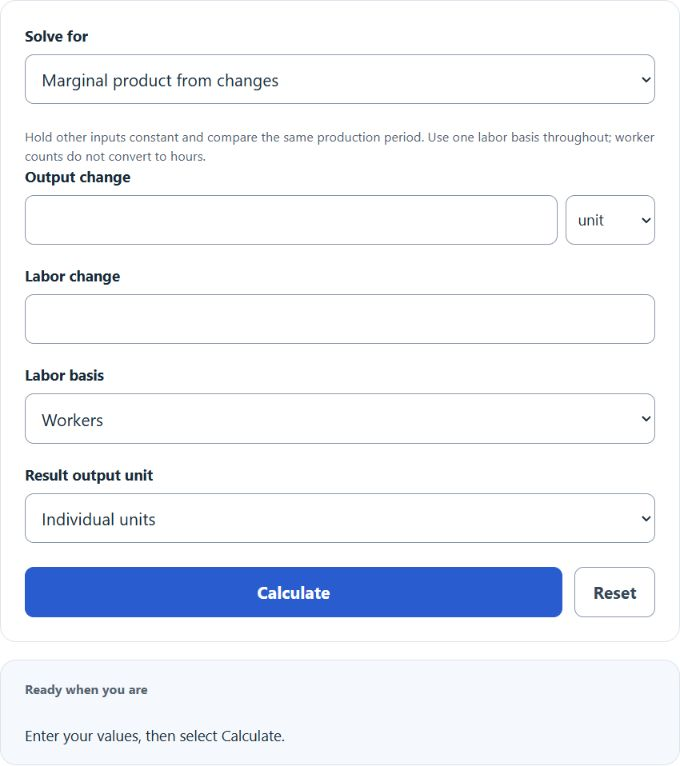
Calculate marginal product of labor (MPL) from the change in output and labor, plus average product of labor and the value of marginal product (VMPL).
- All Business Calculators
- MPC Calculator
- Marginal Cost Calculator
- Marginal Utility Calculator
- Marginal Rate of Substitution Calculator
- Marginal Revenue Product (MRP) Calculator
Calculator Functions
| Function | What it does | What it requires |
|---|---|---|
| Marginal product from changes | Finds the marginal product of labor from a change in output and a change in labor | Requires the output change and the labor change |
| Output change from MPL and labor | Finds the change in output that a change in labor produces | Requires the marginal product and the labor change |
| Labor change from output and MPL | Finds the change in labor needed for a change in output | Requires the output change and a marginal product that is not zero |
| Marginal product from production levels | Finds the marginal product of labor between two production levels, with the average product at each | Requires the initial and final output and the initial and final labor |
| Average product of labor | Finds the output produced per unit of labor | Requires the total output and the labor used |
| Value of marginal product | Finds the dollar value of the output added by one more unit of labor | Requires the marginal product and the price per unit of output |
Labor is counted in workers, labor hours or labor days, and every labor value in one calculation uses the same basis. Output can be entered in units, pieces or dozens and shown in units or dozens. Changes can be negative. The value function has an optional wage, which adds the value left after paying for that unit of labor.
Marginal Product of Labor Formulas
| MPL | Marginal product of labor (output per unit of labor) |
| ΔQ | Change in output |
| ΔL | Change in labor |
The marginal product of labor is the extra output from one more unit of labor, with the other inputs such as equipment and space held fixed [1].
Marginal product from changes
The formula applies directly. Adding 2 workers that raise output by 50 units gives MPL = 50 ÷ 2 = 25 units per worker.
Output change from MPL and labor
With a marginal product of 25 units per worker, 2 more workers add 25 × 2 = 50 units.
Labor change from output and MPL
Raising output by 50 units at 25 units per worker takes 50 ÷ 25 = 2 more workers.
Marginal product from production levels
Output that rises from 100 to 150 units as labor rises from 5 to 7 workers gives MPL = 50 ÷ 2 = 25 units per worker. The result also shows the average product at each level: 20 units per worker before and 21.43 after.
Average product of labor
Average product is total output divided by the labor used, 150 ÷ 7 = 21.43 units per worker in the example above. It describes all the labor in use, while marginal product describes only the last addition.
Value of marginal product
P is the price of one unit of output. A marginal product of 25 units per worker at $4 per unit is worth $100 per worker. With a wage of $80 for that worker, the value less the wage is $20. For a firm that sells at the market price, this figure is the marginal revenue product of labor, and a profit-maximizing firm hires up to the point where it equals the cost of one more unit of labor [2].
Limits of This Estimate
- The result is an average over the interval entered. The marginal product of each individual worker inside that interval can differ.
- Marginal product eventually falls as more labor is added to fixed amounts of other inputs, and it can turn negative when extra labor lowers total output [1]. A value measured at one level does not carry over to another.
- Multiplying by price assumes the firm can sell more output without lowering its price. Where selling more lowers the price, marginal revenue replaces price [2].
- The wage comparison leaves out other costs of added labor, such as materials and benefits, so it is not a hiring recommendation.
Sources
- Principles of Economics (v. 2.0), Section 8.1, Production Choices and Costs: The Short Run: marginal and average product of labor, and diminishing and negative marginal returns
- Principles of Economics (v. 2.0), Section 12.1, The Demand for Labor: marginal revenue product as marginal product times price, and the hiring rule