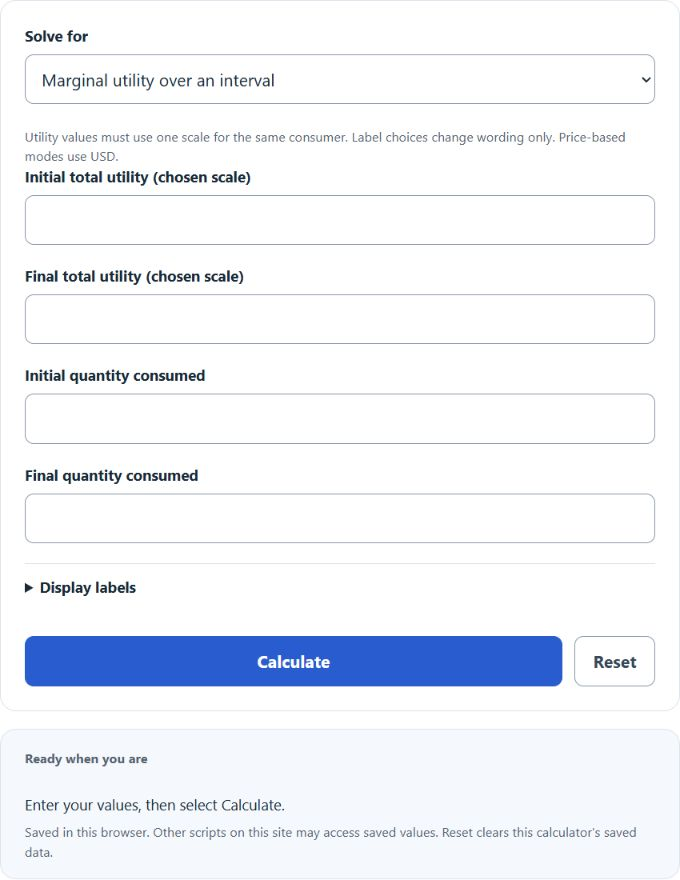
Calculate average marginal utility across a quantity interval, solve for either total utility or quantity, or use the three marginal-utility-per-USD modes. Choose the unknown, enter the displayed values, and select Calculate.
- All Personal Finance Calculators
- Marginal Cost Calculator
- Marginal Revenue Calculator
- Expected Utility Calculator
- Maximum Utility Calculator
Marginal Utility Formula
Marginal utility measures how much additional satisfaction a consumer gets when consumption increases from one quantity level to another. In this calculator, marginal utility is based on the change in total utility divided by the change in quantity consumed.
- MU = marginal utility
- Uf = final total utility
- Ui = initial total utility
- Qf = final quantity consumed
- Qi = initial quantity consumed
This can also be viewed as the change in utility divided by the change in quantity:
A positive result means additional units increased satisfaction. A zero result means extra consumption added no additional satisfaction. A negative result means the added units reduced overall satisfaction.
How to Use the Marginal Utility Calculator
- Enter the initial total utility.
- Enter the final total utility.
- Enter the initial quantity consumed.
- Enter the final quantity consumed.
- Select Calculate to return the average marginal utility for that interval.
To solve for another value, select it in Solve for and enter all displayed required values. The price-based modes use marginal utility per quantity unit and price in USD per quantity unit. Display labels do not convert units. Use the same utility scale and the same good or service for both observations.
Rearranged Forms of the Formula
If one variable is unknown, the marginal utility equation can be rearranged as follows:
| Missing Value | Formula |
|---|---|
| Final Utility | Uf = Uᵢ + MU(Qf - Qᵢ) |
| Initial Utility | Uᵢ = Uf - MU(Qf - Qᵢ) |
| Final Quantity | Qf = Qᵢ + (Uf - Uᵢ) / MU |
| Initial Quantity | Qᵢ = Qf - (Uf - Uᵢ) / MU |
How to Interpret the Result
| Marginal Utility Result | Interpretation |
|---|---|
| Positive | Each added unit increased total satisfaction. |
| Zero | The additional units did not change satisfaction. |
| Negative | Additional consumption reduced satisfaction, often due to overconsumption. |
In consumer theory, marginal utility often declines as more units are consumed. The first unit of a product may provide significant satisfaction, while later units add less and less. This pattern is called diminishing marginal utility and is one of the key ideas behind demand behavior and spending decisions.
Example Calculation
Suppose a consumer’s total utility rises from 24 to 36 when quantity consumed increases from 4 units to 7 units.
The result means the consumer gained 4 units of utility per additional unit consumed over that range. Because this uses two quantity points, it represents the average marginal utility across the interval. If quantity increases by exactly one unit, the result corresponds directly to the utility gained from that extra unit.
Marginal Utility vs. Total Utility
Total utility is the overall satisfaction from all units consumed. Marginal utility is the extra satisfaction gained from consuming more. Total utility can continue increasing while marginal utility falls. For example, a second slice of pizza may still increase satisfaction, but usually by less than the first slice.
This distinction matters in budgeting, pricing, and consumption analysis. Consumers generally allocate spending toward goods that provide the greatest satisfaction per additional unit, especially when working within limited income.
Important Notes and Limitations
- Do not use equal quantity values, because dividing by zero makes marginal utility undefined.
- Use consistent utility measurement across both observations.
- Interpret the result over an interval, not necessarily as a perfect measure of the last single unit unless quantity changed by one.
- Negative values are possible when additional consumption becomes undesirable.
- Utility is subjective, so the same good can have different marginal utility for different consumers.
FAQ
- What is marginal utility in simple terms?
- It is the additional satisfaction gained from consuming more of a good or service.
- Can marginal utility be negative?
- Yes. If consuming extra units lowers satisfaction, the marginal utility becomes negative.
- Why is my result undefined?
- This usually happens when the initial quantity and final quantity are the same, which makes the denominator zero.
- What does a low positive marginal utility mean?
- It means additional units still add satisfaction, but only a small amount.
- Is marginal utility the same as total utility?
- No. Total utility is cumulative satisfaction, while marginal utility is the added satisfaction from more consumption.