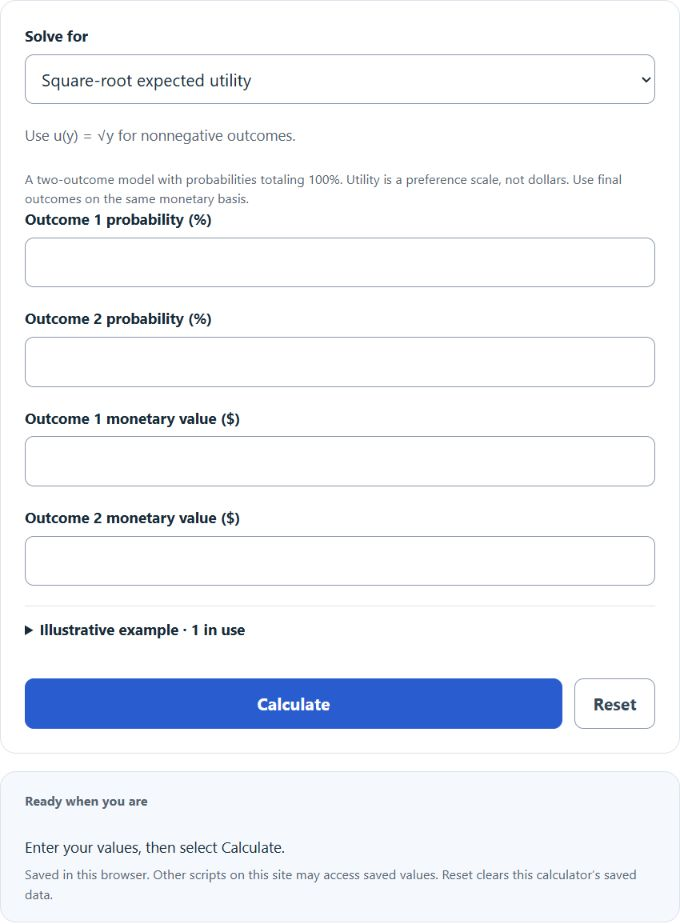
Calculate square-root or CRRA expected utility, certainty equivalent, risk premium, and expected monetary value from two outcomes. Utility is a preference scale, not a monetary amount; use matching final-outcome values and probabilities totaling 100%.
- All Statistics Calculators
- Marginal Utility Calculator
- Marginal Rate of Substitution Calculator
- Horizon Value Calculator
- Maximum Utility Calculator
Expected Utility Formula
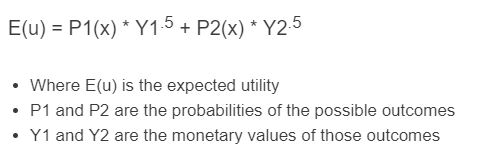
The following formula calculates expected utility for two mutually exclusive, exhaustive outcomes. This calculator uses u(y)=√y for nonnegative outcomes, or normalized CRRA u(y)=(y^(1−r)−1)/(1−r) with log utility at r=1 for strictly positive final outcomes. CRRA r=0.5 and square-root utility have different displayed scales but the same certainty equivalent.
- Where E[u(Y)] is the expected utility
- p1 and p2 are the probabilities of the outcomes (they must sum to 1 as decimals, or to 100% if entered as percentages)
- y1 and y2 are the monetary values (outcomes)
- u(·) is the utility function (for example, u(y)=√y is a common concave utility function)
Expected Utility Definition
Expected utility is a concept used in decision theory to measure the value or desirability of different outcomes. It enables individuals to make rational choices by considering the probabilities and utilities associated with each possible outcome.
Utility refers to the subjective satisfaction or preference an individual assigns to a particular outcome. It represents the individual's evaluation of the desirability or worthiness of that outcome.
The concept of utility acknowledges that people have different preferences and values, allowing decision-makers to quantify and compare these preferences.
The expected utility considers the probabilities of different outcomes and the utilities associated with those outcomes. It allows decision-makers to evaluate the potential outcomes of a choice by multiplying each outcome's utility by its probability of occurring.
By summing these probability-weighted utilities across all possible outcomes, decision-makers can determine the overall expected utility of a particular choice.
Expected utility theory also aligns with the principle of rationality. It suggests that individuals should choose the option that maximizes their expected utility, as they seek to optimize their well-being or satisfaction.
Expected Utility Example
How to calculate expected utility?
- First, determine the two possible monetary outcomes.
For this example, we will analyze a simple lottery with two possible outcomes: winning $100 or winning $150.
- Next, determine the probabilities of the outcomes.
For this example, we will say there is a 45% chance of winning $100 and a 55% chance of winning $150.
- Finally, calculate the expected utility.
Using a square-root utility function (u(y)=√y), calculate the expected utility using the formula. So E(u) = .45*100^.5 + .55*150^.5 = 11.2361 (≈ 11.24).
FAQ
Expected utility is the probability-weighted average of the utilities of the possible outcomes (i.e., E[u(X)]=∑ pᵢu(xᵢ)).