Horizon value (also called terminal value or continuing value) represents the total value of all cash flows beyond a defined forecast cutoff. It can account for a large share of a DCF valuation, so the growth and discount assumptions require careful review.
Horizon Value Formula
Two methods calculate horizon value. The perpetuity growth model (Gordon Growth Model) is preferred by academics and long-term investors. The exit multiple method is preferred by investment banking and private equity practitioners who have defined exit horizons.
Perpetuity Growth Model
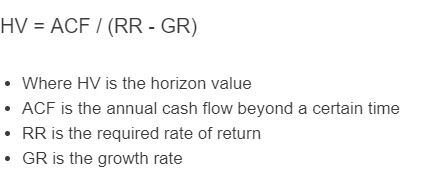
- HV is the horizon value (at the end of year N)
- ACF is the cash flow at year N+1 (not the current year; grow CF0 by the growth rate for N+1 periods to compute this)
- RR is the discount rate (WACC for firm-level valuation)
- GR is the long-term perpetual growth rate; must be less than RR
To convert the horizon value to a present value as of today: PV of HV = HV / (1 + RR)^N. The formula above produces the value as of year N, not the current date.
Exit Multiple Method
HV = Metric at Year N x Exit Multiple. The enterprise-value metric (EBITDA, EBIT, revenue, or free cash flow to firm) is projected by growing the current value at the assumed annual rate for N years. The exit multiple is drawn from comparable public company trading multiples or recent M&A transaction multiples. Use a multiple consistent with the metric, valuation date, and comparable companies.
Benchmark Inputs
Choose a discount rate appropriate to the cash flow: cost of capital for firm cash flows or cost of equity for equity cash flows. Perpetual growth must be below that rate and sustainable for the relevant economy. The forecast horizon and assumptions depend on the business. Exit multiples are pulled from current comparable company analysis and precedent transactions at the time of the valuation.
Sensitivity to Inputs
Horizon value equals CF / (RR – GR), so it is inversely proportional to the spread between the discount rate and growth rate. At a 10% spread, a 100 basis point narrowing increases horizon value by 11%. At a 5% spread, the same 100 bps narrowing increases it by 25%. At a 2% spread, a 100 bps narrowing doubles the horizon value. This nonlinear relationship explains why running a sensitivity table across a range of WACC and perpetual growth rate assumptions is standard in any serious DCF model.
Horizon Value Definition
Horizon value is the aggregate value assigned to a business or investment for all periods beyond the explicit forecast horizon, expressed as a single number at the end of that horizon. The term “horizon” highlights that the cutoff point is a deliberate modeling choice: shifting the horizon from 5 to 10 years moves more value from the terminal estimate into the explicit forecast, but does not change the total valuation if assumptions are consistent.
In M&A analysis, the horizon value typically represents the largest single component of a target company’s appraised worth. In portfolio management, it represents the expected resale price of an investment at a future date, discounted to today. The perpetual growth rate used in this model cannot sustainably exceed the nominal growth rate of the overall economy; a business growing faster than GDP in perpetuity would eventually exceed the entire economy in size.
Horizon Value Example
How to calculate horizon value using the perpetuity growth model
- Determine current free cash flow
Identify the business’s current annual free cash flow. For this example, FCF0 = $5,000,000.
- Set the discount rate and perpetual growth rate
WACC = 10%; long-term perpetual growth rate = 2.5%; forecast horizon N = 5 years.
- Calculate cash flow at year N+1
CF at year 6 = $5,000,000 x (1.025)^6 = $5,798,467.
- Calculate horizon value at end of year 5
HV = $5,798,467 / (0.10 – 0.025) = $77,312,895.
- Discount horizon value to present
PV of HV = $77,312,895 / (1.10)^5 = $48,005,225. Add this to the PV of the explicit 5-year forecasted cash flows to get total enterprise value.
FAQ
Horizon value is the total estimated value of a business or investment attributable to all cash flows beyond a defined forecast cutoff, expressed as a single lump sum at the end of that period. It can be a large component of a DCF valuation; its share depends on the model.
The terms are interchangeable. Terminal value emphasizes the endpoint of the forecast model; horizon value emphasizes that the cutoff is a deliberate modeling choice (the horizon). Continuing value is a third synonym. All three describe the same calculation.
Use sustainable long-term growth consistent with the valuation currency and relevant economy, and below the discount rate. A rate above nominal GDP implies the company would eventually surpass the entire economy in size, which is not possible. The calculator supplies no default growth assumption.
Use the exit multiple method when (1) comparable company or M&A transaction data is available, (2) the investment has a defined exit event such as a PE sale or IPO, or (3) the perpetuity assumption is unrealistic. Use the perpetuity growth model when (1) the business is expected to operate indefinitely, (2) no reliable comparables exist, or (3) a theoretically grounded valuation is required. Best practice is to run both and confirm the implied multiples from one method are consistent with the other.
Horizon value equals CF / (r – g), so the denominator is the spread between the discount rate and the growth rate. At WACC = 10% and g = 2.5%, the spread is 7.5% and HV = 13.3x cash flow. If g rises to 3.5%, the spread drops to 6.5% and HV = 15.4x cash flow, a 16% increase from a 100 bps change. As the spread narrows further, sensitivity becomes extreme. This is why running a sensitivity table over a range of WACC and growth rate assumptions is standard practice in investment banking.