Calculate compound growth, continuous growth, doubling time, and percent change from initial value, final value, time, and rate inputs.
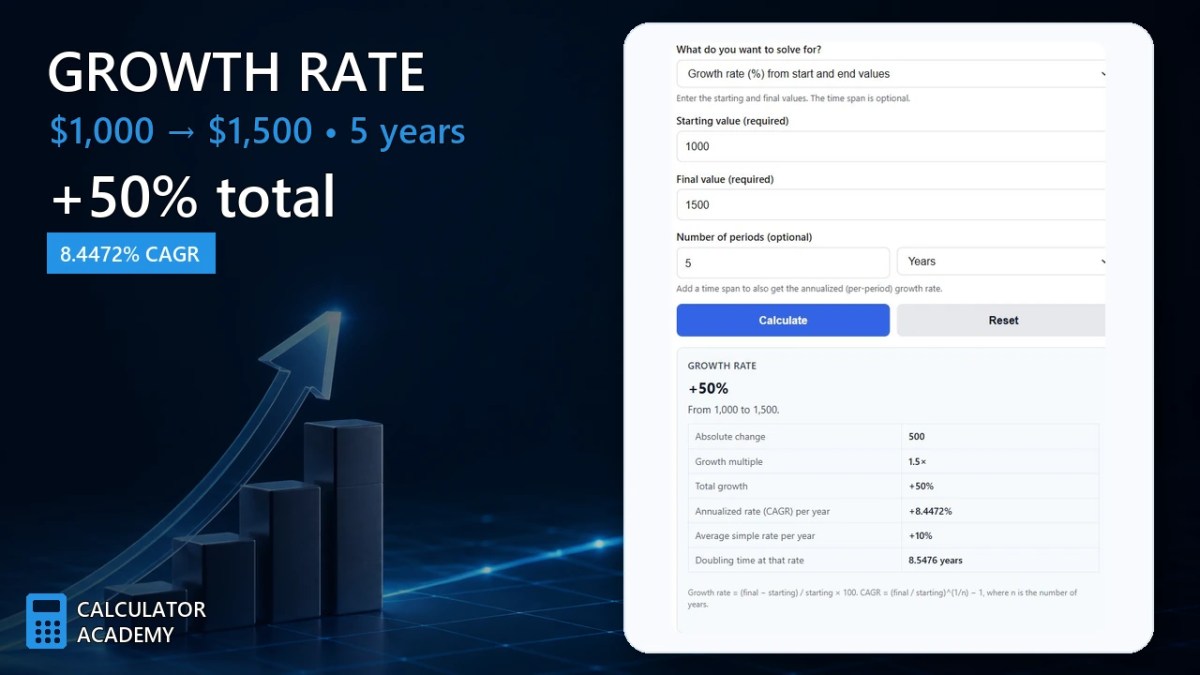
Watch the growth rate and CAGR explainer
Compound Growth Formula
The compound growth calculator uses different formulas depending on the selected mode. In the formulas below, enter percentages as decimal rates when calculating by hand. For example, 6% is 0.06.
Compound growth:
Continuous growth:
Doubling time:
Percent change:
- x(t) = final value after growth
- x0 = initial value
- FV = final value
- IV = initial value
- r = growth rate per time period, written as a decimal
- t = number of time periods
- e = Euler’s number, used for continuous growth
- PC = percent change; this tool uses the magnitude of a nonzero initial value as the denominator for signed inputs
Choose a solve task, then the periodic compound or continuous model. You can solve for the final value, initial value, time, or growth rate when the other three values are known. The formula assumes growth happens in repeated steps, such as monthly or yearly compounding.
In continuous growth mode, the calculator uses the exponential formula with e. This model is used when growth is treated as happening constantly rather than in separate compounding periods.
In doubling time mode, the calculator relates a growth rate to the time needed for a value to become twice as large.
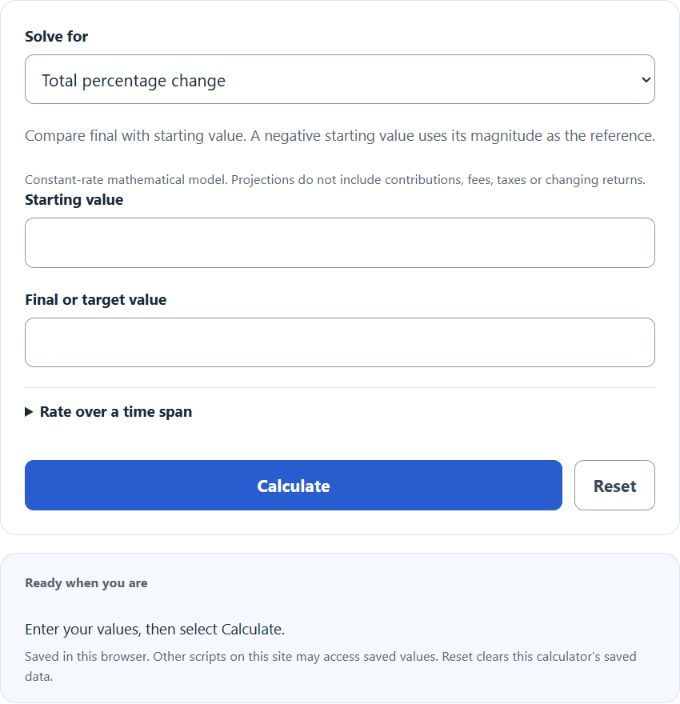
In percent change mode, the calculator compares an initial value and a final value to find the total percentage increase or decrease.
Growth Model and Doubling Time Reference Tables
| Mode | Best used for | Main idea |
|---|---|---|
| Compound growth | Population, investments, users, subscribers, or values that grow by a fixed percent each period | Each period grows from the previous period’s larger value |
| Continuous growth | Math, science, and models where growth is treated as constant | Growth happens continuously using the exponential constant e |
| Doubling time | Estimating how long it takes a quantity to double | Higher growth rates produce shorter doubling times |
| Percent change | Finding the total increase or decrease between two values | Compares the change to the initial value |
| Annual Growth Rate | Approximate Doubling Time |
|---|---|
| 1% | 69.66 years |
| 2% | 35.00 years |
| 5% | 14.21 years |
| 7% | 10.24 years |
| 10% | 7.27 years |
| 20% | 3.80 years |
Examples
Example 1: Find a final value with compound growth
Suppose an initial value of 1,000 grows at 6% per year for 5 years.
The final value is approximately 1,338.23. This is a constant-rate scenario, not a guaranteed investment outcome.
Example 2: Find a continuous growth time
Suppose an initial value of 250 grows continuously at 8% per year until it reaches 500.
The value reaches 500 after approximately 8.66 years.
FAQ
What is the difference between compound growth and continuous growth?
Periodic compound growth can be observed at separate periods; fractional times in this calculator interpolate its mathematical formula. For example, a value might grow once per year or once per month. Continuous growth treats growth as happening at every instant. For the same rate and time, continuous growth usually gives a slightly higher final value than periodic compound growth.
Why do the time and rate units need to match?
The rate and time must describe the same type of period. If the rate is 5% per year, then time should be measured in years. If the rate is 5% per month, then time should be measured in months. The period selector defines both the rate and time. Changing it reinterprets entries rather than converting them; a rate per month or quarter is not an annual rate. Total percentage change also offers an optional elapsed-period input for a compound rate.
Can a compound growth calculator handle decreases?
Yes. A negative growth rate represents decay or decline. For example, a rate of -4% per year means the value decreases by 4% each year. The formulas work as long as the inputs produce a valid result, such as a positive initial value when calculating percent change or exponential growth.