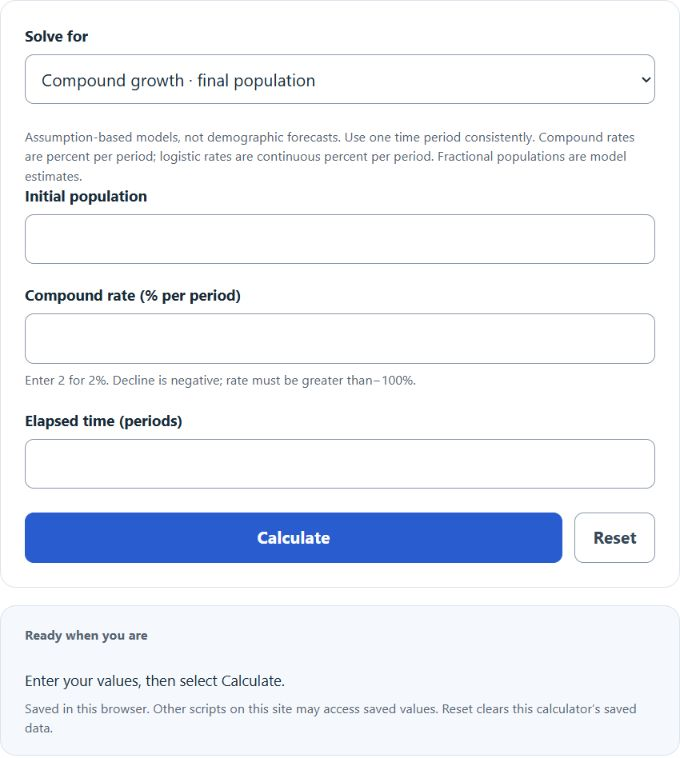
Enter the current population, number of years, and growth rate into the population growth calculator. Select the model and unknown, enter the remaining inputs, then select Calculate. Use one time period consistently; basic models also support inverse solves.
- All Math and Numbers Calculators
- Exponent Calculator
- Population Density Calculator
- Growth Rate Calculator
Population Growth Formulas
The population growth formula varies depending on the assumed growth pattern. In the simplest exponential model, population grows by a constant percentage each period:
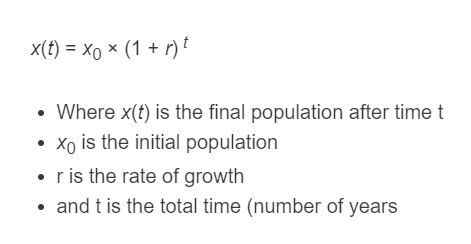
x(t) = x0 × (1 + r) t
This formula says the future population x(t) equals the initial population x0 multiplied by one plus the growth rate r for t time periods. This constant-rate model gives a conditional projection; it is not a demographic forecast.
In a linear growth model the population increases by a constant number each period instead of a percentage. The formula is:
Pt = P0 + k × T
where Pt is the population at time t, P0 is the initial population and k is the constant growth per period.
A doubling‑time model assumes the population doubles every D periods. The relationship is:
Pt = P0 × 2t/D
Here Pt is the population after t periods, P0 is the initial population and D is the time required for the population to double.
When resources limit growth, the logistic model predicts the population will follow an S‑shaped curve and approach a maximum carrying capacity. The logistic growth equation is:
where K is the carrying capacity, P0 is the initial population, r is the continuous logistic rate as a decimal per period and t is time. Enter 80 in the logistic percentage field for r=0.8. As time passes the population approaches K, giving an S‑shaped curve. Logistic growth can also be expressed as a differential equation: dN/dt = rmax N ((K – N)/K). The appropriate formula depends on the assumptions about how the population changes.
- x(t) (or Pt) is the population after time t
- x0 or P0 is the initial population
- r is the model rate expressed as a decimal per period in the formulas; the calculator rate fields take percentages. Compound and continuous logistic rates use different conventions.
- k is the constant increase per period in the linear model
- D is the doubling time in periods
- t is the number of periods (years, months, etc.)
- K is the carrying capacity in logistic growth
Population Growth Definition
Population growth refers to the change in the number of individuals in a population over time. It is driven by a balance of births, deaths and net migration. Populations grow when more people are born or move into an area than die or leave, and growth may slow as environmental limits are reached; this is an assumption of the logistic model.
How to calculate population growth?
Different models require different calculation steps. Below are examples for exponential, linear, doubling‑time and logistic growth.
Exponential Growth Example
Suppose the initial population is 10,000 and the annual growth rate is 12%. To project the population after 5 years using the exponential formula x(t) = x0 × (1 + r)t, plug in x0 = 10,000, r = 0.12 and t = 5. The resulting population is:
x(t) = 10,000 × (1 + 0.12)5 = 17,623.42
This shows how compounding a constant percentage leads to rapid growth.
Linear Growth Example
In a linear model the population increases by a fixed number each period. For example, if a collection contains 30 antique frogs and grows by 24 frogs per year, after 6 years the number of frogs will be Pt = 30 + 24 × 6 = 174. Linear growth produces a straight‑line increase.
Doubling Time Example
If a colony of flies doubles every 8 days and starts with 100 flies, the population after 17 days can be found using Pt = P0 × 2t/D. Substituting P0 = 100, t = 17 and D = 8 gives P17 ≈ 436 flies.
Logistic Growth Example
When resources limit growth, populations eventually slow down as they approach a carrying capacity. Using the logistic formula P(t) = (K P0 e^{r t})/(K + P0(e^{r t} – 1)), suppose a population starts at P0 = 50 with a growth rate r = 0.8 per period and a carrying capacity K = 200. After 3 periods the size is:
This S‑shaped pattern illustrates how growth slows as the population approaches its environmental limits.
FAQ
Population growth is the change in the number of individuals over time caused by births, deaths and net migration. An increase occurs when more people are born or move into an area than die or leave, and growth may slow as environmental limits are reached; this is an assumption of the logistic model.
A population growth rate measures how quickly a population changes each period. In exponential models the growth rate r is a decimal fraction per period in x(t) = x₀ × (1 + r)t; enter 100r in the calculator percentage field. In linear models the growth constant k represents the number of individuals added each period.
Populations can experience exponential growth, linear growth or logistic growth. Exponential growth uses x(t) = x₀ × (1 + r)t; linear growth uses Pt = P₀ + k × t; and logistic growth follows P(t) = (K P₀ e^{r t}) / (K + P₀(e^{r t} − 1)) when resources are limited.
Linear growth assumes the population increases by a fixed number each period rather than a fixed percentage. The relationship is Pt = P₀ + k × t, where P₀ is the initial population and k is the constant growth per period.
The doubling time D is the amount of time it takes for a population to double in size. When growth is characterised by a constant doubling time, the population after t periods is Pt = P₀ × 2^{t/D}.
Logistic growth accounts for environmental limits. It follows P(t) = (K P₀ e^{r t}) / (K + P₀(e^{r t} − 1)), where K is the carrying capacity, P₀ is the initial population and r is the growth rate. As time increases the population approaches the carrying capacity K and growth slows.