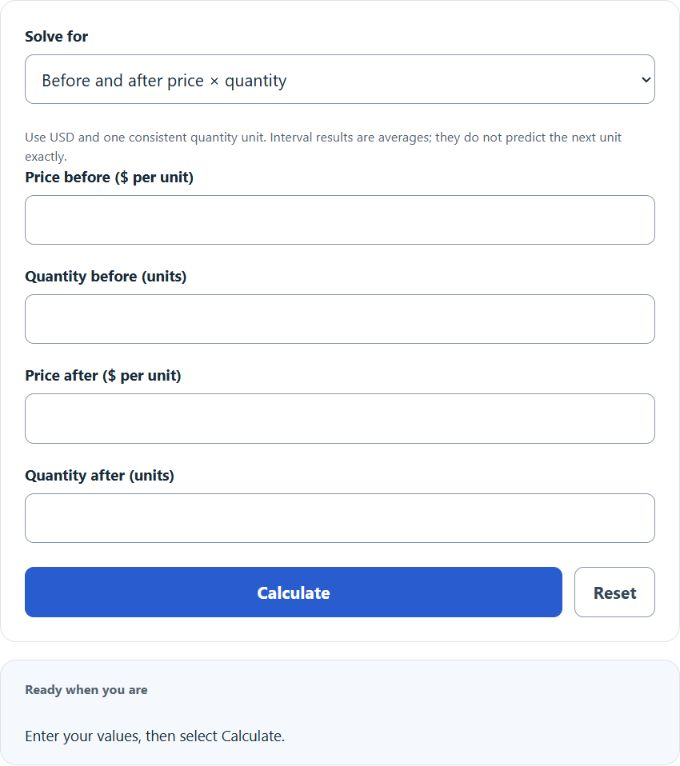
Calculate marginal revenue from before-and-after price and quantity, revenue and quantity changes, or a linear demand curve, with MR per unit shown.
- All Business Calculators
- All Revenue Calculators
- Marginal Cost Calculator
- Markdown Calculator
- Marginal Utility Calculator
- Marginal Benefit Calculator
- Marginal Revenue Product (MRP) Calculator
Marginal Revenue Formula
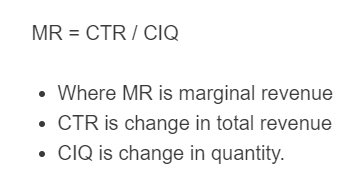
The core formula is the change in total revenue divided by the change in quantity sold:
For the Before/After mode, total revenue is computed first:
For a linear demand curve P = a − b·Q, marginal revenue has twice the slope:
- MR = marginal revenue per additional unit ($/unit)
- TR = total revenue (price × quantity)
- ΔTR = change in total revenue
- ΔQ = change in quantity sold
- P1, Q1 = price and quantity before the change
- P2, Q2 = price and quantity after the change
- a = demand curve intercept (price when Q = 0)
- b = demand curve slope (how much price drops per extra unit)
The Before/After and Change Values modes give average marginal revenue across the interval. The Demand Curve mode gives the exact MR at a single quantity. ΔQ cannot be zero. In perfect competition price is constant, so MR equals price.
Reference Tables
How to read the result:
| MR Value | Meaning | Action |
|---|---|---|
| MR > MC | Each unit adds more revenue than cost | Increase output |
| MR = MC | Candidate profit maximum; check costs, feasibility and the change in marginal profit | Hold output |
| MR < MC | Extra units cost more than they earn | Reduce output |
| MR = 0 | A stationary point for a differentiable model; a zero interval rate alone does not show a peak | Check the revenue curve and constraints |
| MR < 0 | Selling more shrinks revenue | Cut output or raise price |
MR by market structure:
| Market | MR Behavior |
|---|---|
| Perfect competition | MR = P (constant) |
| Monopoly | MR < P for downward demand; twice the slope only for linear demand |
| Monopolistic competition | MR < P, downward sloping |
| Oligopoly | Often kinked, depends on rival reactions |
Example Problem
A bakery sells 100 loaves at $5 each. To move more product, it drops the price to $4.50 and sales rise to 120 loaves.
- TR before = 5 × 100 = $500
- TR after = 4.50 × 120 = $540
- ΔTR = $40, ΔQ = 20
- MR = 40 / 20 = $2.00 per loaf
Average revenue gained was $2 per additional loaf over the interval. The change raises profit only if its total added costs are less than the $40 added revenue; this alone does not establish the best price or output.
FAQ
Is marginal revenue the same as price? Only in perfect competition. When a firm has to lower price to sell more, MR is below price.
Why can MR be negative? If a price cut needed to sell extra units is large enough, the lost revenue on existing units outweighs the gain from new ones.
Why is the slope doubled in MR = a − 2b·Q? Total revenue is P·Q = (a − bQ)Q = aQ − bQ². The derivative with respect to Q is a − 2bQ.
What's the difference between marginal and average revenue? Average revenue (AR) equals price. Marginal revenue is the revenue from the next unit alone, which falls faster than AR when demand slopes down.