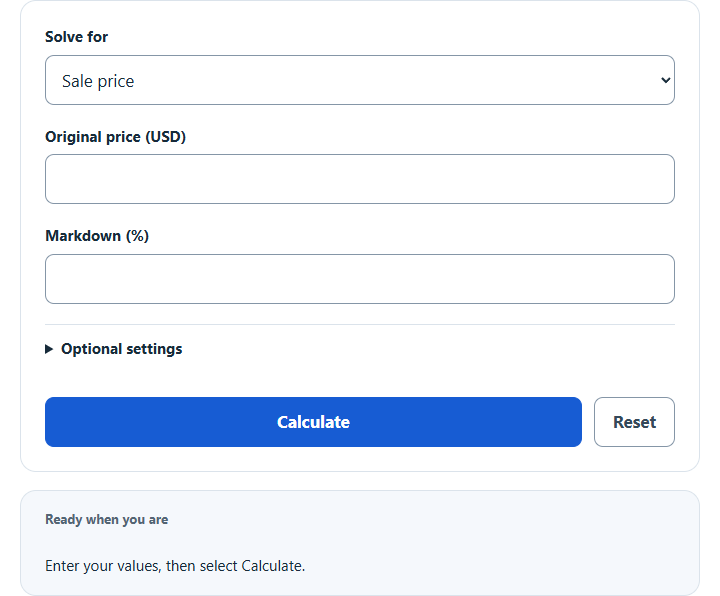
Calculate a markdown sale price from the original price and markdown percentage, or find the markdown rate or original price, including stacked discounts.
- All Business Calculators
- Markup Calculator
- Margin Calculator
- Marginal Cost Calculator
- Original Price Calculator
Markdown Formula
The formula below calculates the marked-down sale price from the original price and markdown percentage. Sequential markdowns multiply the remaining price factors rather than adding percentages.
- Where NP is the new price
- OP is the original price
- MD is the markdown %
To calculate the new price from a markdown, subtract the product of the original price times the markdown rate from the original price.
What Is the Meaning of Markdown in Finance?
In finance, the term "markdown'' refers to the purposeful reduction in the price or value of a good or service. This method makes said goods cheaper, more desirable, and thus much more competitive in the market.
A lower price may increase units sold, but it does not guarantee higher revenue or profit. With a positive unit profit, the calculator can estimate the extra volume needed to retain the original gross-profit dollars under a constant unit-cost assumption.
What Is Markdown vs. Markup?
A markdown reduces an existing selling price. A markup adds an amount to cost to obtain a selling price: markup amount = selling price − cost, and markup percentage = (selling price − cost) ÷ cost ×100. These percentages use different bases.
Neither markdown nor markup guarantees net profit. Enter unit cost if you want gross-profit, margin and volume scenarios; leave it blank to calculate prices only. Taxes, fees, fixed costs and demand changes are excluded.
How to calculate Markdown
Let's take a look at an example of how to use markdown in the real world.
Let's assume you have a product that currently sells for $100.00. This product has not been selling as well as hoped for. As a result, you are looking to decrease the price to increase sales.
To do this, you are going to apply a markdown to that item. After some math, you've determined that a 5% decrease is a good place to start.
Next, you need to plug in the original price and markdown % into the formula, or just simply use the calculator. This should yield a new price of $95.00.
That means the total decrease due to the markdown was $5.00.
A price-elasticity analysis can estimate how quantity demanded might respond to a price change. Profit also depends on costs; the volume scenario here is not a demand forecast.
The four modes calculate sale price, markdown rate, original price or sequential markdowns. A 100% markdown can give a zero sale price, but it cannot identify a unique original price from a zero sale price. Price-based calculations use USD and round displayed money; checkout rules may differ.
FAQ
Markdown is the opposite of markup. In other words, it's the percentage reduction in the price of a good or service.
For more finance calculators, click here.