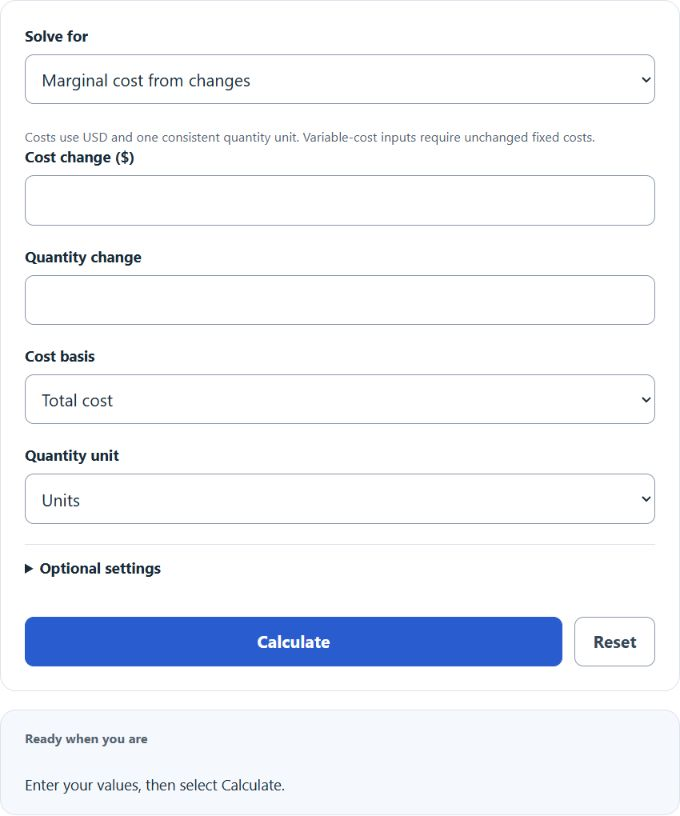
Calculate interval marginal cost from cost and quantity changes, solve either change, or compare two totals. Costs use USD; variable-cost inputs assume fixed costs do not change.
- Maximum Revenue Calculator
- Markdown Calculator
- MPC Calculator
- Markup Calculator
- All Business Calculators
Marginal Cost Formula
- MC is marginal cost
- ΔTC is the change in total cost
- ΔTVC is the change in total variable cost (used when fixed cost does not change over the output range)
- ΔQ is the change in quantity
To calculate marginal cost, divide the change in total cost by the change in quantity. If fixed costs do not change over the relevant range (a common short-run assumption), then ΔTC equals ΔTVC and you can use the change in total variable cost instead.

- Where MC is marginal cost
- MR is marginal revenue
What is marginal cost?
Marginal cost refers to the additional cost of producing one more unit (i.e., the change in cost per additional unit of output).
Marginal cost is the change in total cost that occurs when increasing production by one unit. You may be thinking, isn’t that just the cost per unit? In short, it’s more complicated than that.
For example, let’s say you have a machine that can produce 1,000 units of some item. At that output level, you observe an average cost of X per unit.
Now let’s imagine you want to increase that quantity to 1,100 units. It might be tempting to assume the total cost will simply scale as X times 1,100 units. However, if the machine can only produce 1,000 units, producing beyond that capacity may require buying or leasing another machine (a fixed or step-fixed cost), and possibly adding labor and other variable inputs.
This can lead to a large increase in marginal cost over that range because total cost rises sharply while quantity increases by only 10%.
As you can see, the marginal cost of an output change is not always the same as the prior average cost per unit.
How to calculate marginal cost
There are three steps in calculating marginal cost. First, determine the increase in quantity you wish to analyze (ΔQ).
Next, calculate the change in total cost over that output change (ΔTC). In many short-run problems where fixed costs do not change, this can be approximated by the change in total variable cost (ΔTVC). Variable costs include materials, direct labor, energy consumption, and similar costs that vary with output.
Finally, marginal cost can be calculated using the formula above. For example, assume fixed costs do not change, the increase in quantity is 100 units, and the increase in total variable cost is $5. The marginal cost would be:
MC = ΔTVC / ΔQ
MC = $5 / 100
MC = 0.05 $/unit
FAQ
A marginal cost is the change in total production cost associated with producing one additional unit of output.