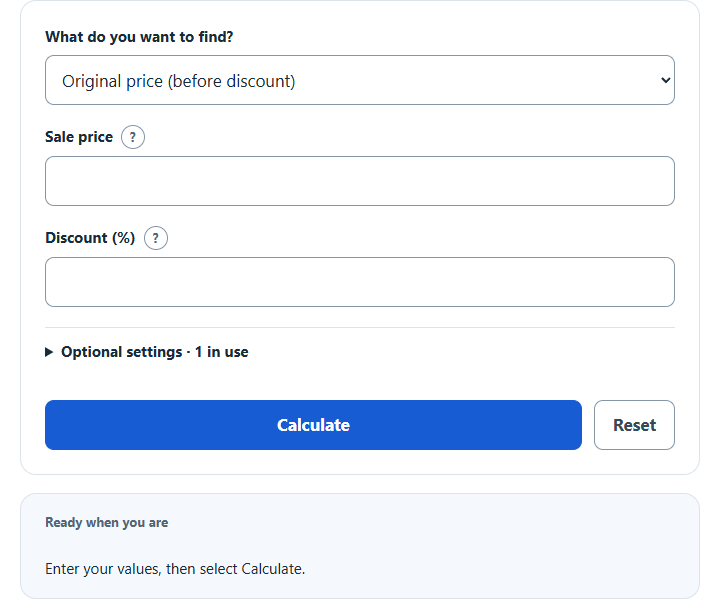
Calculate the original price before a discount from the sale price and percent off, or find the sale price, percent off, or price from the amount saved.
Calculator Functions
| Function | What it does | What it requires |
|---|---|---|
| Original price (before discount) | Finds the price before a percentage discount was taken off | Requires the sale price and the discount percentage |
| Sale price (after discount) | Finds the price after a percentage discount | Requires the original price and the discount percentage |
| Discount percentage | Finds the percent off between two prices | Requires the original price and the sale price |
| Original price from amount saved | Finds the price before the discount when only the money taken off is known | Requires the amount saved and the discount percentage |
Every result shows all four figures together: the original price, the sale price, the amount saved and the discount. An optional setting changes the decimal places shown from 2 to 0, 3 or 4. Prices are before taxes and fees and carry no currency symbol, so any currency works as long as both prices use the same one.
Original Price Formulas
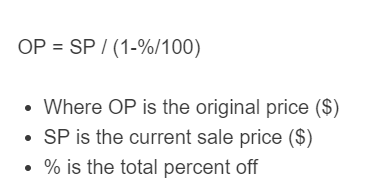
| OP | Original price, before the discount |
| SP | Sale price, after the discount |
| D | Discount in percent, such as 25 for 25% off |
A discount of D percent leaves (100 − D) percent of the original price, and that remaining share is the sale price. Each function below is this one relationship solved for a different unknown.
Original price (before discount)
The main formula applies directly. An item selling for $50 after 25% off had an original price of 50 ÷ 0.75 = $66.67. A discount of 100% is rejected, because a sale price of zero says nothing about where the price started.
Sale price (after discount)
An $80 item at 25% off sells for 80 × 0.75 = $60, a saving of $20.
Discount percentage
A shirt marked down from $22.50 to $18.00 is (22.50 − 18.00) ÷ 22.50 × 100 = 20% off. The sale price cannot be higher than the original price, and the original price must be above zero.
Original price from amount saved
S is the amount of money taken off. A vase that is 75% off, which is $24 off, had an original price of 24 ÷ 0.75 = $32 and sells for $8. The same formula recovers a total from a percentage of it: if 0.5% of sales is $197.31, the sales were 197.31 ÷ 0.005 = $39,462.
What Is the Original Price?
The original price is what an item cost before a discount was applied. It is also called the regular price, list price or full price. The sale price is what is left after the discount, so the original price is always the larger of the two.
How to Find the Original Price After a Discount
Subtract the discount percentage from 100, divide the result by 100, and divide the sale price by that number. For a phone that costs $495 after 10% off: 100 − 10 = 90, 90 ÷ 100 = 0.9, and 495 ÷ 0.9 = $550. Adding the percentage back to the sale price does not work. 10% of $495 is $49.50, which gives $544.50, because the discount was a percentage of the larger original price and not of the sale price.