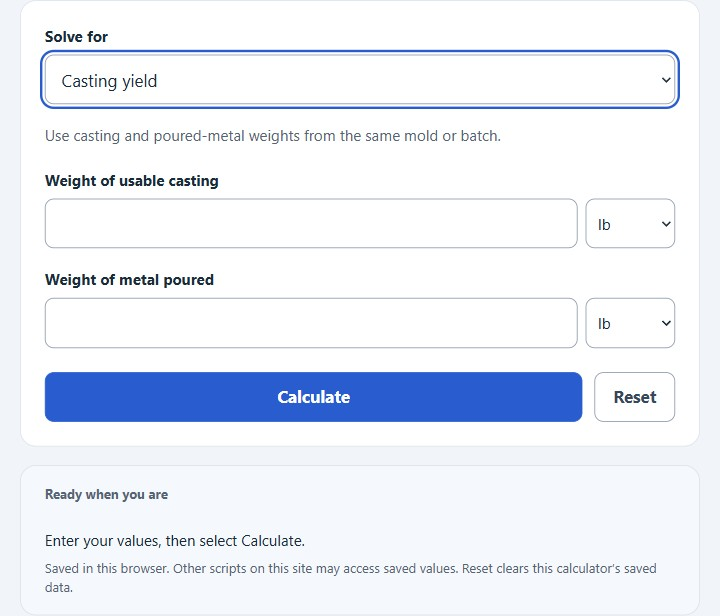
Choose casting yield, usable casting weight, or metal poured; enter the two known values with lb, kg, or oz units.
- All Construction Calculators
- Aluminium Casting Cost Calculator
- Casting Shrinkage Calculator
- Product Yield Calculator
- Scrap Rate Calculator
- Yield Strength Calculator
- X-Factor Welding Calculator
Casting Yield Formula
Casting yield is usable, clean casting weight divided by the total metal poured into the same mold or batch. Exclude gates, runners and risers from the casting weight. Select the value to solve and enter the two known values.
- CY = casting yield, as a percentage
- WC = weight of casting
- WMP = weight of metal poured
The weight values must be in the same unit before the formula is applied. The calculator converts pounds, kilograms, and ounces to a common base unit, performs the calculation, then displays the weight result in the selected result unit. Changing an input unit converts its entered weight.
- To calculate casting yield: enter the weight of casting and the weight of metal poured.
- To calculate weight of casting: enter the weight of metal poured and the casting yield percentage.
- To calculate weight of metal poured: enter a positive usable casting weight and a yield above 0% and at most 100%.
Common Casting Yield Ranges
Actual yield depends on the process, gating and riser design, casting geometry, alloy, rejects, and measurement convention. The dated process references below come from the U.S. Department of Energy’s May 2004 metalcasting report; they are not quality thresholds or predictions for a particular job.
| Casting situation | Typical yield range | What it usually indicates |
|---|---|---|
| Sand casting (2004 reference) | 50% to 65% | Historical process range; actual jobs vary. |
| Nonferrous die or permanent mold (2004 reference) | 65% to 75% | Process-specific historical reference. |
Weight Unit Conversions Used
| Unit | Equivalent in pounds | Equivalent from 1 pound |
|---|---|---|
| Pounds | 1 lb | 1 lb |
| Kilograms | 1 kg ≈ 2.20462262 lb | 1 lb = 0.45359237 kg (exact) |
| Ounces | 1 oz = 0.0625 lb | 1 lb = 16 oz |
Example Calculations
Example 1: Calculate casting yield
You pour 120 lb of metal and the finished casting weighs 78 lb.
The casting yield is 65%.
Example 2: Calculate weight of metal poured
The finished casting weighs 40 kg and the expected casting yield is 80%.
You need to pour 50 kg of metal.
FAQs
What is a good casting yield?
A useful yield target depends on the process and part design. The DOE’s May 2004 report lists a historical sand-casting range of 50% to 65%. Compare only yields using the same treatment of rejects and machining allowance. Higher metal utilization does not by itself establish casting quality; excluded metal may be remelted.
Can casting yield be over 100%?
No. Casting yield should not be over 100% because the finished casting cannot weigh more than the total metal poured. A result above 100% usually means one of the input weights is wrong, the units were mixed up, or the weight of casting includes material that should not be counted.
What is included in weight of metal poured?
Weight of metal poured is the total metal charged into the mold for that casting or mold setup. It includes the final casting plus metal in the gating system, runners, risers, sprues, overflow, and other metal that does not remain in the finished part.