Calculate σ = My/I, reverse-solve allowable moment, or derive I and section modulus for rectangle and circular sections with SI/US units and safety results.
- All Construction Calculators
- Stress Calculator
- Hoop Stress Calculator
- Tensile Strength Calculator
- Live Load Calculator
- Rod Bending Force Calculator
Bending Stress Formula
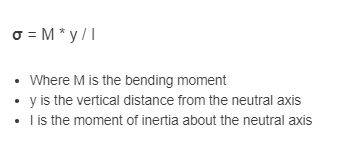
The basic bending stress equation relates bending moment, distance from the neutral axis, and the second moment of area.
- σ = bending stress
- M = bending moment
- y = distance from the neutral axis to the point where stress is being calculated
- c = distance from the neutral axis to the extreme outer fiber of the section
- I = second moment of area, also called area moment of inertia
- S = section modulus
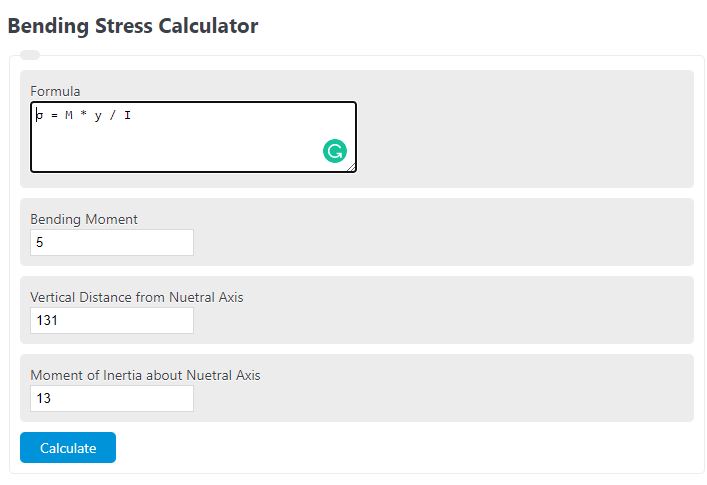
In the My/I stress mode, you enter M, y, and I directly. The calculator applies σ = My/I after converting the selected units to base units.
In the beam shape mode, you enter a common cross-section shape and its dimensions. The calculator finds I, sets c as the distance to the outermost fiber, computes S = I/c, and then calculates stress from σ = M/S.
The section property formulas used for the built-in shapes are:
- b = rectangle width
- h = rectangle height
- a = square side length
- d = diameter, or inner diameter for a hollow round section
- D = outer diameter of a hollow round section
- B = outer width of a rectangular tube
- H = outer height of a rectangular tube
- t = wall thickness of a rectangular tube
Common Bending Stress Units and Conversions
These conversions help you check whether the output unit is in the range you expect.
| Stress Unit | Equivalent | Common Use |
|---|---|---|
| 1 MPa | 1 N/mm² | Metric beam and material stress calculations |
| 1 GPa | 1000 MPa | Large stress or modulus values |
| 1 ksi | 1000 psi | US customary structural calculations |
| 1 MPa | 145.038 psi | Comparing metric and US stress values |
Shape Inputs Used for Section Properties
| Shape | Required Inputs | Extreme Fiber Distance |
|---|---|---|
| Rectangle | Width b, height h | c = h/2 |
| Square | Side a | c = a/2 |
| Solid round | Diameter d | c = d/2 |
| Hollow round | Outer diameter D, inner diameter d | c = D/2 |
| Rectangular tube | Outer width B, outer height H, wall thickness t | c = H/2 |
Example Bending Stress Calculations
Example 1: Rectangular beam section
You have a rectangular section with a bending moment of 500 Nm, width 50 mm, and height 100 mm.
- I = bh³/12 = 50 × 100³ / 12 = 4,166,666.67 mm⁴
- c = h/2 = 50 mm
- S = I/c = 4,166,666.67 / 50 = 83,333.33 mm³
- M = 500 Nm = 500,000 Nmm
- σ = M/S = 500,000 / 83,333.33 = 6 MPa
Example 2: Direct My/I calculation
You have a bending moment of 2 kNm, a distance from the neutral axis of 25 mm, and a moment of inertia of 8,000,000 mm⁴.
- M = 2 kNm = 2,000,000 Nmm
- σ = My/I = 2,000,000 × 25 / 8,000,000
- σ = 6.25 MPa
Bending Stress Calculator FAQ
What is the difference between y and c?
y is any distance from the neutral axis where you want to find the bending stress. c is the maximum distance from the neutral axis to the outermost fiber of the cross-section. If you use c, the result is the maximum bending stress in that section.
Why does increasing height reduce bending stress so much?
For rectangular and tube sections, the moment of inertia depends strongly on height. A solid rectangle has I = bh³/12, so height is cubed. Increasing the section height usually increases stiffness and section modulus much more than increasing width by the same amount.
Does the calculator check whether the beam material is safe?
No. The result is the bending stress for the entered moment and cross-section. To judge safety, compare the calculated stress with an allowable stress for the material and design code you are using. You may also need to check shear, deflection, buckling, stress concentrations, load combinations, and connection details.