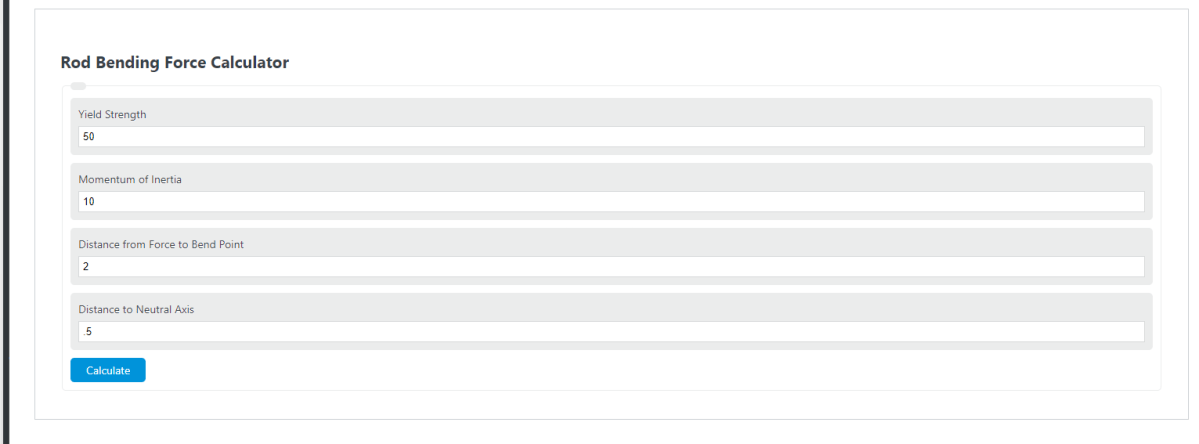
Calculate bending force, maximum stress, or required diameter for a solid round rod with cantilever or center-loaded support in metric or imperial units.
- All Physics Calculators
- All Force Calculators
- Pipe Bend Weight Calculator
- Bend Force Calculator
- Bending Strength Ratio Calculator
Rod Bending Force Formula
The following equation is used to calculate the Rod Bending Force (based on bending stress with a moment arm y such that M = F·y).
- Where F is the rod bending force (N)
- S is the yield strength of the material (Pa = N/m²)
- I is the second moment of area (area moment of inertia) of the cross section (m⁴)
- y is the distance from the applied force to the bend point / section of interest (m)
- d is the distance from the neutral axis to the outermost fiber (m) (typically the radius or half the thickness)
To calculate the rod bending force, multiply the area moment of inertia by the yield strength, then divide by the product of the distance from the force to the bend point and the distance from the neutral axis to the outer surface.
What is a Rod Bending Force?
Definition:
A rod bending force is a force that causes a rod (or beam) to flex or bend, creating an internal bending moment and internal stresses.
The amount of force needed to bend an object varies depending on the loading geometry (lever arm), the material’s yield strength, and the cross-sectional geometry (through the area moment of inertia/section modulus). Bending force is not the same thing as tensile stress; bending produces a stress distribution with tension on one side and compression on the other.
How to Calculate Rod Bending Force?
Example Problem:
The following example outlines the steps and information needed to calculate the Rod Bending Force.
First, determine the yield strength. In this case, the yield strength of the material is 50 MPa.
Next, determine the area moment of inertia (second moment of area). In this case, I = 1 cm⁴ (which is 1×10⁻⁸ m⁴).
Next, determine the distance from the force to the bending point. In this case, the distance is 2 m.
Next, determine the distance from the neutral axis to the outer surface. In this case, this is measured to be 0.5 mm (which is 0.0005 m).
Finally, calculate the rod bending force using the formula above:
F = S * I / (y*d)
F = (50×10⁶ Pa) * (1×10⁻⁸ m⁴) / (2 m * 0.0005 m)
F = 500 N
FAQ
What materials can be used for rod bending?
Rod bending can be performed on a variety of materials, including but not limited to steel, aluminum, and copper. The key factor is the material’s yield strength, as it helps determine how easily the rod can be bent without permanently deforming.
How does the thickness of a rod affect its bending force?
In the simplified relationship F = S·I/(y·d), d is the distance from the neutral axis to the outermost fiber, and I is the area moment of inertia. If I were held constant, increasing d would decrease F. In real rods, however, making a rod thicker/larger usually increases I much more strongly than d increases, so the force required to reach yield typically increases with diameter/thickness.
Can the rod bending force formula be used for any shape of the rod?
Yes, the same bending-stress relationship can be used for any cross-sectional shape as long as you use the correct area moment of inertia I for that shape and the correct outer-fiber distance d (sometimes written as c). Precise results still depend on the actual loading and support conditions.