Calculate bend force, k constant, bend length, tensile strength, thickness, or die opening from five known press brake bending values.
- All Construction Calculators
- All Force Calculators
- Bending Strength Ratio Calculator
- Pipe Bend Weight Calculator
- Punching Force Calculator
- Rod Bending Force Calculator
- Bending Stress Calculator
Bend Force Formula
The bend force calculator estimates the relationship between bend length, tensile strength, thickness, die opening, and a user-supplied bending factor. Confirm the factor with your tooling manufacturer; this model does not verify safe machine or tool capacity.
- F = bend force
- k = bending factor, unitless. Supply a value appropriate to your tooling and process; no universal default is assumed.
- L = length of bend
- S = tensile strength of the material
- t = material thickness
- V = die opening
Choose the quantity to solve for. The calculator rearranges the same formula:
The calculator uses consistent millimeter, N/mm² and newton units for the relationship, then converts the answer to the selected result unit. lbf denotes pound-force, not mass.
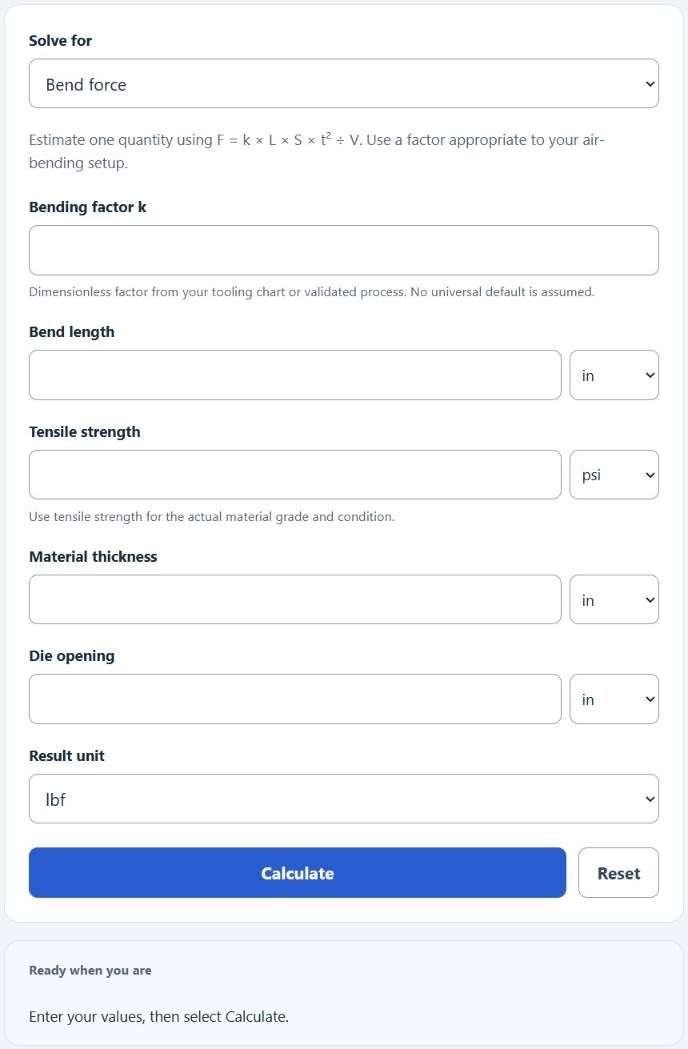
Select Solve for, enter the five displayed known values and choose a result unit where applicable. Select Calculate to show the answer below the form. All quantities must be greater than zero.
Typical Inputs for Bend Force Estimates
The following are illustrative values from the original examples, not certified material properties or design inputs. Obtain tensile strength for the actual grade, temper, thickness and condition from its material certificate.
| Material | Illustrative tensile strength | Equivalent psi |
|---|---|---|
| Mild steel | 400 MPa | 58,000 psi |
| Stainless steel | 515 MPa | 75,000 psi |
| Aluminum 5052-H32 | 228 MPa | 33,000 psi |
| Aluminum 6061-T6 | 310 MPa | 45,000 psi |
Common V-Die Opening Guidelines
These broad air-bending examples are not tool-selection instructions. Follow the manufacturer’s application limits for the actual material and geometry. Bystronic’s tooling reference uses thickness-dependent opening guidance and a geometry-dependent bending factor; a fixed k is an approximation.
| Material thickness | Common V-die opening | Effect on force |
|---|---|---|
| Thin sheet | 6t to 8t | Smaller opening increases required force |
| General air bending | 8t | Common estimating value |
| Thicker plate | 10t to 12t | Larger opening reduces required force |
Example Problems
Example 1: Calculate bend force
You have a V-die bend with these values:
- k = 1.33
- Length of bend = 24 in
- Tensile strength = 60,000 psi
- Thickness = 0.125 in
- Die opening = 1 in
The required bend force is about 29,925 lbf, or about 133.1 kN.
Example 2: Calculate die opening
You know the available force and want to find the die opening:
- k = 1.33
- Length of bend = 36 in
- Tensile strength = 58,000 psi
- Thickness = 0.25 in
- Bend force = 100,000 lbf
The calculated die opening is about 1.74 in.
FAQs
What k constant should you use for bend force?
Use a factor supported by your tooling manufacturer or validated process. The examples retain 1.33 as an assumed input, not a universal recommendation. Manufacturer models can account for thickness-to-opening ratio and other conditions. This calculator does not model bottoming or coining.
Why does thickness have such a large effect on bend force?
Thickness is squared in the formula. If the thickness doubles, the force increases by about four times when all other values stay the same. This is why small changes in sheet or plate thickness can make a large difference in required tonnage.
Does a larger die opening reduce bend force?
Yes. Die opening is in the denominator of the bend force formula, so increasing the die opening lowers the required force. A larger die opening can also increase the inside bend radius and may affect the final bend geometry, so it should be selected based on both force capacity and part requirements.