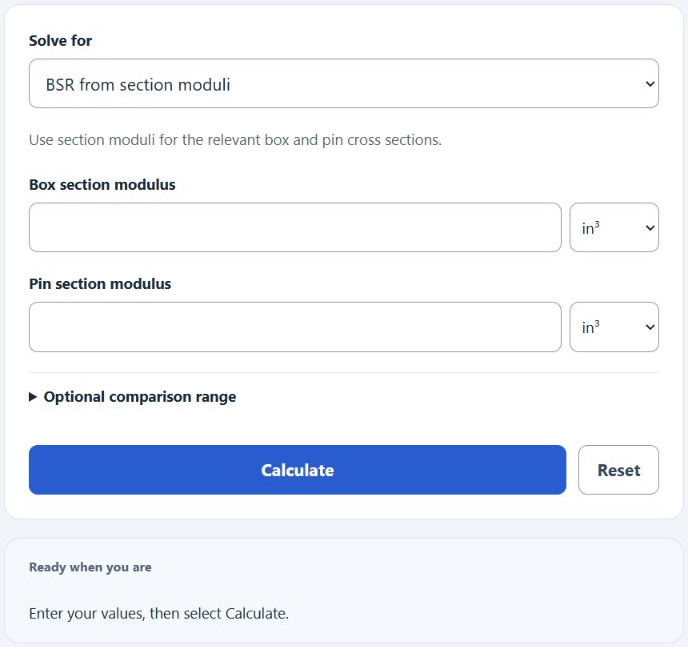
Choose a solve mode to calculate BSR or a section modulus, compare ideal circular-section diameters, or solve for an inside diameter from a target BSR. Optional comparison limits must come from your applicable specification; no automatic acceptance range is assumed.
- All Construction Calculators
- Bend Force Calculator
- Bending Stress Calculator
- Plastic Modulus Calculator
- Moment of Resistance Calculator
- Moment Capacity Calculator
- Cantilever Load Calculator
Bending Strength Ratio Formula
The following equation is used to calculate the Bending Strength Ratio.
- Where BSR is the bending strength ratio
- BSM is the box section modulus
- PSM is the pin section modulus
To calculate the bending strength ratio, divide the box section modulus by the pin section modulus in the same units. Select a solve mode, enter the displayed known values, then select Calculate. Diameter modes use Z = π(OD⁴ − ID⁴)/(32 OD), an ideal circular-section model, and require 0 ≤ ID < OD. Impossible target diameters are rejected.
What is a Bending Strength Ratio?
Definition:
A bending strength ratio compares the box section modulus at the pin-end location with the pin section modulus at the last engaged thread. Use the correct critical-section geometry or manufacturer-supplied moduli, not arbitrary nominal diameters. IADC’s definition identifies these locations. BSR alone does not establish connection strength, fatigue life or safe service. The calculator’s ideal-section designer is not a thread-design or certification tool.
How to Calculate Bending Strength Ratio?
Example Problem:
The following example outlines the steps and information needed to calculate Bending Strength Ratio.
First, determine the box section modulus. In this example, the box section modulus is 500 in³.
Next, determine the pin section modulus. The section modulus at the pin is measured to be 400 in³.
Finally, calculate the bending strength ratio using the formula above:
BSR = BSM / PSM
BSR = 500/400
BSR = 1.25