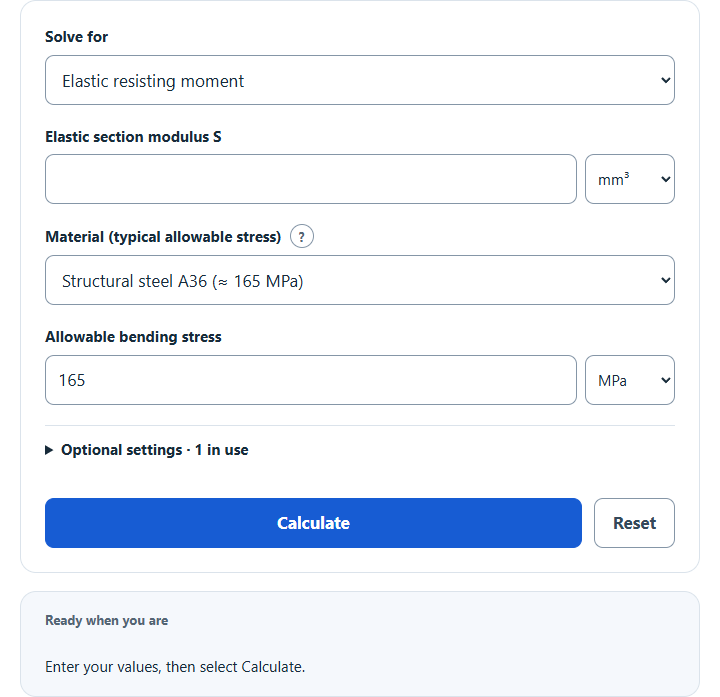
Calculate moment of resistance (M = S × σ) from section modulus and allowable bending stress, with typical steel and wood values, or find the required S.
Related Calculators
- Weld Section Modulus Calculator
- Tensile Strength Calculator
- Thread Pull-Out Force Calculator
- Scaffolding Load Capacity Calculator
- All Construction Calculators
Moment of Resistance Formula
The following formula is used to calculate the moment of resistance for a given section modulus and allowable stress.
Variables:
- M is the moment of resistance
- S is the section modulus
- σ is the allowable stress
To calculate the moment of resistance, multiply the section modulus by the allowable stress.
What is Moment of Resistance?
The moment of resistance is a measure of the capacity of a structural element to resist bending. It is the product of the section modulus and the allowable stress. This elastic expression uses a supplied allowable stress. Stability, other failure modes, detailing and governing-code checks must be evaluated separately before structural use.
How to Calculate Moment of Resistance?
The following steps outline how to calculate the moment of resistance.
- First, determine the section modulus (S) of the structural element.
- Next, determine the allowable stress (σ) for the material of the structural element.
- Finally, calculate the moment of resistance using the formula M = S * σ.
- After inserting the values and calculating the result, check your answer with the calculator above.
Example Problem :
Use the following variables as an example problem to test your knowledge.
Section modulus (S) = 200 cm³
Allowable stress (σ) = 150 MPa
Moment of resistance = 200,000 mm³ × 150 N/mm² = 30,000,000 N·mm = 30 kN·m.