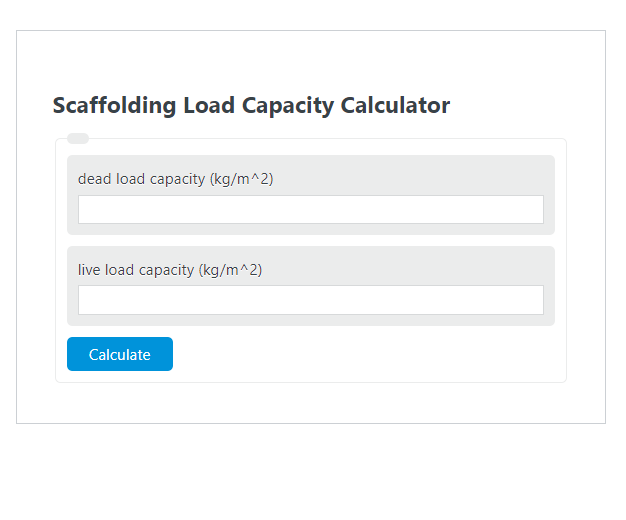
Scaffolding Load Capacity Calculator comparing leg and platform ratings with dead weight, OSHA intended-load factor, reverse ratings, and load checks.
Related Calculators
- Dead Load Calculator
- Load Per Square Foot Calculator
- Safe Working Load Calculator
- Effective Projected Area Calculator
- Handling Lift Capacity Calculator
- Floor Weight Capacity Calculator
- All Construction Calculators
Scaffolding Capacity (OSHA 4:1) Formula
The following example problem outlines the steps and information needed to estimate the minimum required scaffold/component strength using OSHA’s 4:1 requirement (support its own weight plus at least four times the maximum intended live load).
Variables:
- Creq is the minimum required scaffold/component capacity (per OSHA 4:1), expressed as a load per unit area (kg/m²)
- DL is the dead load (self‑weight) per unit area (kg/m²)
- LL is the maximum intended live load per unit area (workers/tools/materials) (kg/m²)
To estimate the minimum required capacity per OSHA’s 4:1 rule, multiply the maximum intended live load by 4, then add the dead load.
How to Calculate Scaffolding Capacity (OSHA 4:1)?
The following steps outline how to calculate the minimum required scaffold/component capacity using OSHA’s 4:1 requirement.
- First, determine the dead load (DL) per unit area (kg/m²).
- Next, determine the maximum intended live load (LL) per unit area (kg/m²).
- Next, use the formula from above: Creq = DL + 4·LL.
- Finally, calculate Creq (the minimum required capacity per OSHA 4:1).
- After inserting the variables and calculating the result, check your answer with the calculator above.
Example Problem :
Use the following variables as an example problem to test your knowledge.
DL (dead load, kg/m²) = 300
LL (maximum intended live load, kg/m²) = 500
Creq = DL + 4·LL = 300 + 4·500 = 2300 kg/m²