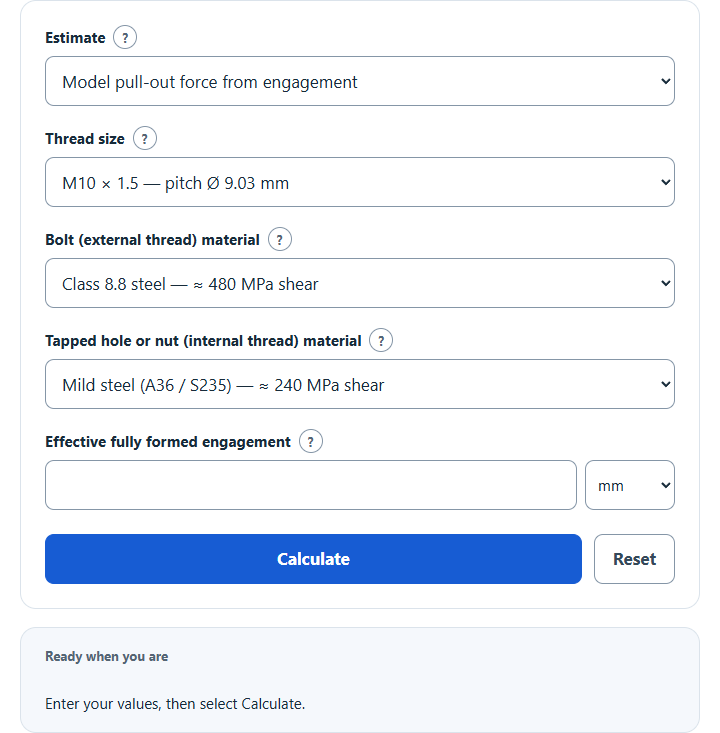
Calculate thread pull-out force from thread size, engagement length and bolt and tapped-part materials, or the engagement needed for a target load.
Thread Pull-Out Screening Formula
This calculator uses a simplified custom relation for thread stripping: Fscreen = πdmLτs/3, where τs is the lower entered shear strength. Its inverse is Lscreen = 3Ftarget/(πdmτs). This is different from checking tensile failure of the bolt cross-section.
Variables:
- Fscreen is the screened axial load; Ftarget is the entered target force used in the inverse mode
- dm is the applicable thread pitch diameter; L is effective axial engagement of fully formed mating threads
- τs = min(τexternal, τinternal) is the lower of the entered external- and internal-material shear strengths
- 3 is the fixed screening safety factor, applied once; enter both strengths on the same ultimate or yield basis before safety-factor reductions
Use N, mm and MPa together, or lbf, inches and psi together. NASA/TM-2017-219475 gives the relation P = πdmFsL/3 and defines dm as pitch diameter and Fs as material ultimate or yield shear stress. Its installation-torque tables have specific noncritical assembly assumptions; they do not certify this calculator or an arbitrary loaded joint. Taking the lower of two entered strengths is a custom extension, not a complete NASA check of both thread-failure modes.
What is Thread Pull-Out?
Thread stripping or pull-out occurs when mating thread material fails in shear under axial loading. It differs from tensile failure of the bolt cross-section. Internal and external thread shear areas are different, so choosing the lower material strength does not establish which part fails first. Actual design also depends on thread tolerances and fit, material condition, wall thickness, bolt tension, preload, combined loading and fatigue. This screen does not verify those conditions.
How to Use the Thread Pull-Out Screen?
The following steps describe the calculator model, not a complete joint-design procedure. Do not substitute nominal major diameter for pitch diameter or include incomplete entrance, chamfer and runout threads in effective engagement.
- First, pick a thread size, or choose Custom and enter the pitch diameter in mm or inches.
- Next, supply justified external- and internal-thread shear strengths on a consistent ultimate or yield basis before any safety reduction. The calculator offers typical presets; choose Custom to enter your own values.
- Enter the effective fully formed engagement to estimate load, or select the inverse mode and enter the target axial force to estimate engagement.
- Use τs = min(τexternal, τinternal), then Fscreen = πdmLτs/3 or Lscreen = 3Ftarget/(πdmτs).
- Read the screened load or model engagement with its unit; the fixed factor 3 is already included.
- Check geometry, each thread failure mode, bolt strength and all applicable design requirements separately. Thread pitch is not an input, so this calculator does not verify the number of fully engaged threads.
Example Problem:
This hypothetical example demonstrates the arithmetic only. The shear strengths below are assumed inputs, not material recommendations or verified allowables.
pitch diameter dm = 9 mm
effective fully formed engagement L = 10 mm
external shear strength = 200 MPa; internal shear strength = 120 MPa; lower entered strength τs = 120 MPa
Fscreen = π × 9 × 10 × 120 / 3 ≈ 11,309.734 N = 11.310 kN. This is a custom model result, not a rated joint capacity.