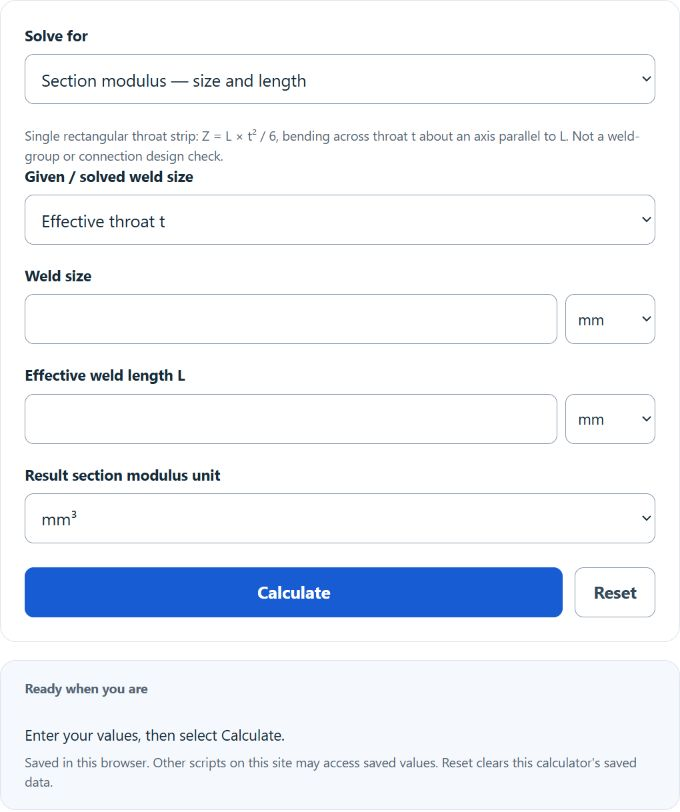
Calculate section modulus, elastic stress and inverse sizes for one rectangular weld-throat strip. The stated axis and simplified model do not establish weld-group capacity or code compliance.
Related Calculators
- Bending Strength Ratio Calculator
- Thickness Calculator
- Tube Bend Radius Calculator
- Laser Cutting Time Calculator
- All Construction Calculators
Weld Section Modulus Formula
For a single idealized rectangular strip of width L and effective throat depth t, bending across t gives Z = L × t² / 6. This follows from I = L × t³ / 12 and c = t/2. The other rectangular axis uses t × L² / 6; real weld groups require their own geometry and loading analysis.
Variables:
- WSM is the Weld Section Modulus (mm^3)
- t is the effective throat depth (mm), not automatically plate thickness
- L is the length of weld (mm)
Square the effective throat depth, multiply by effective length and divide by 6 for this axis. An ideal equal-leg 90° fillet has throat t = a/√2. Elastic bending stress magnitude is M/Z. The optional electrode reference 0.30 × FEXX is a weld-metal ASD reference, not an automatic allowable normal bending stress or a complete connection check.
How to Calculate Weld Section Modulus?
The following steps outline how to calculate the Weld Section Modulus.
- First, determine the effective throat depth for the stated rectangular-strip model (mm).
- Next, determine the length of weld (mm).
- Next, use WSM = t^2*L / 6 for the stated axis.
- Finally, calculate the Weld Section Modulus.
- After inserting the variables and calculating the result, check your answer with the calculator above.
Example Problem :
Use the following variables as an example problem to test your knowledge.
effective throat depth (mm) = 3
length of weld (mm) = 10
WSM = t^2*L / 6 = 3² × 10 / 6 = 15 mm³