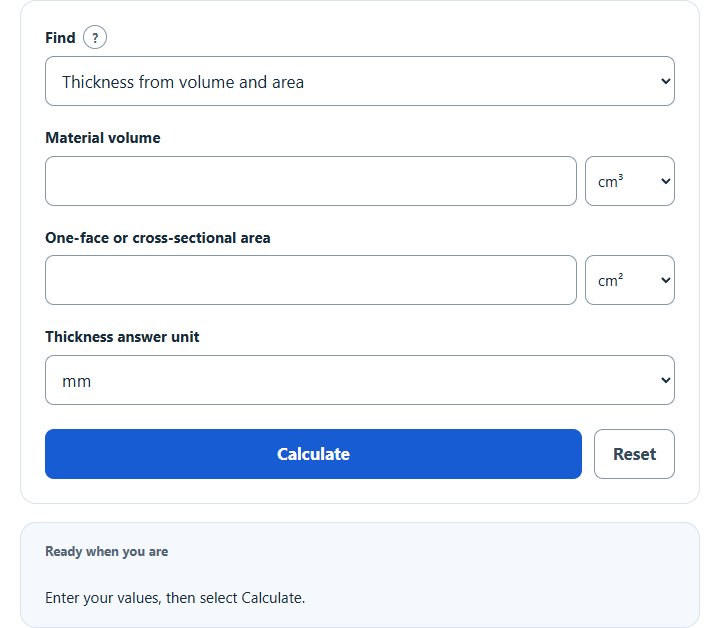
Calculate average thickness from volume and area (thickness = volume ÷ area) or from mass and density, and solve for volume or area in US or metric units.
Related Calculators
- Self-Leveling Coverage Calculator
- Asphalt Tonnage Calculator
- Weight Per Foot Calculator
- Slurry Volume Calculator
- All Construction Calculators
Thickness Formula
For a layer or constant cross-section, the relation between volume, one-face area and average thickness is:
Variables:
- T is average thickness, in the consistent length unit (ft in the example below)
- V is the total object volume (ft3)
- A is the one-face coverage or cross-sectional area normal to thickness (ft² in the example), not the sum of all exposed faces and edges
To calculate average thickness, divide material volume by the one-face coverage area. For the mass route, first use V = mass/density, so T = mass/(density × area). Density references in the calculator are representative, editable approximations that vary by material grade and conditions; use the actual bulk density when known. The other paths use V = A × T and A = V/T.
Thickness from length and width
For a rectangular face, choose Length × width under Area input. Enter the length and width of that one face with their units. The calculator uses A = L × W, then T = V/(L × W) or, with mass and density, T = mass/(density × L × W). The volume mode uses V = L × W × T. The covered-area mode still solves A = V/T without asking for area dimensions.
For example, 600 cm³ spread over a 20 cm × 10 cm face has an area of 200 cm² and an average thickness of 3 cm (30 mm). Use the rectangular footprint, not the sum of all exposed faces. This geometry does not determine a safe structural slab thickness.
For a pipe wall under internal pressure, use the Pipe Pressure Rating Calculator and choose Wall thickness from pressure. Its Barlow calculation uses the stress basis, outside diameter and applicable factors. It is a different model from volume divided by area and does not cover external-pressure buckling or establish a complete piping-system design.
How to Calculate Thickness?
Choose thickness from volume, thickness from mass and density, volume, or covered area. Enter the visible positive source values and select their actual units; the answer is calculated manually.
- For direct thickness, first determine the material volume in a supported cubic unit. For mass-based thickness, supply the mass and a consistent bulk density instead.
- Next, determine the one-face area covered by that volume, measured perpendicular to the thickness direction. Do not add the opposite face or edge areas.
- Next, gather the formula from above = T = V / A.
- Finally, calculate the Thickness.
- After inserting the variables and calculating the result, check your answer with the calculator above.
Example Problem :
Use the following variables as an example problem to test your knowledge.
total object volume (ft3) = 30
one-face area (ft²) = 15
T = V/A = 30 ft³/15 ft² = 2 ft = 24 in. This is the average thickness over the stated one-face area; it does not establish a minimum local thickness.