Calculate scissor lift actuator force from payload, platform and arm weight, and lift angle. Convert N, kN, lbf and kgf with a safety factor.
- All Force Calculators
- Lift Force Calculator
- Forklift Load Center Capacity Calculator
- Tipping Force Calculator
- All Construction Calculators
Scissor Lift Force Formula
The following simplified equation is used to estimate the scissor lift input force for an idealized single-stage scissor mechanism driven by a horizontal force that changes the base width (centered load, neglecting friction and other geometry factors).
- Where F is the required input/actuator force (same force units as W and WA)
- W is the weight (force) of the payload
- WA is the total weight (force) of the scissor arms (often approximated as contributing about half to the lifted load)
- a is the angle between the arms and the ground (use degrees or radians consistently with the tangent function)
To estimate scissor lift input force, add half the weight of the scissor arms to the weight of the payload, then divide by the tangent of the angle between the arms and the ground.
What is a Scissor Lift Force?
Definition:
A scissor lift is a lifting mechanism that raises and lowers a platform (and its load) vertically using linked, folding supports arranged in an “X” pattern. The scissor lift force is the input/actuator force required to raise the platform at a given arm angle; in real equipment it depends on the lift geometry (cylinder/screw placement, number of stages), friction, and load distribution. Scissor lifts are commonly powered by hydraulic cylinders or electric screw/drive systems, and some designs use pneumatic actuation.
How to Calculate Scissor Lift Force?
Example Problem:
The following example outlines the steps and information needed to calculate Scissor Lift Force.
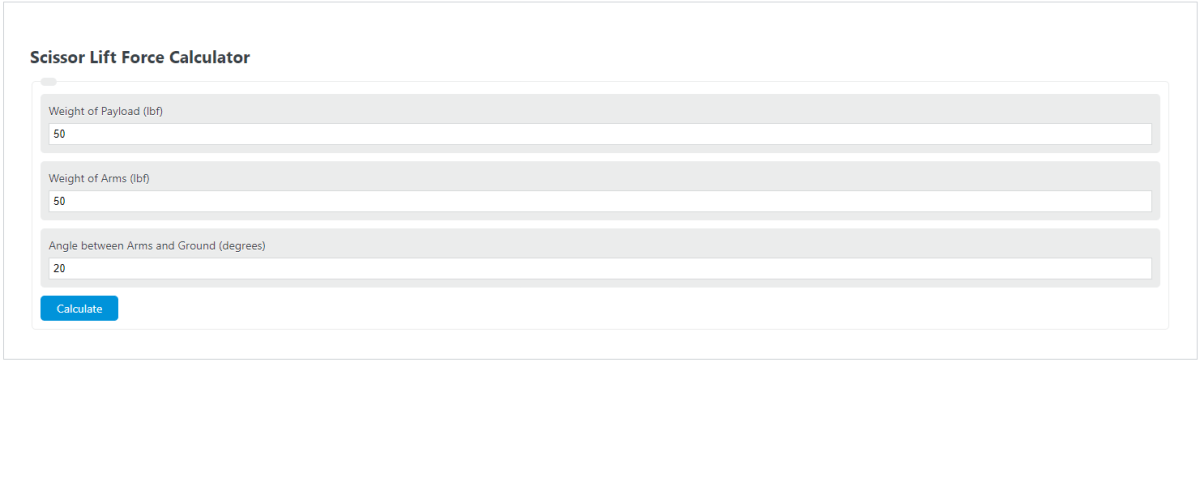
First, determine the weight of the payload. In this example, the weight of the payload is 50 lbf.
Next, determine the weight of the scissor arms. These are measured to be 50 lbf.
Next, determine the angle between the arms and the ground. This is measured to be 20 degrees.
Finally, calculate the scissor lift force using the formula above:
F = (W+(WA/2)) / (tan(a))
F = (50+(50/2)) / (tan(20°))
F = 206.06 lbf