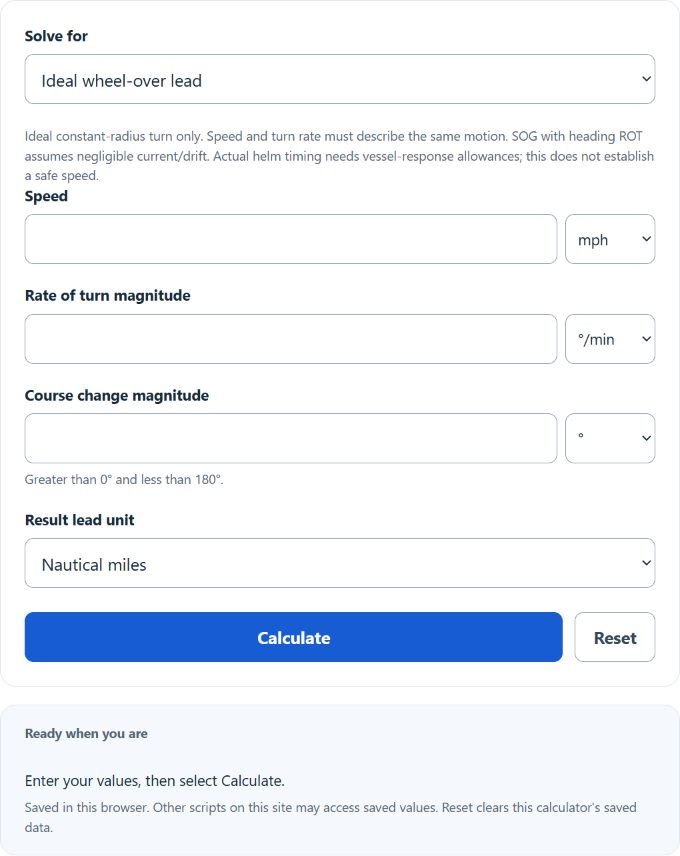
Calculate wheel-over distance, speed, rate of turn, or course change angle for a waypoint turn by choosing the unknown and entering three values in multiple units.
- All Automotive Calculators
- Wheel Bolt Pattern (PCD) Calculator
- Ground Speed Calculator
- Turning Radius Calculator
- Nautical Mile Calculator
- Reverse Bearing Calculator
- Magnetic Variation Calculator
- Boat Travel Time Calculator
Wheel Over Point Formula
This formula gives ideal circular-arc lead measured back from the inbound and outbound track intersection. It assumes an established constant-radius turn tangent to both tracks. Actual helm initiation also requires allowances from vessel manoeuvring data for steering response and turn build-up.
This equation is based on constant-radius turn geometry. The term v / ω gives the turn radius, and the tangent term adjusts that radius for the planned course change angle.
| Variable | Meaning | Typical Units |
|---|---|---|
| WOP | Wheel-over distance, or the lead distance before the waypoint along the inbound leg | Nautical miles, miles, kilometers, meters, feet |
| v | Speed over ground | Knots, mph, km/h, m/s |
| ω | Rate of turn | Radians per minute or radians per second |
| Δ | Planned course change angle between the inbound and outbound tracks | Degrees or radians |
| r | Turn radius produced by the chosen speed and rate of turn | Same distance units used for the result |
Unit Conversions That Matter
The main formula requires the turn rate to be in radians per unit time. It also requires the speed and turn rate to use compatible time units. A common mistake is entering speed in knots while using a turn rate in degrees per minute without converting the turn rate first.
If your speed is in knots and your rate of turn is in degrees per minute, the following form gives the wheel-over distance directly in nautical miles:
This is often the quickest manual form for marine navigation problems because it avoids converting knots into nautical miles per minute by hand.
How to Calculate Wheel Over Point
- Determine the vessel’s speed over ground.
- Determine the planned rate of turn.
- Determine the course change angle between the current leg and the next leg.
- Convert the rate of turn into radians per unit time, or use the nautical-mile form if your inputs are in knots and degrees per minute.
- Calculate the turn radius.
- Apply the wheel-over formula to get the lead distance before the waypoint.
- Measure that distance backward along the inbound leg to locate the wheel-over point.
Because this calculator accepts any three known values, it can also be used in reverse. For example, you can solve for the required rate of turn to keep the maneuver inside a desired lead distance, or solve for the speed implied by the selected geometry and turn rate. This is not an operational speed limit.
Example
Assume a speed over ground of 15 knots, a rate of turn of 10 degrees per minute, and a course change of 90 degrees.
The ideal circular-arc lead is about 1.43 nautical miles before the track intersection, before adding vessel-response allowances. For a 90-degree change of course, the wheel-over distance equals the turn radius, which makes this a useful mental check when reviewing the result.
How Each Input Affects the Result
| Change | Effect on Wheel-Over Distance | Why |
|---|---|---|
| Higher speed over ground | Increases | A faster vessel needs a larger turn radius at the same turn rate |
| Higher rate of turn | Decreases | A tighter turn reduces the lead distance required |
| Larger course change angle | Increases | A bigger heading change requires more distance to establish the tangent turn geometry |
| Smaller course change angle | Decreases | The vessel needs less lead distance to connect the two legs |
Practical Notes
- The result is a planning distance, not a guarantee of exact vessel behavior under every condition.
- The model assumes constant speed and angular rate in the same reference motion. Using speed over ground with heading-based rate of turn additionally assumes negligible current or changing drift.
- Real-world wheel-over points may need adjustment for steering response delay, autopilot behavior, vessel loading, draft, nearby channel limits, and local environmental effects.
- The course change angle should represent the actual change between the inbound and outbound tracks, not the compass heading error or cross-track correction.
- The geometry is most useful for ordinary course changes greater than zero degrees and less than 180 degrees.
Common Mistakes
- Using degrees per minute directly in the main formula without converting to radians.
- Mixing time bases, such as speed per hour with turn rate per second.
- Confusing waypoint distance with wheel-over distance.
- Ignoring the difference between ideal geometric lead distance and actual maneuvering performance.
Why This Calculator Is Useful
The calculator compares ideal turn geometries and supplies an algebraic consistency check. It does not verify vessel capability, channel clearance or safe helm timing; use vessel manoeuvring data and the applicable navigation plan for those decisions.