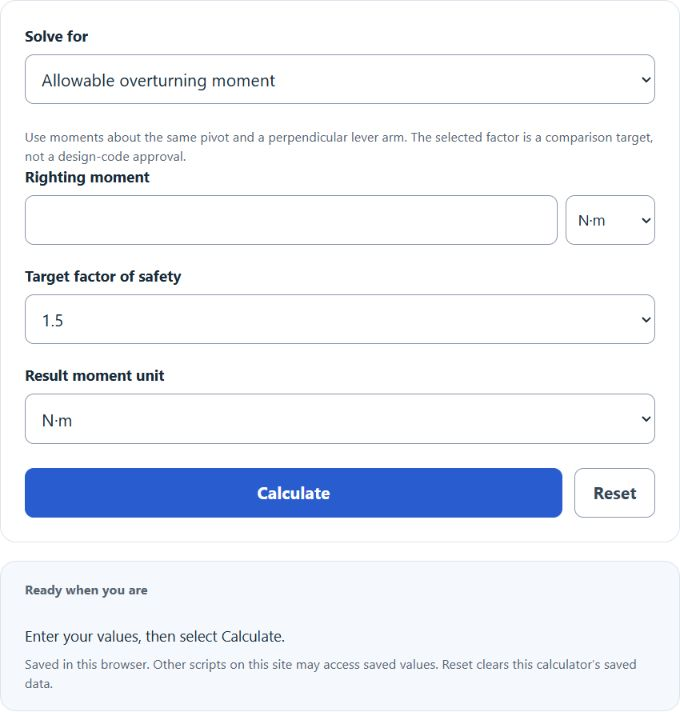
Calculate allowable overturning moment, required righting moment, their factor-of-safety ratio, or force times perpendicular lever arm. Use the same pivot and loading basis. A selected comparison factor and this moment check alone do not establish structural stability.
- All Construction Calculators
- Angular Force Calculator
- Crane Tipping Load Calculator
- Tipping Force Calculator
- Moment of Force Calculator
- Active Earth Pressure Calculator
- Earth Pressure Coefficient Calculator
Overturning Moment Formula
The following relationship is commonly used in retaining-wall overturning checks.
- Where OM is the overturning (driving) moment from loads
- RM is the righting (resisting) moment
- FS is the factor of safety against overturning
To compute the allowable overturning moment for a target safety factor, divide the righting moment by the chosen FS (for example, if FS = 1.5, then OM = RM / 1.5).
Overturning Moment Definition
What is an overturning moment?
An overturning moment is the driving torque produced by applied loads (such as lateral earth pressure, surcharge, or water) that tends to rotate a wall about its toe. Whether the wall is stable depends on how this driving moment compares to the righting (resisting) moment, typically expressed using a factor of safety.
Example Problem
How to calculate an overturning moment?
First, determine the righting moment of the retaining wall (the resisting moment from the wall weight and other stabilizing forces). For this example, the righting moment is RM = 50 ft-lb and the target factor of safety is FS = 1.5.
Next, use the formula above to compute the corresponding allowable overturning moment.
OM = RM / FS
OM = 50 / 1.5
OM = 33.33 ft-lb