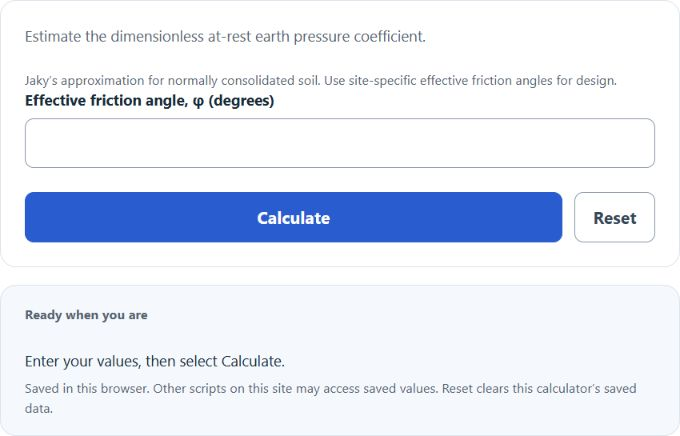
Calculate the at-rest earth pressure coefficient K0 from internal friction angle using Jaky’s approximation, K0 ≈ 1 − sin(φ).
At-Rest Earth Pressure Coefficient (K0) Formula
The calculator uses Jaky’s approximation for normally consolidated soil. It estimates the at-rest earth pressure coefficient from the soil’s internal friction angle.
When the friction angle is entered in degrees, the angle is first converted to radians before applying the sine function:
- K0 = at-rest earth pressure coefficient, dimensionless
- phi = internal friction angle of the soil or granular material
- phi_deg = internal friction angle in degrees
- phi_rad = internal friction angle in radians
- sin(phi) = sine of the internal friction angle
The calculator takes the internal friction angle, converts it from degrees to radians, evaluates the sine of that angle, then subtracts the result from 1. The output is K0, which is used to estimate lateral earth pressure when the soil is at rest and lateral strain is restrained.
Typical K0 Values by Internal Friction Angle
The table below shows approximate K0 values using Jaky’s formula.
| Internal Friction Angle, φ | sin(φ) | K0 = 1 − sin(φ) |
|---|---|---|
| 20° | 0.342 | 0.658 |
| 25° | 0.423 | 0.577 |
| 30° | 0.500 | 0.500 |
| 35° | 0.574 | 0.426 |
| 40° | 0.643 | 0.357 |
| 45° | 0.707 | 0.293 |
Common Soil Friction Angle Ranges
These illustrative friction-angle ranges are not recommended design inputs. The coefficient ranges are arithmetic outputs of Jaky’s formula; actual design values require site-specific geotechnical data.
| Material Type | Typical φ Range | Approximate K0 Range |
|---|---|---|
| Loose sand | 28° to 32° | 0.53 to 0.47 |
| Medium dense sand | 32° to 36° | 0.47 to 0.41 |
| Dense sand or gravel | 36° to 45° | 0.41 to 0.29 |
| Normally consolidated clay | 20° to 30° | 0.66 to 0.50 |
Example Calculations
Example 1: Soil with φ = 30°
For an internal friction angle of 30°:
The at-rest earth pressure coefficient is 0.5000.
Example 2: Soil with φ = 38°
For an internal friction angle of 38°:
The at-rest earth pressure coefficient is 0.3843.
FAQ
What does K0 mean in earth pressure calculations?
K0 is the coefficient of earth pressure at rest. It applies when soil cannot move sideways enough to reach active or passive conditions. This condition is common behind rigid retaining walls, basement walls, braced excavations, and buried structures where lateral deformation is small.
Why does K0 decrease as the friction angle increases?
A higher internal friction angle means the soil has greater shear strength. In Jaky’s approximation, K0 equals 1 minus the sine of the friction angle, so a larger friction angle gives a larger sine value and a smaller K0.
Is Jaky’s formula valid for all soils?
Jaky’s formula is commonly used for normally consolidated soils. It may not be appropriate for overconsolidated soils, cemented soils, heavily compacted fills, or materials with unusual stress history. For those cases, K0 may need adjustment based on geotechnical testing or project-specific design guidance.