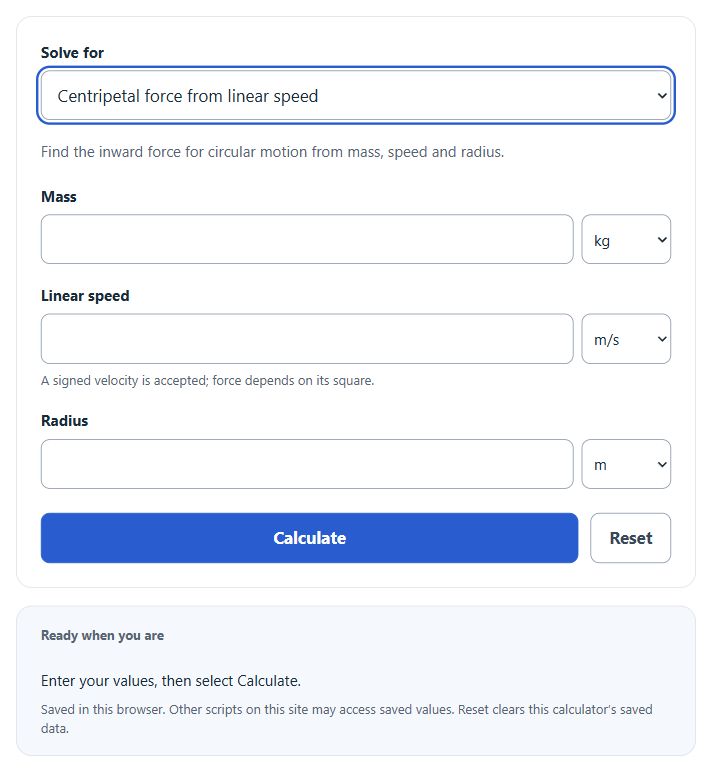
Calculate centripetal force from mass, radius, and either speed, RPM, or period, with unit conversions for kg, m/s, rev/min, and time.
Related Calculators
- Capstan Equation Calculator
- Torque Ratio Calculator
- Lateral Force Calculator
- Resultant Force Calculator
- All Physics Calculators
Angular (Centripetal) Force Formula
The calculator finds centripetal force, which is the inward force needed to keep a mass moving in a circular path. It converts your inputs to SI units first, then applies the formula for the mode you select.
Using linear speed
- Fc = centripetal force, in newtons (N)
- m = mass, in kilograms (kg)
- v = linear velocity, in meters per second (m/s)
- r = radius of the circular path, in meters (m)
Using RPM
- Fc = centripetal force, in newtons (N)
- m = mass, in kilograms (kg)
- ω = angular speed, in radians per second (rad/s)
- RPM = revolutions per minute
- r = radius, in meters (m)
Using period
- Fc = centripetal force, in newtons (N)
- m = mass, in kilograms (kg)
- r = radius, in meters (m)
- T = period, or time for one full revolution, in seconds (s)
Choose the appropriate force calculation under Solve for: linear speed, RPM, or period. You can also solve for mass, linear speed, or radius using the displayed known values. Select Calculate to show the answer.
Common Input Conversions
These are the unit conversions applied before calculating force.
| Quantity | Input unit | SI conversion |
|---|---|---|
| Mass | 1 g | 0.001 kg |
| Mass | 1 lb | 0.45359237 kg |
| Velocity | 1 km/h | 0.277778 m/s |
| Velocity | 1 mph | 0.44704 m/s |
| Radius | 1 ft | 0.3048 m |
| Period | 1 min | 60 s |
Force Result Reference
| Result size | Equivalent form | Meaning |
|---|---|---|
| 1 N | 0.2248 lbf | A small force, about the weight of a 102 g mass under gravity. |
| 100 N | 22.48 lbf | About the weight of a 10.2 kg mass under gravity. |
| 1,000 N | 1 kN | A large force often written in kilonewtons. |
Example Problems
Example 1: Linear speed
A 2 kg object moves in a circle with a radius of 4 m at a speed of 6 m/s.
The centripetal force is 18 N.
Example 2: RPM
A 0.5 kg mass rotates at 300 RPM at a radius of 0.2 m.
The centripetal force is about 98.7 N.
FAQ
Is angular force the same as centripetal force?
In this context, angular force means centripetal force: the inward force required for circular motion. In physics, “angular force” is not usually treated as a separate standard force. The actual force could come from tension, friction, gravity, a normal force, or another interaction, but its required inward value is the centripetal force.
Why does speed affect centripetal force so strongly?
Centripetal force depends on velocity squared. If you double the speed while mass and radius stay the same, the required force becomes four times larger. If you triple the speed, the required force becomes nine times larger.
What happens if the radius gets larger?
For the same linear speed, a larger radius reduces the required centripetal force because the turn is less sharp. For the same RPM or period, a larger radius increases the required force because the object travels faster around a larger circle in the same amount of time.