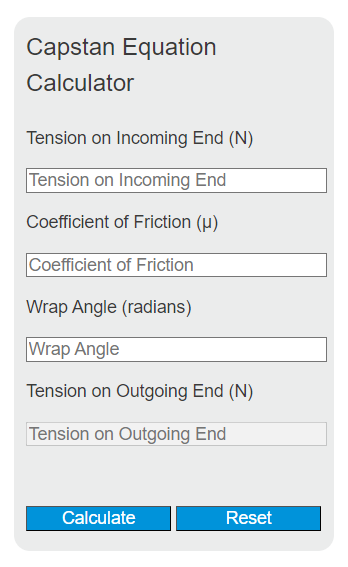
Solve capstan holding tension, load tension, friction coefficient, wrap angle, required turns, and slip margin with automatic unit conversion.
Related Calculators
- Shaft Torque Calculator
- Tipping Force Calculator
- Speed to Force Calculator
- Velocity to Work Calculator
- All Physics Calculators
Capstan Equation Formula
The capstan equation relates the tension on one side of a rope, belt, cable, or line wrapped around a post, drum, pulley, or capstan to the tension on the other side.
Rearranged forms used by the calculator:
- Tin = tension on the incoming end
- Tout = tension on the outgoing end
- μ = coefficient of friction between the line and the surface
- θ = wrap angle in radians
- e = Euler’s number, approximately 2.71828
The calculator lets you enter any three values and solves for the missing one. If you leave incoming tension blank, it divides outgoing tension by the exponential friction factor. If you leave outgoing tension blank, it multiplies incoming tension by that factor. If you leave μ blank, it solves for the coefficient of friction using the natural logarithm of the tension ratio. If you leave the wrap angle blank, it solves for θ in radians and then converts it to degrees if that unit is selected.
Tension inputs can be entered in newtons, pound-force, or kilogram-force. Wrap angle can be entered in radians or degrees, but the formula itself uses radians.
Wrap Angle and Friction Reference Values
The wrap angle is the total contact angle between the line and the surface. More wrap angle increases the possible tension ratio exponentially.
| Wrap | Degrees | Radians | Description |
|---|---|---|---|
| 1/4 turn | 90° | 1.5708 | Line contacts one quarter of the cylinder |
| 1/2 turn | 180° | 3.1416 | Line wraps halfway around |
| 1 turn | 360° | 6.2832 | One complete wrap |
| 2 turns | 720° | 12.5664 | Two complete wraps |
| Contact Pair | Typical μ Range | Notes |
|---|---|---|
| Steel cable on steel drum | 0.10 to 0.20 | Lower when smooth or lubricated |
| Rope on wood | 0.30 to 0.50 | Depends strongly on rope material and surface finish |
| Rope on rough metal | 0.25 to 0.45 | Higher with rougher or more compliant surfaces |
| Rubber belt on metal pulley | 0.40 to 0.80 | Common in belt friction problems |
Examples
Example 1: Calculate outgoing tension
You have an incoming tension of 100 N, a coefficient of friction of 0.30, and a wrap angle of 180°.
Convert the angle to radians:
Apply the capstan equation:
The outgoing tension is approximately 256.61 N.
Example 2: Calculate coefficient of friction
You have an incoming tension of 50 N, an outgoing tension of 200 N, and a wrap angle of 360°.
Convert the angle to radians:
Solve for μ:
The coefficient of friction is approximately 0.2206.
FAQ
Does the wrap angle have to be in radians?
Yes, the capstan equation uses radians. If you enter degrees, the calculator converts degrees to radians before applying the formula. For example, 180° is 3.1416 radians, and 360° is 6.2832 radians.
Why does tension increase so much with extra wraps?
The equation uses an exponential term, eμθ. That means the tension ratio does not increase linearly. Adding more wrap angle can greatly increase the holding effect, especially when the coefficient of friction is high.
Can the coefficient of friction be negative?
For normal capstan equation use, μ should be positive. A negative value would imply the wrapped contact reduces the tension ratio in the opposite direction, which does not match the usual friction model. If the calculated μ is negative, check whether the incoming and outgoing tensions were entered in the correct fields.