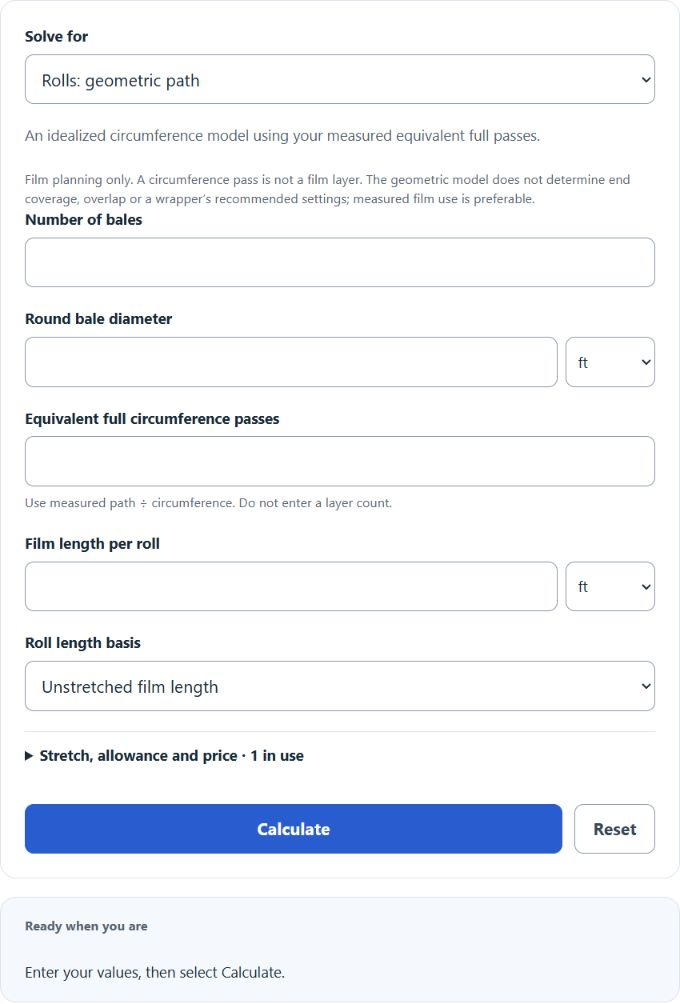
Estimate wrap length, whole rolls, bales per roll, material buffer, and cost from round-bale diameter, full passes, film stretch, roll length, and waste.
Bale Wrap Formula
The geometric modes use an ideal circular film path. Measured-use modes instead use actual film consumed per bale on the same length basis as the roll. Neither predicts protective layers or coverage.
Rolls needed mode:
Roll yield mode:
- D = bale diameter (converted to feet)
- W = user-supplied equivalent circular film paths; not layers or machine revolutions
- B = number of bales to wrap
- L = roll length (converted to feet); F = film use per bale including allowance; E = effective available roll length
- pi * D = circumference of one wrap around the bale
In geometric mode, baseline film path is pi × D × W. Apply the user-selected extra-consumption allowance to obtain F. For unstretched roll length, E = L × (1 + effective machine stretch / 100); use already adjusted roll length directly. Do not count factory prestretch twice. Measured consumption must match the roll basis and receives no additional stretch conversion. Follow your film and wrapper instructions for overlap, all-surface coverage and layer settings.
Reference Values
Illustrative circular paths with zero additional stretch and allowance. These are arithmetic examples, not wrapper or layer recommendations.
| Diameter / paths | Film / complete bales |
|---|---|
| 4 ft / 3 paths | 37.7 ft / 132 bales per 5,000 ft |
| 5 ft / 3 paths | 47.1 ft / 106 bales per 5,000 ft |
| 5 ft / 4 paths | 62.8 ft / 79 bales per 5,000 ft |
| 6 ft / 4 paths | 75.4 ft / 66 bales per 5,000 ft |
Coverage and layer settings require the film and wrapper instructions.
Layer settings depend on the film, wrapper, overlap, crop and storage conditions. Use the manufacturer’s coverage instructions rather than a generic storage-time wrap count. See Silotite film instructions and MaxiStretch application guidance.
Example
For an idealized example, use 120 round bales at 5 ft diameter, 4 equivalent circular paths per bale, and 5,000 ft per roll at $150, with zero additional stretch or allowance. This is not a four-layer wrapping prescription.
- Wrap per bale: pi * 5 * 4 = 62.83 ft
- Total wrap: 62.83 * 120 = 7,540 ft
- Rolls needed: ceil(7,540 / 5,000) = 2 rolls
- Cost: 2 * $150 = $300, or about $2.50 per bale
FAQ
Does “wraps” mean layers of film or trips around the bale? No. Film layers, wrapper turns and equivalent circular film paths are different. Film width, overlap and wrapper motion determine coverage. Obtain machine settings from the manufacturer; use measured film consumption for this calculator where possible.
Why does my actual usage exceed the calculation? End coverage, overlap, tails, tears and remnants affect actual consumption. A generic percentage does not determine coverage. Measure representative bale consumption and choose any extra allowance for your actual operation.
Does this work for inline wrappers? No. This calculator assumes individual bale wrapping. Inline tube wrappers consume film based on the number of bales, end caps, and tube length, not bale circumference alone.