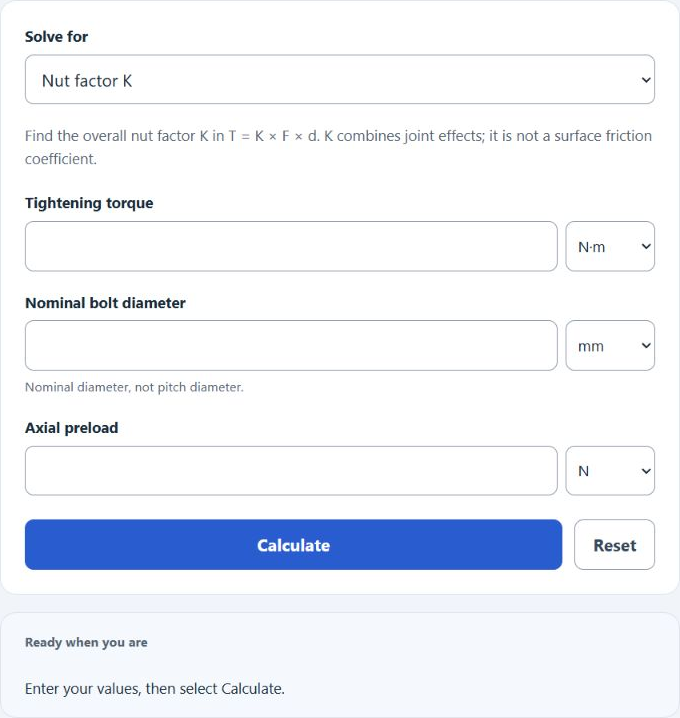
Select bolt torque, diameter, axial preload, or nut factor K to solve from the other three inputs. This calculator estimates the overall nut factor, not a surface friction coefficient.
- All Construction Calculators
- Bolt Area Calculator
- Bolt Pull Out Force Calculator
- Bolt Preload Calculator
Bolt Nut Factor Formula
The bolt nut factor, also called the torque coefficient, relates tightening torque to bolt diameter and axial force. The calculator uses the standard torque-preload relationship:
- T = tightening torque
- K = nut factor, also called torque coefficient, unitless
- d = nominal bolt diameter
- F = axial force or preload
To solve for the missing value, the formula is rearranged as needed:
- Torque calculation: enter nut factor, diameter, and axial force to calculate an estimated tightening torque.
- Nut factor calculation: enter torque, diameter, and axial force to calculate the implied K value.
- Axial force calculation: enter torque, nut factor, and diameter to estimate the resulting bolt preload.
- Diameter calculation: enter torque, nut factor, and axial force to solve for the nominal diameter used in the relationship.
The calculator converts inputs to base units internally: torque in N·m, diameter in meters, and force in newtons. The nut factor is unitless.
Joint-Specific Nut Factor Values
Nut factor depends strongly on thread condition, lubrication, surface finish, washer use, and coating. Use joint-specific test or manufacturer data; no universal K range is assumed.
| Condition | K value | Notes |
|---|---|---|
| Clean, dry steel threads | Use tested joint data | A generic default does not establish the correct value for this joint. |
| Lightly oiled threads | Use tested joint data | Lubrication usually lowers the required torque for the same preload. |
| Moly or high-performance lubricant | Use tested joint data | Can create much higher preload at the same torque than dry threads. |
| Zinc-plated or coated fasteners | Use tested joint data | Coating type and lubricant topcoat can change K significantly. |
Common Unit Conversions
| Quantity | Conversion |
|---|---|
| Torque | 1 lb-ft = 1.355817948 N·m |
| Torque | 1 kgf-m = 9.80665 N·m |
| Diameter | 1 in = 0.0254 m |
| Diameter | 1 mm = 0.001 m |
| Force | 1 lbf = 4.448221615 N |
| Force | 1 kN = 1000 N |
Example Problems
Example 1: Calculate torque
You have a bolt with a nominal diameter of 12 mm, an axial force of 30 kN, and a nut factor of 0.20.
Convert the inputs: 12 mm = 0.012 m and 30 kN = 30,000 N.
The estimated torque is 72 N·m.
Example 2: Calculate nut factor
A bolt is tightened to 100 N·m. The nominal diameter is 0.016 m and the measured axial force is 31,250 N.
The nut factor is 0.20.
FAQ
What is the difference between nut factor and friction coefficient?
The nut factor K is not the same as a simple friction coefficient. K is an overall torque coefficient that combines the effects of thread friction, bearing surface friction, fastener geometry, lubrication, and surface condition into one practical value. It is useful for estimating the torque-preload relationship, but it does not describe one single contact surface.
Why does lubrication change the required torque?
Lubrication reduces friction in the threads and under the nut or bolt head. With less torque lost to friction, more of the applied torque becomes bolt preload. That means the same torque can create a higher axial force when K is lower. If you use a dry-thread K value for lubricated threads, the preload estimate can be too low or the actual preload can be too high.
Should nominal diameter or pitch diameter be used?
This common torque equation normally uses the nominal bolt diameter. It is an approximation intended for general torque-preload estimates. More detailed bolted joint calculations may use thread geometry, pitch diameter, bearing diameter, and separate friction coefficients instead of a single K value.