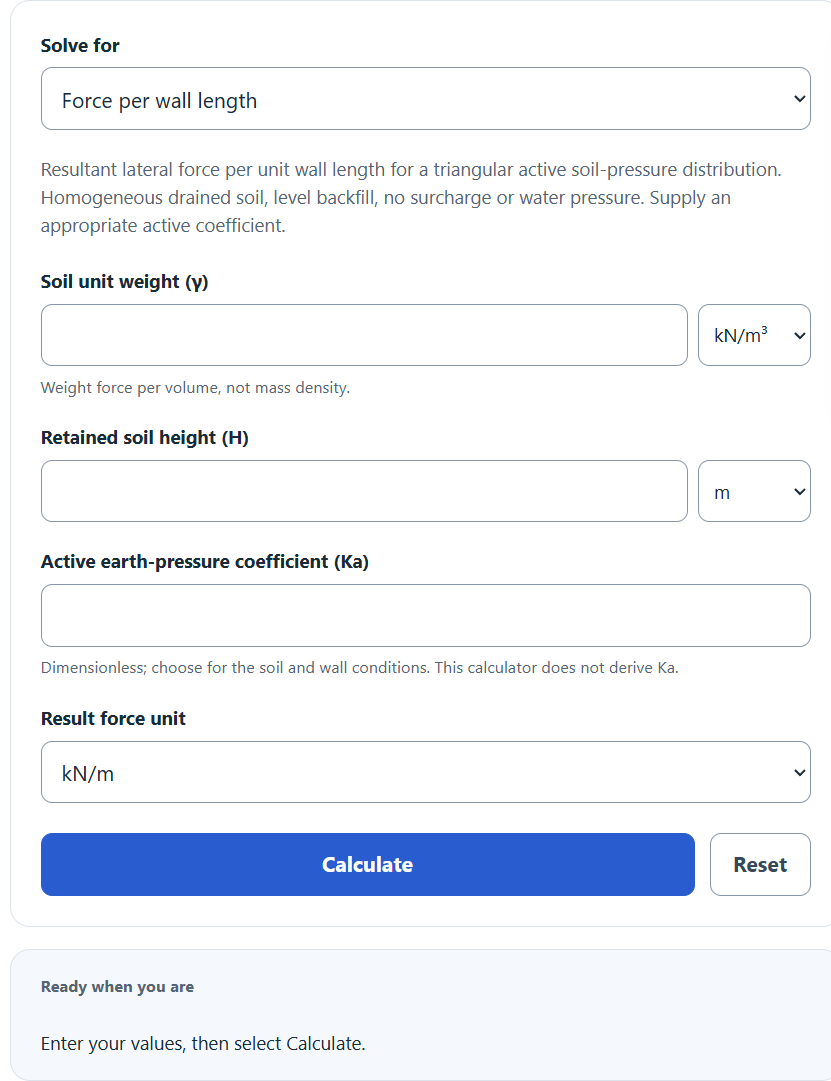
Calculate the active soil-force resultant per unit wall length from soil unit weight, height and Ka, or solve for another variable. This triangular-load model assumes homogeneous drained soil and level backfill, excluding water, surcharge, cohesion and seismic loads. It is not a complete wall design.
- Earth Pressure Coefficient Calculator
- Active Soil Pressure Calculator
- Passive Pressure Coefficient Calculator
- Angle of Internal Friction Calculator
- Saturated Unit Weight of Soil Calculator
- Overburden Pressure Calculator
- All Construction Calculators
Active Earth Pressure Formula
The calculator uses the active earth pressure resultant equation and rearranges it to solve for the missing value when you choose the unknown in Solve for and enter the other three values.
- Pa = resultant lateral force per unit wall length, in N/m internally
- gamma = unit weight of soil, converted to N/m³ for the calculation
- H = height of wall, converted to meters for the calculation
- Ka = coefficient of active earth pressure, unitless
If active earth pressure is missing, the calculator multiplies one-half by the soil unit weight, the square of the wall height, and Ka. If unit weight, wall height, or Ka is missing, it rearranges the same equation to isolate that variable. The calculator also converts the selected input units to base units before solving, then converts the result back to the selected result unit.
Typical Values and Unit Conversions for Active Earth Pressure
Common active earth pressure coefficients can be estimated from the Rankine relationship for level backfill and cohesionless soil. Actual design values depend on wall movement, backfill slope, drainage, surcharge, and soil testing.
| Soil friction angle, φ | Approx. Ka | General interpretation |
|---|---|---|
| 25° | 0.41 | Loose sand or lower-strength granular fill |
| 30° | 0.33 | Typical granular backfill estimate |
| 35° | 0.27 | Dense sand or well-compacted granular fill |
| 40° | 0.22 | Very dense granular material |
| Quantity | Supported units | Base conversion used |
|---|---|---|
| Resultant force per wall length | N/m, kN/m, lbf/ft | 1 kN/m = 1,000 N/m; 1 lbf/ft ≈ 14.5939 N/m |
| Unit weight of soil | N/m³, kN/m³, lbf/ft³ | 1 lbf/ft³ ≈ 157.0875 N/m³; 1 kN/m³ = 1,000 N/m³ |
| Wall height | m, cm, ft, in | 1 cm = 0.01 m; 1 ft = 0.3048 m; 1 in = 0.0254 m |
Example Active Earth Pressure Calculations
Example 1: Calculate active earth pressure
Suppose the soil unit weight is 18,000 N/m³, the wall height is 4 m, and Ka is 0.33.
The calculator result is 47,520 N/m, or 47.52 kN/m if kN/m is selected.
Example 2: Calculate Ka
Suppose resultant force per wall length is 50,000 N/m, soil unit weight is 19,000 N/m³, and wall height is 4 m.
The coefficient of active earth pressure is approximately 0.329.
Active Earth Pressure Calculator FAQ
What is Ka in active earth pressure?
Ka is the coefficient of active earth pressure. It represents how much of the vertical soil pressure is converted into lateral pressure when a retaining wall moves enough for the soil to reach the active condition. For cohesionless soil with level backfill, Ka is often estimated from the soil friction angle, but project-specific design should use appropriate geotechnical data.
Why does wall height have such a large effect on the result?
The formula uses H², so resultant force per wall length increases with the square of the wall height. If the wall height doubles, the calculated value becomes four times larger, assuming the same soil unit weight and Ka.
What units should you enter?
You can enter the values in any supported units shown in the dropdowns. The calculator converts resultant force per wall length to N/m, unit weight to N/m³, and height to meters before solving. Ka has no units, so you should enter it as a decimal such as 0.33, not 33 percent.