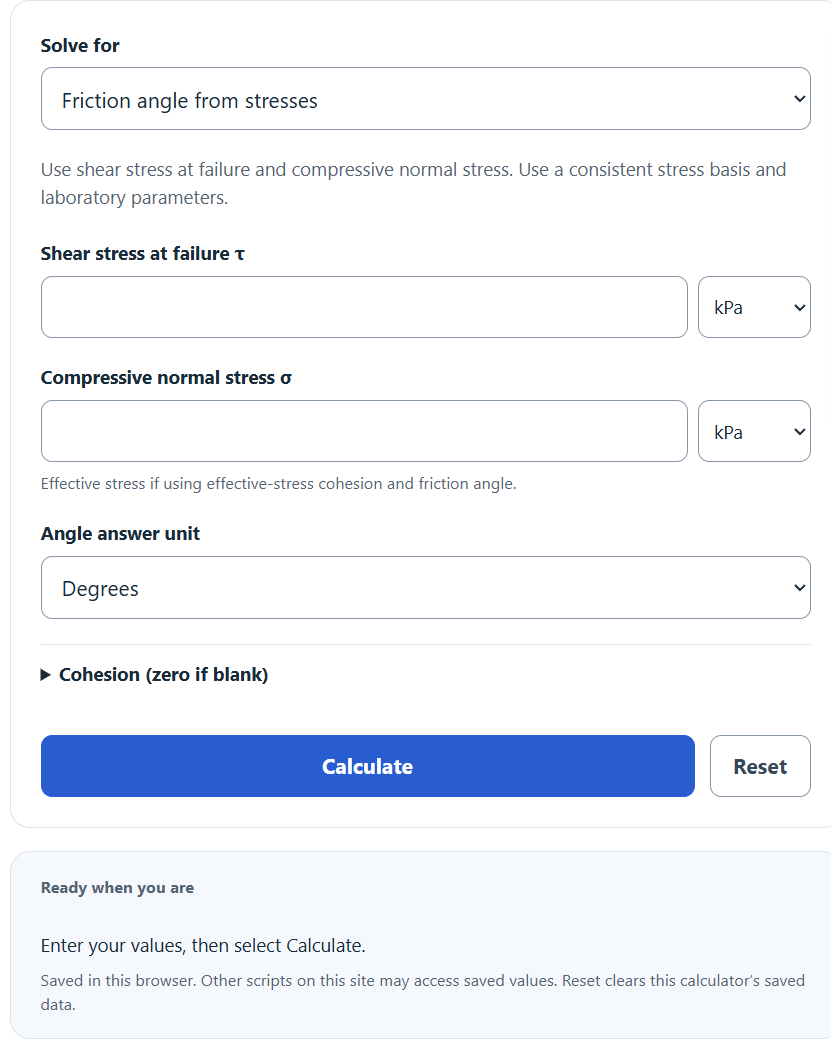
Calculate the angle of internal friction, shear stress, normal stress, cohesion, or friction coefficient from Mohr-Coulomb equations for soils.
Related Calculators
- Void Ratio Calculator
- Bulk Density Calculator
- Percent Slope Calculator
- Soil Infiltration Rate Calculator
- All Construction Calculators
Angle of Internal Friction Formula
For cohesionless material, the following failure-envelope equation relates shear strength, compressive normal stress and friction angle. Select the quantity to solve for; optional cohesion is zero when blank.
Variables:
- τ is the shear stress at failure
- σ is the compressive normal stress, on the same total-stress or effective-stress basis as the supplied parameters
- φ is the angle of internal friction (degrees or radians as selected)
For zero cohesion and positive normal stress, φ = atan(τ/σ). With known cohesion c, use τ = c + σ tan(φ), so φ = atan((τ − c)/σ). The coefficient mode uses μ = tan(φ). Use measured parameters with a consistent stress basis; soil names alone do not determine them.
What is the Angle of Internal Friction?
The angle of internal friction, also known as the friction angle, is a measure of the shear strength of soils and other granular materials. Its tangent is the slope of the linear Mohr–Coulomb failure envelope; it is not the physical inclination of a failure plane. This angle is crucial in geotechnical engineering for designing foundations, slopes, and retaining structures. The angle of internal friction is determined through laboratory tests such as the direct shear test or triaxial test and is influenced by factors such as soil type, density, and moisture content.
How to Calculate the Angle of Internal Friction?
The following steps apply to the cohesionless case. For cohesive material, expand Cohesion and enter its known value. A single stress point cannot determine both cohesion and friction angle.
- First, determine the shear stress (τ).
- Next, determine the normal stress (σ).
- Next, calculate the tangent of the angle of internal friction using the formula tan(φ) = τ / σ.
- Finally, calculate the angle of internal friction (φ) by taking the arctangent of the result and converting it to degrees.
- After inserting the values and calculating the result, check your answer with the calculator above.
Example Problem :
Use the following variables as an example problem to test your knowledge.
Shear Stress (τ) = 50 kPa
Normal Stress (σ) = 100 kPa. With cohesion zero, φ = atan(50/100) ≈ 26.5651°.