Calculate bulk density, material mass, or total occupied volume for soil, powders, grains, and other bulk materials in metric and imperial units.
- All Construction Calculators
- All Density Calculators
- Bulk Specific Gravity (Gsb) Calculator
- Specific Gravity to Density Calculator
- Moisture Content Calculator
- Porosity Calculator
- Saturated Unit Weight of Soil Calculator
Bulk Density Formula
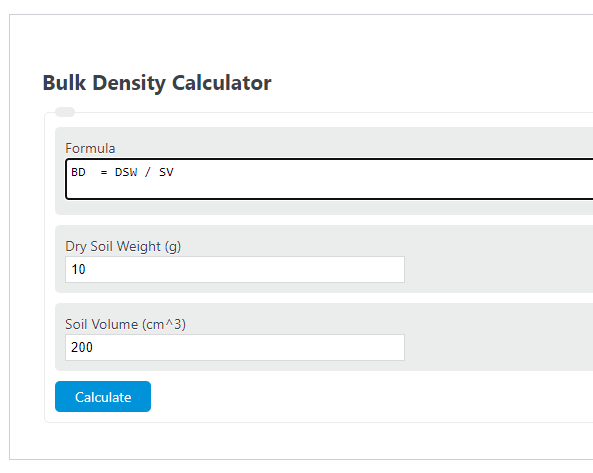
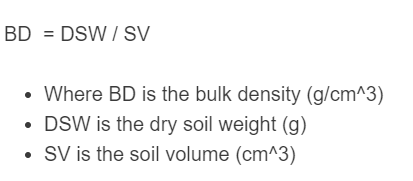
The following formula is used to calculate bulk density:
- Where BD is the bulk density (g/cm³ or kg/m³)
- M_d is the oven-dry mass of the material (g or kg)
- V_t is the total volume occupied, including all pore space (cm³ or m³)
The total volume includes the solid particles themselves plus all air gaps and voids between them. This distinguishes bulk density from particle density, which measures only the solid material without any pore space.
What Is Bulk Density?
Bulk density is the mass of a material per unit of total volume, where total volume includes the volume of solid particles, the volume of pores between particles, and any internal pore volume within the particles themselves. In soil science, it specifically refers to the mass of oven-dried soil divided by the volume that soil occupies in its natural, undisturbed state. The standard drying temperature is 105 degrees C (221 degrees F) for 24 hours.
Bulk density applies far beyond soil. In pharmaceutical manufacturing, it determines how much powder fits into a capsule or tablet die. In food processing, it governs packaging volumes for granular products like flour, sugar, and coffee. In mining and aggregate industries, it is critical for estimating tonnage from volumetric measurements. The same formula applies across all of these fields.
Bulk Density by Soil Texture
Soil texture is the single strongest predictor of bulk density in undisturbed, non-compacted soil. The table below shows typical ranges for each USDA texture class, along with the threshold where root penetration becomes restricted. Values are based on USDA NRCS soil quality indicator data.
| Soil Texture | Ideal BD (g/cm³) | Root-Restricting BD (g/cm³) |
|---|---|---|
| Sand, loamy sand | 1.55 – 1.80 | ≥ 1.80 |
| Sandy loam, loam | 1.40 – 1.60 | ≥ 1.75 |
| Sandy clay loam | 1.40 – 1.50 | ≥ 1.70 |
| Silt loam | 1.30 – 1.50 | ≥ 1.65 |
| Clay loam | 1.30 – 1.40 | ≥ 1.55 |
| Silty clay loam | 1.20 – 1.40 | ≥ 1.55 |
| Sandy clay, silty clay, clay (35-45% clay) | 1.10 – 1.30 | ≥ 1.47 |
| Clay (>45% clay) | 1.00 – 1.20 | ≥ 1.39 |
| Peat, muck (organic soils) | 0.02 – 0.50 | N/A |
Sandy soils pack more tightly because their large, uniform particles leave fewer air gaps. Clay soils, despite having smaller particles, maintain lower bulk density because clay platelets form aggregates with substantial internal pore space. Organic soils (peat) have the lowest bulk density of any natural soil because organic matter is inherently less dense than mineral particles (roughly 1.1 to 1.4 g/cm³ for humus vs. 2.65 g/cm³ for quartz).
Bulk Density by Land Use
Land use changes bulk density independently of texture. Data from the European Soil Data Centre (ESDAC), covering over 20,000 sampling sites across Europe, shows clear patterns. Arable cropland averages 1.26 g/cm³, permanent crop land averages 1.23 g/cm³, pastures average 1.08 g/cm³, shrubland averages 1.01 g/cm³, and woodland averages 0.84 g/cm³. Croplands carry nearly 1.5x the bulk density of forest soils due to repeated tillage and machinery traffic compressing the upper soil layers while simultaneously reducing organic matter inputs.
Bulk Density and Porosity
Bulk density and porosity are inversely linked through a simple equation:
Where BD is bulk density and PD is particle density. For most mineral soils, particle density is assumed to be 2.65 g/cm³ (the density of quartz, which dominates most soil mineral fractions). A bulk density of 1.33 g/cm³ therefore corresponds to 50% porosity, which is considered ideal for plant growth because it provides roughly equal volumes of solid material and pore space. That pore space is further divided into macropores (which drain freely and supply air) and micropores (which hold water against gravity).
When bulk density rises above the root-restricting thresholds in the table above, macropores collapse first. This eliminates aeration channels before water-holding micropores are affected, which is why compacted soils often become waterlogged even when total porosity has not dropped dramatically.
Factors That Change Bulk Density
Organic matter content. Every 1% increase in soil organic matter reduces bulk density by approximately 0.05 to 0.10 g/cm³. Organic particles are less than half the density of mineral particles, and they promote aggregate formation, which creates additional pore space between clusters of particles.
Compaction from traffic. A single pass of a loaded farm truck (axle load around 5 tonnes) on wet soil can increase topsoil bulk density by 0.1 to 0.2 g/cm³. Subsoil compaction below 30 cm depth is largely irreversible on human timescales because natural freeze-thaw and root activity rarely reach that deep.
Depth. Bulk density naturally increases with depth. Topsoil (0 to 15 cm) typically reads 0.1 to 0.3 g/cm³ lower than subsoil (30 to 60 cm) in the same profile. The weight of overlying material compresses lower layers, and biological activity (roots, earthworms, microbial channels) is concentrated near the surface.
Tillage and management. Freshly tilled soil can temporarily drop to bulk densities of 0.9 to 1.1 g/cm³, but this is unstable. Within one growing season, natural settling and rain impact typically restore bulk density to 85 to 95% of pre-tillage values. No-till systems with cover crops achieve the most sustainable reductions in bulk density by building organic matter without mechanically disrupting soil structure.
Measurement Methods
The core method is the standard for field measurement. A metal ring or cylinder of known volume (commonly 5 cm diameter by 5 cm height, giving 98.17 cm³) is driven into the soil. The intact core is removed, dried at 105 degrees C for 24 hours, and weighed. The dry mass divided by the ring volume gives bulk density directly.
The clod method works for rocky or gravelly soils where a ring cannot be driven cleanly. A natural soil clod is coated in paraffin wax, weighed in air, then weighed submerged in water. The volume is determined by displacement (Archimedes’ principle), and the wax volume is subtracted based on its known density of roughly 0.9 g/cm³.
For large-scale surveys, gamma-ray attenuation probes (like the Troxler nuclear density gauge) measure bulk density in situ without excavation. A radioactive source emits gamma rays into the soil, and a detector measures how many pass through. Denser soil absorbs more radiation. These instruments require licensing and calibration but can produce readings in under 60 seconds per location.
Bulk Density Beyond Soil
In pharmaceutical manufacturing, bulk density determines capsule fill weights and compression ratios for tablet presses. Most pharmaceutical powders fall in the range of 0.1 to 0.7 g/mL. The ratio of bulk density to tapped density (after controlled vibration) is called the Hausner ratio, and values above 1.25 indicate poor powder flow that will cause manufacturing problems.
In aggregate and mining, bulk density converts between volumetric measurements (truck loads, stockpile surveys) and mass for sales and transport logistics. Crushed limestone typically runs 1.52 g/cm³ loose bulk density, while iron ore concentrate ranges from 2.4 to 3.4 g/cm³ depending on grade and moisture.
In food processing, bulk density governs packaging dimensions. Wheat flour has a bulk density of roughly 0.59 g/cm³, granulated sugar sits at about 0.85 g/cm³, and whole coffee beans range from 0.35 to 0.45 g/cm³. These values shift significantly with particle size and moisture content, so packaging engineers must test under production conditions rather than relying on reference tables alone.
Bulk Density vs. Specific Gravity vs. Particle Density
These three terms are frequently confused. Bulk density measures total mass over total volume (solids plus voids). Particle density measures only the mass and volume of the solid particles with no air gaps, and for most mineral soils it falls between 2.60 and 2.75 g/cm³. Specific gravity is the dimensionless ratio of a substance’s density to water’s density (1.00 g/cm³ at 4 degrees C). A soil with a particle density of 2.65 g/cm³ has a specific gravity of 2.65. Bulk density is always lower than particle density for any porous material because the voids reduce the effective mass per unit volume.
Why Bulk Density Increases With Depth
Three mechanisms drive the increase. First, the overburden pressure from overlying soil layers physically compresses deeper horizons. Second, organic matter concentrations drop sharply below the root zone, removing the low-density material that keeps surface soils light. Third, biological activity (root growth, earthworm burrowing, fungal hyphae networks) is most intense in the top 15 to 30 cm, creating macropores that do not exist in deeper, less biologically active layers. In some profiles, bulk density can increase from 1.1 g/cm³ at the surface to 1.6 g/cm³ at 1 meter depth.