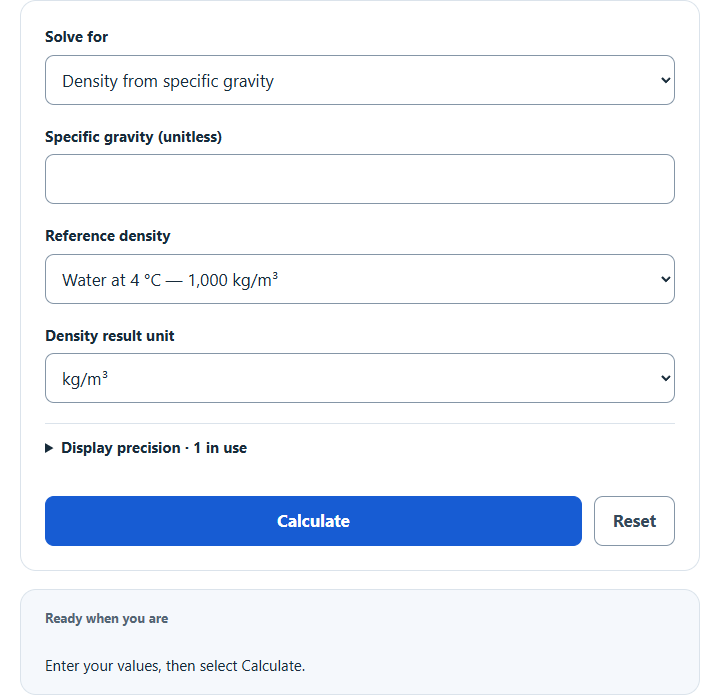
Convert specific gravity to density in kg/m³, g/cm³ or lb/ft³ using water as the reference, or convert a density back to specific gravity.
- All Physics Calculators
- Thermodynamics and Fluid Unit Converters
- All Density Calculators
- Specific Gravity Calculator
- Specific Volume Calculator
- API Gravity Calculator
Calculator Functions
| Function | What it does | What it requires |
|---|---|---|
| Density from specific gravity | Converts a specific gravity to a density in kg/m³, g/cm³, kg/L, lb/ft³ or lb/US gallon | Requires the specific gravity, the reference density and the result unit |
| Specific gravity from density | Converts a density to a specific gravity | Requires the substance density and the reference density |
The reference density starts as water at 4 °C, 1,000 kg/m³. The other presets are water at 20 °C (998.2 kg/m³), water at 25 °C (997.05 kg/m³), water at 60 °F (999 kg/m³) and air at 15 °C and sea level (1.225 kg/m³) for gases, and a custom reference density can be entered. Every result lists the density in kg/m³, g/cm³, lb/ft³ and lb/US gallon with the reference used. An optional setting changes the decimal places.
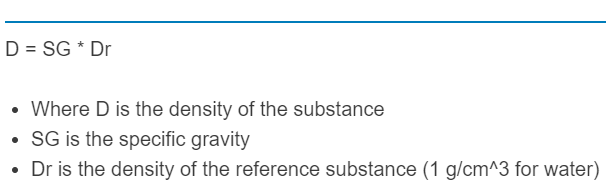
Specific Gravity to Density Formulas
| ρ | Density of the substance (kg/m³) |
| SG | Specific gravity, a ratio with no unit |
| ρref | Density of the reference substance (kg/m³), usually water at 4 °C |
Specific gravity, also called relative density, is the ratio of the density of a substance to the density of a reference substance, which for liquids is typically water at its maximum density at 4 °C [1].
Density from specific gravity
The specific gravity is multiplied by the reference density. With water at 4 °C, a specific gravity of 0.85 is 0.85 × 1,000 = 850 kg/m³, which is 0.85 g/cm³, 53.064 lb/ft³ and 7.094 lb/US gallon. A specific gravity of 7.85 is 7.85 g/cm³. The reference matters in the third digit: the same 0.85 is 848.47 kg/m³ against water at 20 °C and 849.15 kg/m³ against water at 60 °F. For a gas measured against air, a specific gravity of 0.6 is 0.6 × 1.225 = 0.735 kg/m³.
Specific gravity from density
The density is converted to kg/m³ and divided by the reference density. A liquid at 850 kg/m³ has a specific gravity of 850 ÷ 1,000 = 0.85, a density of 0.96 g/cm³ gives 0.96, and 62.428 lb/ft³ gives 1.
How to Convert Specific Gravity to Density
Multiply the specific gravity by the density of water in the unit wanted: 1 for g/cm³, 1,000 for kg/m³, 62.43 for lb/ft³ or 8.345 for lb/US gallon. A specific gravity of 1.2 is 1.2 g/cm³, 1,200 kg/m³, 74.91 lb/ft³ or 10.014 lb/US gallon. In g/cm³ the density has the same number as the specific gravity, because water at 4 °C is 1 g/cm³ [1].
| Specific gravity | g/cm³ | kg/m³ | lb/ft³ | lb/US gal |
|---|---|---|---|---|
| 0.6 | 0.6 | 600 | 37.46 | 5.007 |
| 0.7 | 0.7 | 700 | 43.70 | 5.842 |
| 0.8 | 0.8 | 800 | 49.94 | 6.676 |
| 0.85 | 0.85 | 850 | 53.06 | 7.094 |
| 0.9 | 0.9 | 900 | 56.19 | 7.511 |
| 1 | 1 | 1,000 | 62.43 | 8.345 |
| 1.03 | 1.03 | 1,030 | 64.30 | 8.596 |
| 1.1 | 1.1 | 1,100 | 68.67 | 9.180 |
| 1.2 | 1.2 | 1,200 | 74.91 | 10.014 |
| 1.5 | 1.5 | 1,500 | 93.64 | 12.518 |
| 2 | 2 | 2,000 | 124.86 | 16.691 |
| 2.7 | 2.7 | 2,700 | 168.56 | 22.533 |
| 7.85 | 7.85 | 7,850 | 490.06 | 65.511 |
| 13.6 | 13.6 | 13,600 | 849.02 | 113.498 |
The table uses water at 4 °C, rounded to 1,000 kg/m³, as the reference.
Limits of This Estimate
- A specific gravity only converts correctly with the reference it was measured against. Water is slightly less dense when warmer, about 999.1 kg/m³ at 60 °F and 998.0 kg/m³ at 70 °F [1], so the preset should match the basis stated with the specific gravity.
- The calculator does not correct the substance itself for temperature or pressure. The density applies at the conditions where the specific gravity was measured.
- The water presets are rounded values, and the air preset is the standard sea-level figure at 15 °C and 101.325 kPa. A gas specific gravity must be on the same pressure and temperature basis. These estimates are based on the best available data and estimations.
Sources
- U.S. Geological Survey, Water Science School, Water Density: specific gravity as a ratio to a reference density, water at 4 °C as the usual reference, and the density of water by temperature