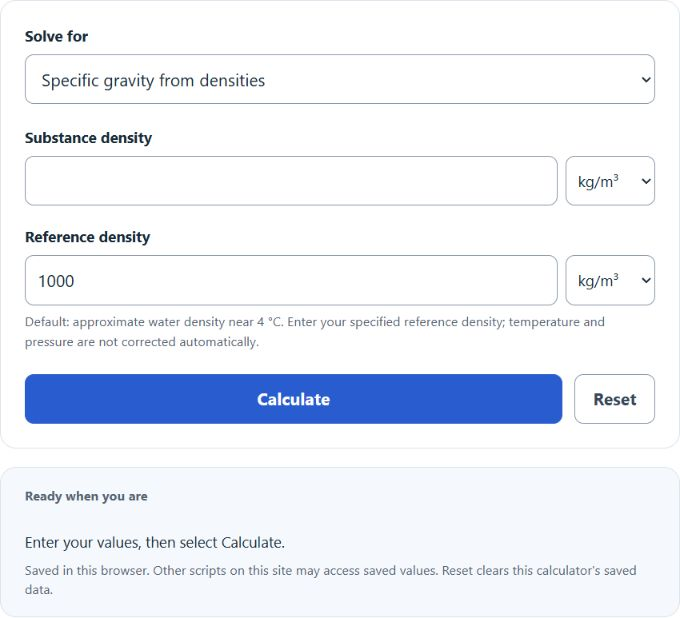
Specific Gravity Calculator finds relative density, material density, or sample specific gravity from density, mass, volume, and selectable metric or US units.
- All Chemistry Calculators
- Specific Volume Calculator
- Specific Heat Calculator
- API Gravity Calculator
Specific Gravity Formula
Specific gravity compares a material density with a stated reference density, usually water near 4 °C. Specify the temperature and pressure basis of both densities; the two reference temperatures need not be identical. Because it is a ratio, specific gravity is unitless. This makes it useful for comparing liquids, solids, slurries, and powders without converting the result into a separate unit system.
- SG = specific gravity
- ρs = density of the substance
- ρw = density of water used as the reference
The calculator offers specific gravity from two densities, substance density from specific gravity and a reference density, or specific gravity from sample mass and volume. The reference-density rearrangement below is an algebraic identity, not a separate solve mode.
How to Use the Specific Gravity Calculator
- Select the quantity and input method under Solve for.
- Enter the displayed required quantities and select their units.
- Confirm the reference density and its unit. The default 1000 kg/m³ is a rounded approximation for water near 4 °C.
- Select Calculate. The density mode leads with substance density; the other modes lead with unitless specific gravity.
- Open Calculation details for substitutions and density conversions.
- After editing an input, select Calculate again. Reset clears this calculator’s saved values.
The calculator converts the selected density units before forming their ratio. Use the material and reference densities for the specified conditions; it does not infer fluid identity or correct temperature and pressure automatically.
Why Water Density Matters
Specific gravity is only meaningful when the water reference is clear. Water density changes slightly with temperature, so the calculated ratio also changes slightly. In many engineering and laboratory contexts, water at 4 °C is used as the standard reference because water is near its maximum density at that temperature.
If your process data uses a different temperature, enter the water density that matches that temperature rather than assuming a default value. This is especially important in quality control, chemical batching, fluid handling, and materials testing.
| Water Temperature | Approximate Water Density |
|---|---|
| 0 °C | 999.84 kg/m³ |
| 4 °C | 999.97 kg/m³ |
| 20 °C | 998.21 kg/m³ |
| 25 °C | 997.05 kg/m³ |
How to Interpret Specific Gravity
Specific gravity gives a fast way to judge whether a material is lighter or heavier than water.
- Less than one: the material is less dense than water and will generally float in freshwater.
- About one: the material has a density close to water and may show near-neutral buoyancy.
- Greater than one: the material is denser than water and will generally sink in freshwater.
This interpretation is most direct for the material itself. The behavior of a real object can still depend on shape, trapped air, internal voids, or whether the object displaces enough water to float.
Density Formula Used Before Finding Specific Gravity
If you do not already know the density of a substance, you can determine it from mass and volume first, then use that result in the specific gravity calculation.
For irregular solids, volume is often measured by fluid displacement.
- m = mass of the sample
- V = volume of the sample
- Vi = initial liquid volume
- Vf = final liquid volume after immersion
Example Applications
Specific gravity is used in many technical and practical settings because it communicates density in a quick, comparable form.
- Chemistry: checking concentration trends, identifying liquids, and comparing solutions.
- Petroleum and fuels: estimating product character and storage behavior.
- Minerals and geology: helping distinguish materials with similar appearance but different density.
- Manufacturing: verifying batches, fillers, coatings, and molded parts.
- Marine and process work: understanding buoyancy, separation, and fluid stratification.
- Food and beverage: monitoring syrups, brines, and fermentation conditions.
Approximate Specific Gravity of Common Materials
| Material | Approximate Specific Gravity | Typical Behavior in Water |
|---|---|---|
| Ice | 0.92 | Floats |
| Gasoline | 0.68–0.75 | Floats |
| Vegetable oil | 0.91–0.93 | Floats |
| Seawater | 1.02–1.03 | Slightly denser than freshwater |
| Aluminum | 2.70 | Sinks |
| Steel | 7.8 | Sinks |
| Mercury | 13.6 | Very dense liquid |
These values are approximate and can vary with temperature, alloy composition, purity, and manufacturing method.
Common Mistakes
- Mislabeling units: selecting a unit that does not match the entered quantity. Different selected units are converted automatically.
- Ignoring temperature: using a water density value that does not match the test condition.
- Confusing density with specific gravity: density has units, specific gravity does not.
- Using the wrong type of density: bulk density, particle density, and true density can lead to very different results.
- Applying freshwater assumptions to seawater problems: buoyancy changes when the surrounding fluid changes.
Practical Measurement Methods
Specific gravity can be calculated from density data or measured indirectly with instruments designed for liquids and slurries.
- Hydrometer: common for quick liquid checks.
- Pycnometer: useful for precise laboratory density measurements.
- Digital density meter: common when repeatability and speed matter.
- Mass-and-volume method: useful for solids and machined samples.
- Displacement method: helpful for irregular objects that are difficult to measure directly.
Specific Gravity vs. Density
| Property | Density | Specific Gravity |
|---|---|---|
| Meaning | Mass per unit volume | Density relative to water |
| Units | Has units | Unitless |
| Typical Use | Absolute material property | Quick comparison to water |
| Temperature Sensitivity | Directly affected | Affected through both densities |
Frequently Asked Questions
Does specific gravity have units?
No. It is a ratio, so the units cancel as long as both densities are expressed in the same unit.
Can specific gravity be used for gases?
Yes, but the reference substance and the pressure-temperature basis must be stated clearly because gas density changes significantly with conditions.
Is a higher specific gravity always better?
No. A higher value only means the material is denser relative to water. Whether that is desirable depends on the application.
Why can two samples of the same material show slightly different values?
Temperature, trapped air, moisture content, porosity, impurities, and measurement method can all change the result.