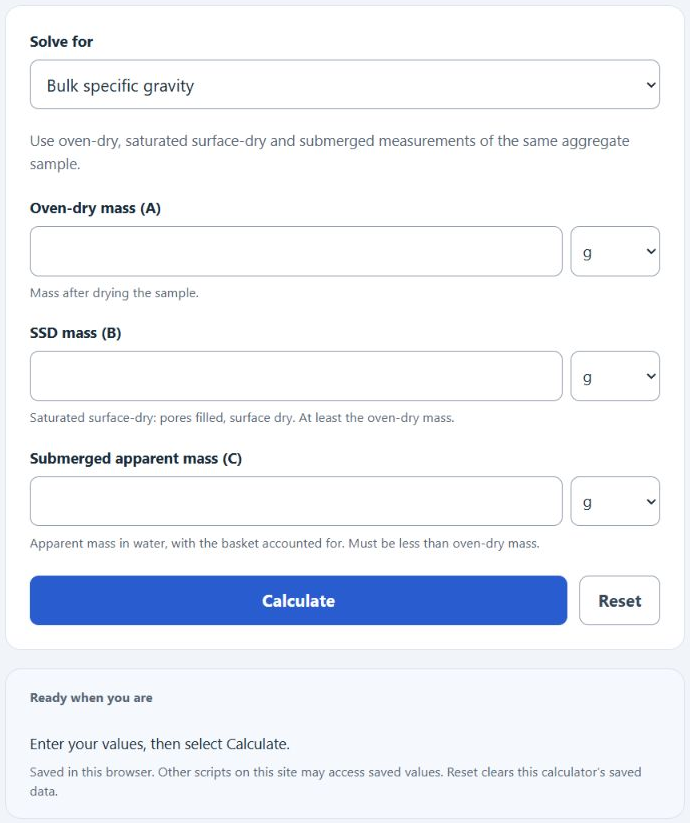
Select the value to solve, enter the other three measurements, and select Calculate. This calculator uses the oven-dry bulk specific gravity equation for compatible aggregate measurements; SSD mass must be at least oven-dry mass.
Bulk Specific Gravity (GSB) Formula
The calculator uses the bulk specific gravity relationship between oven dry weight, saturated surface dry weight, and weight in water.
- Gsb = bulk specific gravity, unitless
- A = oven dry weight
- B = saturated surface dry weight, often written as SSD weight
- C = weight in water, also called submerged weight
When you select another solve mode, the calculator rearranges the same equation:
- Calculate Gsb: enter oven dry weight, SSD weight, and weight in water.
- Calculate oven dry weight: enter Gsb, SSD weight, and weight in water.
- Calculate SSD weight: enter oven dry weight, Gsb, and weight in water.
- Calculate weight in water: enter oven dry weight, SSD weight, and Gsb.
Weights can be entered in grams, kilograms, or pounds. The weights must be in compatible mass units, but bulk specific gravity itself has no unit.
Common Aggregate Specific Gravity Terms
| Term | Meaning | How it relates to the calculator |
|---|---|---|
| Oven dry weight | Mass after drying the sample to remove moisture | Used as the numerator in the Gsb formula |
| SSD weight | Saturated surface dry mass, with pores filled but surface dry | Used with weight in water to find displaced water volume |
| Weight in water | Apparent mass of the sample while submerged | Subtracted from SSD weight in the denominator |
| Bulk specific gravity | Ratio comparing aggregate mass to the mass of an equal volume of water | Final unitless result |
Choosing an Aggregate Test Method
| Material type | Measurement guidance | General note |
|---|---|---|
| Lightweight aggregate | Use the applicable lightweight-aggregate method | The cited coarse-aggregate T 85 procedure excludes lightweight aggregates |
| Sand and gravel | Choose the method for the particle size | Fine aggregate uses a different measurement procedure |
| Crushed stone | Use measured values for the tested sample | Specific gravity alone does not establish material suitability |
Example
Example 1: Calculate bulk specific gravity
You have:
- Oven dry weight = 1,250 g
- SSD weight = 1,300 g
- Weight in water = 780 g
The bulk specific gravity is 2.4038.
Example 2: Calculate oven dry weight
You have:
- Bulk specific gravity = 2.5
- SSD weight = 900 g
- Weight in water = 560 g
The oven dry weight is 850 g, less than the 900 g SSD mass.
FAQ
Is bulk specific gravity the same as apparent specific gravity?
No. Bulk specific gravity includes the volume of permeable pores in the aggregate particle. Apparent specific gravity excludes those permeable pores. Because of that, apparent specific gravity is usually higher than bulk specific gravity for the same material.
Why does the formula use SSD weight minus weight in water?
The difference between SSD weight and weight in water represents the buoyant effect from the water displaced by the sample. That difference is used as the volume-related part of the equation. Dividing oven dry weight by this value gives bulk specific gravity.
Can I mix grams, kilograms, and pounds?
Yes, as long as each weight value has the correct unit selected. The calculator converts the weights before applying the formula. Bulk specific gravity remains unitless, so it does not need a unit selection. Mass answers have a result-unit choice. Floating samples and negative submerged readings are outside this calculator’s scope. Follow the applicable laboratory method; this calculator does not certify testing compliance. See the WSDOT coarse-aggregate T 85 procedure for definitions and the equation.