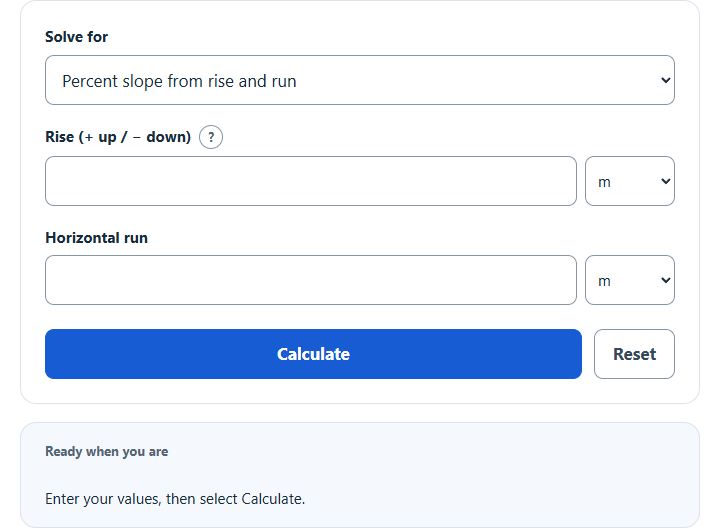
Calculate percent slope from rise and run, convert degrees to percent slope or percent to degrees, or find the rise or run for a target grade.
- All Construction Calculators
- All Slope Calculators
- Slope Calculator
- Perpendicular Line Calculator
- Ramp Slope Calculator
- Degree to Percent Slope Calculator
Percent Slope Formula
Percent slope expresses vertical change divided by horizontal distance, as a percentage. The calculator solves for percent slope, rise or run, then derives the angle and surface length. It also converts between degrees and percent slope.
- rise: vertical change between the two points. Use a negative value for downhill.
- run: horizontal distance between the two points, measured level, not along the slope.
- angle: slope angle in degrees from horizontal.
- surface length: distance measured along the sloped surface itself.
Percent slope mode takes rise and horizontal run, converts compatible length units, then applies rise divided by run times 100. The angle formula above uses arctangent in radians.
Slope conversions (reference): for an angle in degrees, percent slope = tan(angle × pi / 180) × 100. A positive gradient of 1 in N gives 100 ÷ N percent. Roof pitch X:12 and pipe fall X inches per foot give X ÷ 12 × 100 percent. The Degrees to percent slope and Percent slope to degrees modes apply the angle relationship directly.
Rise mode uses a target percent slope and horizontal run: rise = (% ÷ 100) × run. Horizontal run mode uses percent slope and rise: run = rise ÷ (% ÷ 100). Surface length is derived from the resulting rise and run; it is not an input.
Common Slope Values and Limits
The first table gives rounded slope conversions. The application examples below have different U.S. code and design scopes; they are not universal limits or approval of a design. Confirm adopted requirements, including cross slope, drainage and other criteria.
| Percent | Degrees | Gradient | Roof pitch |
|---|---|---|---|
| 1% | 0.57° | 1 in 100 | 0.12:12 |
| 2% | 1.15° | 1 in 50 | 0.24:12 |
| 5% | 2.86° | 1 in 20 | 0.6:12 |
| ≈8.33% | 4.76° | 1 in 12 | 1:12 |
| 10% | 5.71° | 1 in 10 | 1.2:12 |
| 25% | 14.04° | 1 in 4 | 3:12 |
| 50% | 26.57° | 1 in 2 | 6:12 |
| 100% | 45° | 1 in 1 | 12:12 |
| Application | Context and slope |
|---|---|
| 4-in horizontal building drain (2021 IPC) | Minimum 1/8 in/ft (≈1.04%); upstream of a grease interceptor, 1/4 in/ft (≈2.08%) |
| Driveway, paved | Project-specific: local access rules, use, transitions, vehicle clearance and drainage |
| Ground away from foundation (2024 IRC example) | 6 in fall within 10 ft (5%); constrained sites may need drains/swales; impervious surfaces have separate 2% provision |
| ADA ramp running slope | 1:12 maximum (≈8.33%); specific existing-site exceptions apply |
| ADA accessible walking-surface running slope | 1:20 maximum (5%); cross slope is a separate requirement |
| Low-slope roof (OSHA fall-protection definition) | 4:12 or less (about 33.33%); roofing material minimums differ |
| Steep roof (OSHA fall-protection definition) | Greater than 4:12 (about 33.33%) |
| Rural highway maximum grade | Depends on governing standard, road class, terrain and design speed |
Examples and FAQ
Example 1: Driveway grade. A driveway rises 4 ft over a horizontal run of 50 ft. Percent slope = 4 ÷ 50 × 100 = 8%. The angle is 4.57°. This exceeds the 5% running-slope limit for an accessible walking surface; ramps have separate criteria. Driveway suitability also depends on local rules, grade transitions, vehicle clearance and drainage.
Example 2: Sewer pipe fall. You need 2% slope on a 30 ft pipe run. Required fall = 0.02 × 30 = 0.6 ft, or 7.2 inches. That works out to 0.24 inches per foot.
Is 1:12 the same as 8.33%? Approximately. A 1:12 ratio is exactly 100 ÷ 12 percent, or 8.3333…%. The value 8.33% is rounded; use the specified ratio when checking a 1:12 requirement.
How do I convert percent slope to degrees? Take the arctangent of the percent divided by 100. A 10% slope is arctan(0.10) = 5.71°. The relationship is not linear, so 100% slope is 45°, not 90°.
Can percent slope be over 100%? Yes. Anything steeper than 45° produces a percent above 100. A 200% slope is about 63.4°.
Should I measure along the slope or horizontally? Use horizontal run, not the distance along the slope. Sloped distance alone is insufficient: you also need an angle, rise or other independent measurement to determine the run. This calculator accepts rise and run, or percent slope and one of those distances; surface length is an output.