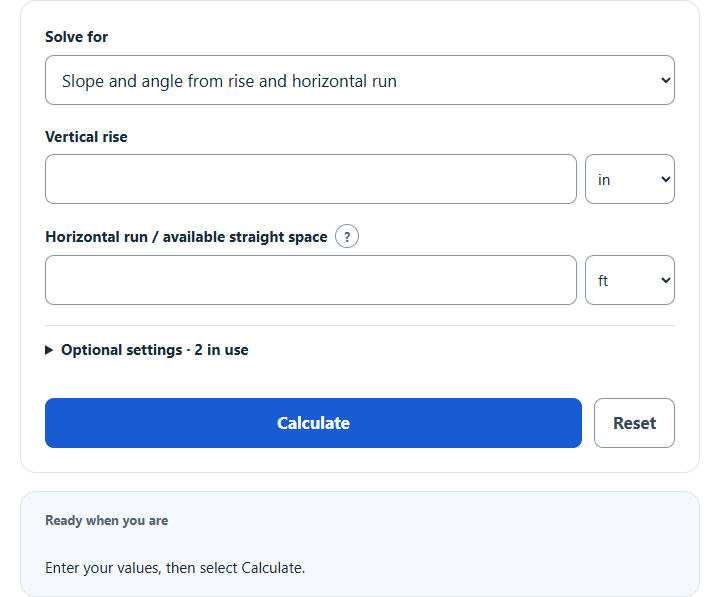
Calculate ramp slope, angle and grade from rise and run, or find the ramp length needed for a 1:12 or other slope, with landing and run estimates.
- All Construction Calculators
- All Slope Calculators
- Slope Calculator
- Percent Slope Calculator
- Slant Height Calculator
- Hill Grade Calculator
Ramp Slope Formula
- Rise: vertical height from the lower landing to the upper landing.
- Run: horizontal distance covered by the ramp (not the surface length).
- Surface length: the length along the sloped ramp surface itself.
- Ratio: written as 1:x, where x is run divided by rise.
Rise and run must be in the same unit before dividing. The calculator converts automatically. If you measured the ramp surface instead of the run, the run is back-calculated as √(Surface² − Rise²), so the surface length must be greater than the rise.
Slope Reference Tables
Common ramp slopes and what each one means in practice:
| Ratio | Slope % | Angle | Typical use |
|---|---|---|---|
| 1:20 | 5% | 2.86° | Walking-surface slope range; other requirements apply |
| 1:16 | 6.25% | 3.58° | Preferred accessible ramp slope |
| 1:12 | 8.33% | 4.76° | ADA maximum for new construction |
| 1:10 | 10% | 5.71° | Space-limited existing sites, up to 6 in rise per run |
| 1:8 | 12.5% | 7.13° | Space-limited existing sites, up to 3 in rise per run |
| 1:6 | 16.7% | 9.46° | Non-ADA geometric preset; safety not assessed |
| 1:4 | 25% | 14.0° | Non-ADA geometric preset; safety not assessed |
Quick lookup for horizontal run at selected slopes (level landings are extra):
| Rise | Horizontal run (1:12) | Horizontal run (1:16) | Horizontal run (1:20) |
|---|---|---|---|
| 6 in | 6 ft | 8 ft | 10 ft |
| 12 in | 12 ft | 16 ft | 20 ft |
| 24 in | 24 ft | 32 ft | 40 ft |
| 30 in | 30 ft | 40 ft | 50 ft |
| 36 in | 36 ft | 48 ft | 60 ft |
Worked Example and FAQ
Example. Your porch sits 22 inches above the walkway. For a 1:12 ramp:
- Run = 22 in × 12 = 264 in = 22 ft
- Surface length = √(264² + 22²) ≈ 264.9 in ≈ 22.08 ft
- Slope = 8.33%, angle ≈ 4.76°
The usual ADA maximum is 30 in of rise per ramp run, so this 22 in example needs no intermediate landing. Suitable level landings are still required at the top and bottom. The usual minimum landing length is 60 in; turns and doorways have additional clearance requirements.
Is rise the same as ramp length? No. Rise is vertical only. Run is horizontal only. Surface length is the diagonal you walk on.
What slope should I use? 1:12 is the usual maximum running slope for new accessible ramps under ADA. Gentler slopes generally improve usability. At 1:20 or flatter, the route is in the walking-surface slope range rather than the ramp range. Steeper existing-site exceptions require space limitations and the applicable per-run rise limit. Check all other requirements and local rules.
How do I convert a percent to a ratio? Divide 100 by the percent. A 5% slope is 100 ÷ 5 = 1:20. A 10% slope is 1:10.