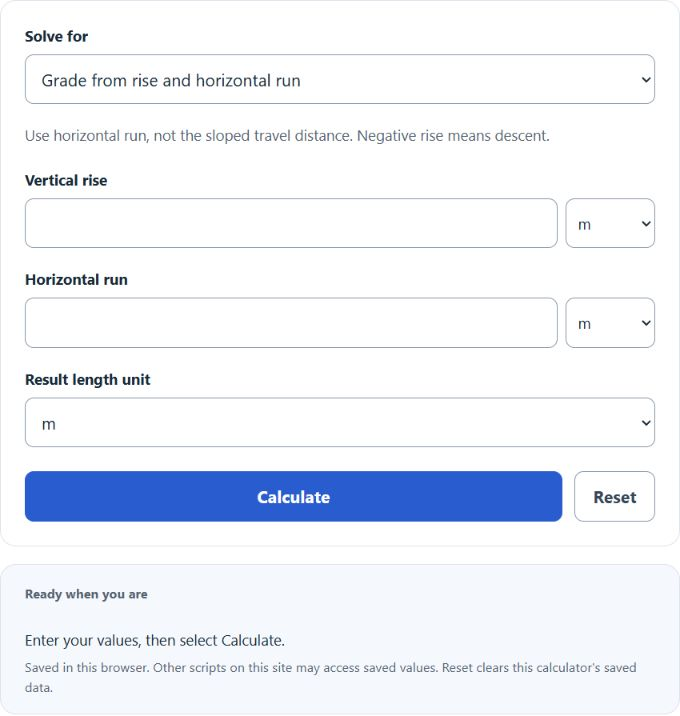
Calculate hill grade as a percent from rise and run, start and end elevations, or an incline angle in degrees, plus the angle, ratio and slope length.
- All Construction Calculators
- Percent Slope Calculator
- Treadmill Elevation Gain Calculator
- Slope Calculator
- Ramp Slope Calculator
- Gradient to Slope Calculator
- Gradient to Degrees Calculator
- Angle to Slope Calculator
- Elevation Percentage Calculator
Hill Grade Formula
The following formula calculates the grade of a supplied segment from vertical change and horizontal run, in matching units.
- Where G is the hill grade %
- EG is the signed vertical elevation change (ft/m/etc.), not cumulative ascent
- HD is the positive horizontal run for the same segment; it is not the sloped travel distance
To calculate hill grade, divide the elevation gain by the horizontal distance, then multiply by 100.
Hill Grade Definition
Hill grade is the signed vertical change divided by horizontal run, expressed as a percentage. Endpoint grade does not describe every slope along a winding or undulating trail.
Hill Grade Example
How to calculate a hill grade?
- First, determine the elevation gain.
Subtract the starting elevation from the ending elevation using the same vertical datum.
- Next, determine the horizontal distance.
Calculate the straight-line horizontal distance from the trailhead to the end of the hike.
- Finally, calculate the hill grade.
Calculate the percentage hill grade using the formula above.
FAQ
Hill grade describes the supplied rise relative to horizontal run. Route difficulty also depends on terrain, distance and conditions.