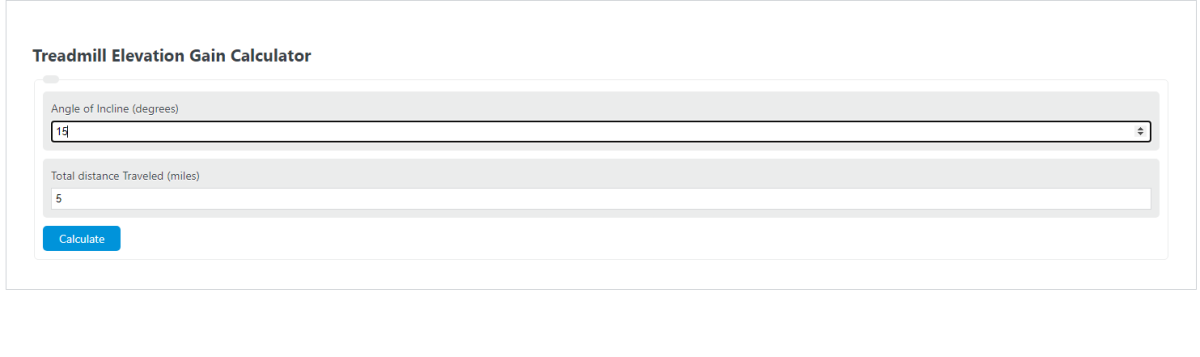
Calculate treadmill elevation gain, distance, or grade with correct grade-versus-angle geometry, plus sum up to three incline workout segments.
Treadmill Elevation Gain Formula
This calculator treats the treadmill display as grade percent, not an angle in degrees. Grade is rise divided by horizontal run, multiplied by 100. The calculator derives the incline angle when it is useful as a secondary result.
The distance-basis selector determines which geometry applies:
Horizontal distance is the level run beneath the sloped belt. Belt distance is the longer path traveled along the belt. The difference is small at low grades but grows as incline increases. The calculator keeps these bases separate in every solve mode.
| Treadmill grade | Derived angle | Horizontal-distance basis | Belt-distance basis |
|---|---|---|---|
| 1% | 0.57° | 52.8 ft | 52.8 ft |
| 5% | 2.86° | 264.0 ft | 263.7 ft |
| 10% | 5.71° | 528.0 ft | 525.4 ft |
| 15% | 8.53° | 792.0 ft | 783.2 ft |
How to Use the Calculator
- Choose whether to solve for elevation gain, distance, grade, or a three-segment workout total.
- Select miles and feet or kilometers and meters.
- Choose whether the entered distance is horizontal/run distance or belt/sloped distance.
- Enter the required distance, elevation target, and treadmill grade percentages shown for the selected mode.
- Select Calculate and read the primary answer, supporting conversions, derived angle, and calculation steps.
Solving the Same Geometry in Reverse
For a known climb target, horizontal distance is rise divided by the grade ratio. Belt distance is slightly longer because it follows the hypotenuse:
When solving for grade, the selected basis still matters:
Examples
Three miles at 8% grade: If 3 miles represents horizontal distance, the equivalent gain is 0.24 mile, or 1,267.2 feet. If 3 miles represents belt distance, the equivalent gain is about 1,263.2 feet.
Distance for 1,000 feet at 10% grade: The horizontal-distance requirement is 10,000 feet, or about 1.894 miles. The belt-distance requirement is about 10,049.9 feet, or 1.903 miles.
Changing incline: In three-segment mode, enter each segment’s distance and grade. The calculator applies the selected distance basis to each segment and adds the three vertical gains.
What the Result Means
- Elevation gain is a vertical-equivalent training measure; the treadmill does not change geographic altitude.
- Grade percent describes rise relative to horizontal run. The displayed incline angle is derived as arctangent of the grade ratio.
- Gain per mile and equivalent floors help compare sessions, while the detailed steps show which distance basis was used.
- Speed changes effort and workout duration but does not change geometric elevation gain for the same distance and grade.
Common Mistakes
- Entering degrees: A console value of 12 usually means 12% grade. Enter 12, not the derived angle of about 6.84 degrees.
- Choosing the wrong distance basis: Use belt/sloped distance when the reported mileage is measured along the belt; use horizontal/run distance only when that is the intended basis.
- Averaging changing grades: For interval workouts, use the segment mode instead of applying one simple average to unlike distances.
- Mixing systems: In imperial mode, pair miles with feet. In metric mode, pair kilometers with meters.
Frequently Asked Questions
Does the calculation work for both walking and running?
Yes. The geometric rise depends on grade and distance. Walking or running speed affects effort, not the vertical component of a fixed path.
Why are the horizontal and belt results different?
The belt is the sloped side of the triangle and is longer than its horizontal projection. Treating a belt mile as a horizontal mile therefore overstates rise slightly, especially at higher grades.
Can the calculator solve for a required incline?
Yes. Choose the grade mode, enter distance and target elevation gain, and select the matching distance basis. The primary result is the required treadmill grade percentage.