Calculate the missing distance, height, or angle of elevation from two known values, with results in meters, feet, degrees, or radians.
- All Math and Numbers Calculators
- Lead Angle Calculator
- DMS Calculator (Degrees, Minutes, Seconds)
- Reference Angle Calculator
- Ladder Angle Calculator
- Vertical Exaggeration Calculator
- Inclined Plane Force Calculator
Angle of Elevation Formula
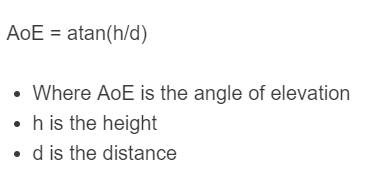
The angle of elevation is found from a right triangle where the distance is the horizontal distance along the ground and the height is the vertical difference from the observer’s horizontal line. The calculator uses the tangent relationship:
To calculate the angle of elevation:
To calculate height from surface:
To calculate horizontal distance:
- theta = angle of elevation
- H = vertical height relative to the observer
- D = horizontal distance from the observer to the point below the object
- tan = tangent function
- arctan = inverse tangent function
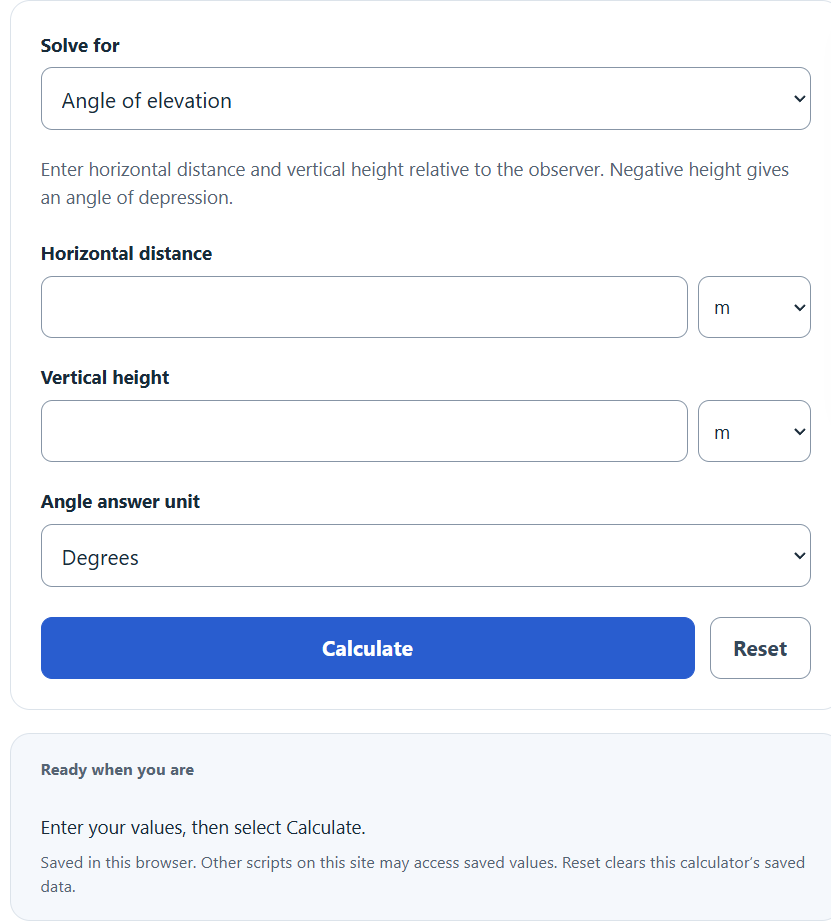
Select the value to solve for, then enter the two visible measurements. If you enter distance and height, it finds the angle. If you enter distance and angle, it finds the height. If you enter height and angle, it finds the distance. Length units are converted internally so that distance and height can be entered in different units. Angles can be entered or returned in degrees or radians.
Common Angle and Tangent Values
These values can help you check whether an angle of elevation result is reasonable.
| Angle | Radians | tan(angle) | Meaning |
|---|---|---|---|
| 5° | 0.0873 | 0.0875 | Small rise over a long distance |
| 15° | 0.2618 | 0.2679 | Moderate elevation |
| 30° | 0.5236 | 0.5774 | Height is about 58% of distance |
| 45° | 0.7854 | 1.0000 | Height equals horizontal distance |
| 60° | 1.0472 | 1.7321 | Height is much greater than distance |
Length Unit Conversion Factors
The calculator converts distance and height to meters before applying the trigonometric formula.
| Unit | Abbreviation | Meters per unit |
|---|---|---|
| Centimeter | cm | 0.01 |
| Meter | m | 1 |
| Kilometer | km | 1000 |
| Inch | in | 0.0254 |
| Foot | ft | 0.3048 |
| Yard | yd | 0.9144 |
| Mile | mi | 1609.344 |
Example Calculations
Example 1: Find the angle of elevation
At ground level, you are 50 meters horizontally from the base of a building that is 20 meters tall.
The angle of elevation is about 21.8014 degrees.
Example 2: Find the height from surface
The horizontal distance is 100 feet and the angle of elevation is 30 degrees.
The height above the observer’s horizontal line is about 57.7350 feet. Add the observer’s height for total height above ground.
FAQ
What is the angle of elevation?
The angle of elevation is the angle measured upward from a horizontal line of sight to an object above you. For example, if you stand on level ground and look up at the top of a tree, the angle between the ground-level horizontal line and your line of sight is the angle of elevation.
Do distance and height need to use the same unit?
No. You can enter distance and height in different units, such as feet for distance and meters for height. The calculator converts both values to meters before calculating, then converts the missing length to the Length answer unit. Zero horizontal distance with nonzero height gives ±90°; coincident points have no defined angle. Negative height represents depression below the observer.
Why does the distance have to be horizontal distance?
The tangent formula uses the opposite side divided by the adjacent side of a right triangle. The height is the opposite side, and the ground distance is the adjacent side. If you use a sloped line-of-sight distance instead of horizontal distance, the tangent formula will not match the triangle used by this calculator.