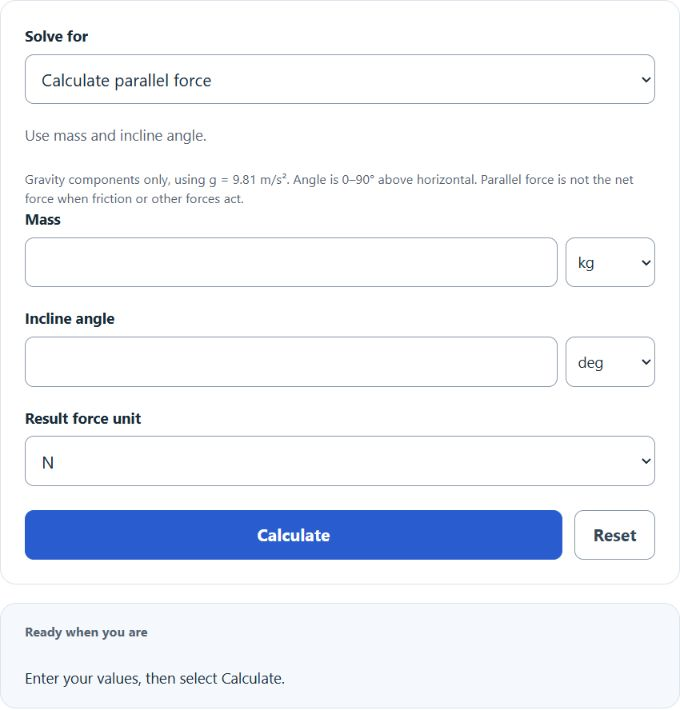
Calculate the force parallel to an incline, mass, or angle from two known values, with force in N or lbf and mass in kg or lb units.
- All Physics Calculators
- All Force Calculators
- Horizontal + Vertical Force Calculator
- Magnitude of Force Calculator
- Reaction Force Calculator
- Contact Force Calculator
Inclined Plane Force Formula
The following equations give the components of gravitational weight parallel and perpendicular to an ideal plane. The parallel component is not the net force when friction or other forces act.
- Where F|| is the force parallel to the plane (N)
- F⊥ is the force perpendicular to the plane (N)
- m is the mass of the object (kg)
- g is the acceleration due to gravity (9.81 m/s^2)
- a is the angle of the incline (degrees)
To calculate the force component parallel to the plane, multiply the mass by the acceleration due to gravity, then multiply by the sine of the angle.
What is an Inclined Plane Force?
Definition:
The forces acting on a body on an inclined plane typically include gravity (weight) acting vertically downward, the normal force from the surface acting perpendicular to the plane, and (if the surfaces are rough) friction acting along the plane opposite the direction of motion (or impending motion). The weight can be resolved into two components: one parallel to the plane and one perpendicular to the plane.
How to Calculate Inclined Plane Force?
Example Problem:
The following example outlines the steps and information needed to calculate the Inclined Plane Force.
First, determine the mass of the object. In this example, the object has a mass of 40 kg.
Next, determine the angle of the plane. The plane has an angle of 35 degrees when measured from the x-axis.
Finally, calculate the inclined plane forces using the formula above:
F|| = m*g*sin (a)
F⊥ = m*g*cos (a)
F|| = 40*9.81*sin (35deg) = 225.07 N
F⊥ = 40*9.81*cos (35deg) ≈ 321.44 N